The Register® — Biting the hand that feeds IT

Feeds

Starlight-sifting boffins can now spot ALIEN LIFE LIGHT YEARS AWAY

New method filters out glare for rapid chemical analysis

Cloud storage: Lower cost and increase uptime

Pics Boffins have made a breakthrough in the search for alien life with a new technique for determining the colours, chemical composition and even physical characteristics of exoplanets that are light years away.
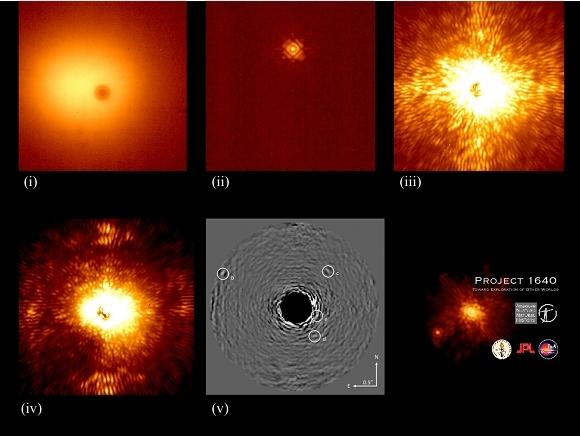
Chemical analysis progression of HR8799 planets

Chemical analysis progression of HR8799 planets
Credit: American Museum of Natural History

An international collaboration, Project 1640, has used a new telescopic imaging capability to reveal the respective chemical compositions of four worlds in a distant solar system at once, a feat that could lead to the rapid characterisation of far-flung planets for their life-sustaining potential.

“The spectra of these four worlds clearly show that they are far too toxic and hot to sustain life as we know it,” said co-author Ian Parry, a senior lecturer at the Institute of Astronomy at Cambridge University.

“But the really exciting thing is that one day, the techniques we’ve developed will give us our first secure evidence of the existence of life on a planet outside our solar system.”

Previous studies had only managed to partially measure the outermost planet in the system before starlight blinded the technology. But, using new software and instruments, astroboffins from the University of Cambridge and the American Museum of Natural History were able to filter out the light from the system's sun and read the light signature of the chemical elements of the planets instead.

Project 1640 is attached to the Hale Telescope in California and uses the world's most advanced adaptive optics system, which can make millions of tiny adjustments to the device's two 6-inch mirrors every second. It also has a coronagraph to optically dim the star but not other celestial objects in the field of view and a specialised wave front sensor that can distinguish between residual starlight and light from planets.

The spectra of the planets from the HR8799 system have proven to be "quite strange", Ben Oppenheimer from the American Museum said.

"These warm, red planets are unlike any other known object in our universe. All four planets have different spectra, and all four are peculiar. The theorists have a lot of work to do now," he said.

The planets appear to be chemically imbalanced, since basic chemistry would predict that ammonia and methane should naturally coexist in varying quantities unless they are in extremely hot or cold environments. The four worlds are only "lukewarm" - all with temperature readings of about 1,000° Kelvin (1,340°F, 727°C) - but each has either ammonia or methane, with little or no amounts of their chemical partners. Other substances such as acetylene, previously undiscovered on any exoplanet and carbon dioxide may be present as well, the boffins said.

The planets are also "redder" than expected, emitting longer wavelengths of light than other celestial objects with similar temperatures, which could be explained by significant cloud cover over the worlds.

“The variation in the spectra of the four planets is really intriguing,” said Didier Saumon, an astronomer at Los Alamos National Laboratory who was not involved in this study.

“Perhaps this shouldn't be too surprising, given that the four gaseous planets of the solar system are all different. The hundreds of known exoplanets have forced us to broaden our thinking, and this new data keeps pushing that envelope.”

The full study, "Reconnaissance of the HR 8799 Exosolar System I: Near IR Spectroscopy", will be published in The Astrophysical Journal and is available for download here. ®

Customer Success Testimonial: Recovery is Everything

Re: Anything we can do

Even if they happen to be within a few tens of light-years, even if they are currently watching Lucille Ball on Earth-TV and trying to work out what those strange techno-primitives are up to, they may still be thwarted by real-world physics. In other words, they've come to the same conclusion that our scientists have, that interstellar travel isn't ever going to happen outside of the movies. No wormholes, warp drives, ZPE drives, reactionless drives, or any of the other devices that SF authors use to get an interstellar plot going. Just rocketry and relativity and radiobiology, saying "can't be done".

My riposte to the (strong) Anthropic principle is that the universe is NOT optimised for Homo Sapiens. It's optimised for our silicon successors, who'll be able to slow their clock rates down so that a thousand light-years becomes a few years subjective. They'll prefer just about anywhere in the universe to those hot balls with moist oxidizing atmospheres, where some (mostly ridiculed) few amongst them think their ancestors must have developed, back before the Archives and the Memories.

In the worst-case scenario, they're here in our Oort clouds already, we're making far too much noise, and they're getting ready to drop a comet on us. (It worked last time, 65 Myears ago).

6
1

Re: Anything we can do

"A few thousand light years away, on average (give or take a few thousand orders of magnitude). The man-made light that we have really only been generating for a couple of hundred years, or the radio waves which we've been doing for much less than that, are only a fraction of the way to the aliens looking for them."

Don't need man-made light. Our planet has been beaming a "THERE IS LIFE HERE" signal into space for hundreds of millions of years. If life is incredibly rare then this alone will have attracted attention.

I mean that's what we are doing, we are looking for life supporting planets. We don't require them to be emitting radio-signals.

5
0
Anonymous Coward

Re: Anything we can do

"where the hell are they?"

A few thousand light years away, on average (give or take a few thousand orders of magnitude). The man-made light that we have really only been generating for a couple of hundred years, or the radio waves which we've been doing for much less than that, are only a fraction of the way to the aliens looking for them.

Unless they happen to have invented a way to bend space-time to detect us, in which case I'm sure they're gradually working through the gazillions of potentially life-supporting planets and will reach us eventually (if they even deem us to be worthy!)

5
0

More from The Register

Boffins find evidence Atlantic Ocean has started closing
'Embryonic subduction zone' that flattened Lisbon headed for Blighty
Google launches broadband balloons, radio astronomy frets
A careless Loon could blind the square kilometre array
 breaking news
You've seen the Large Hadron Collider. Now comes the HUGE Hadron Collider
International Linear Collider ready to rock and roll
Headbangers have a gas, gas, gas in mosh pits
Boffins say heavy metal crowds behave like The Vapours
Hubble spies unlikely planet being born in hostile neighborhood
Hoovering a cloud of sand 7.5 billion miles from a tiny star
 breaking news
Jaguar to open new car-making factory in Blighty (virtually)
Britain still makes stuff, it's just not real any more...
New material enables 1,000-meter super-skyscrapers
Before you read on, see if you can guess how the new stuff will be used
 breaking news
China's second woman 'naut blasts off for coupling in HEAVEN
Wang and pals test the cosmic waters for Chinese space station
Scientists investigate 'dark lightning' threat to aircraft passengers
One stormy flight could give lifetime radiation dose
 breaking news
Chinese 'nauts prep for next coupling in Heaven, clear way for new station
Second woman taikonaut and pals test tech for China's own orbiting platform