The Register® — Biting the hand that feeds IT

Feeds

Curiosity photographs evidence of ancient streams on Mars

A river ran through it

Cloud based data management

NASA has announced that the Curiosity rover has found evidence of a fast-moving stream that once flowed over the Martian surface.

"From the size of gravels it carried, we can interpret the water was moving about 3 feet per second, with a depth somewhere between ankle and hip deep," said Curiosity science co-investigator William Dietrich of the University of California, Berkeley in a statement.

"Plenty of papers have been written about channels on Mars with many different hypotheses about the flows in them. This is the first time we're actually seeing water-transported gravel on Mars. This is a transition from speculation about the size of streambed material to direct observation of it."

Curiosity found the long-gone water course between the north rim of Gale Crater and the base of Mount Sharp, using its mast-mounted camera system to examine two outcroppings named "Hottah" and "Link."

Water-rounded gravel, ranging from small pebbles to rocks the size of golf balls, and the remains of a sedimentary streambed are clearly visible, albeit since fractured and twisted, possibly by a later meteoroid strike.
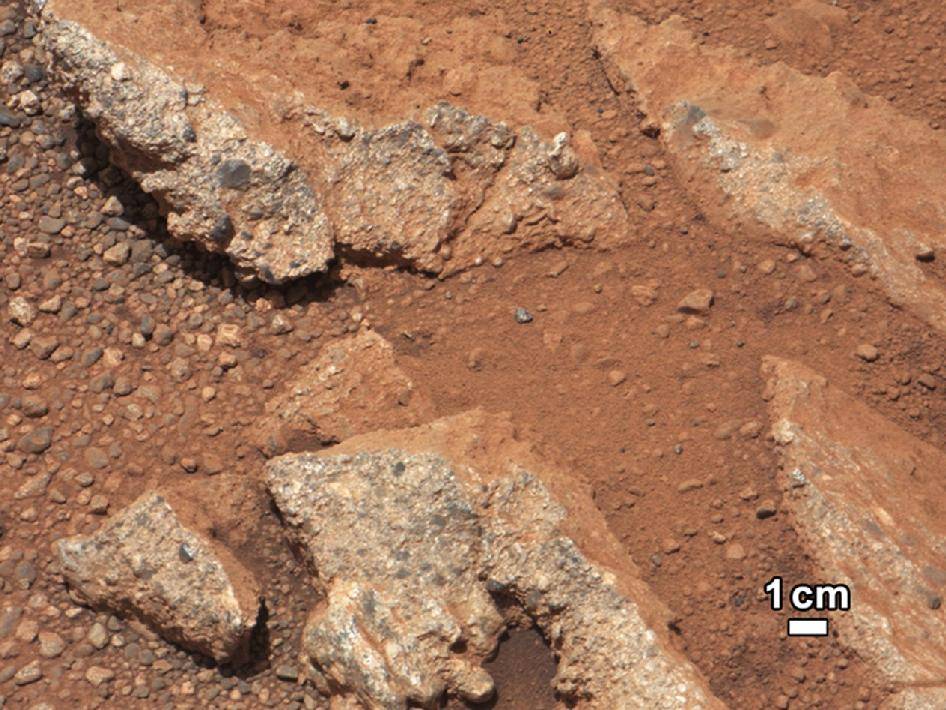
mars snow fall map

Next up, the hunt for the Martian sand trout (click to enlarge)

"Hottah looks like someone jack-hammered up a slab of city sidewalk, but it's really a tilted block of an ancient streambed," said Mars Science Laboratory Project Scientist John Grotzinger of the California Institute of Technology.

Despite the discovery, the Curiosity team isn't hopeful that the stream bed will be a good place to look for signs of organic life on Mars. They are still banking on finding that in the clay and sulfate minerals found on the sides of Mount Sharp.

"A long-flowing stream can be a habitable environment," said Grotzinger. "It is not our top choice as an environment for preservation of organics, though. We're still going to Mount Sharp, but this is insurance that we have already found our first potentially habitable environment." ®

SaaS data loss: The problem you didn’t know you had

Re: Interesting

Its a while since i did the planetary geology stuff (I've moved onto more local hydrocarbon exploration since), but in answer to the above;

The gravel is dense enough and rounded enough to prove transportation by a viscous medium.

Mars likely stopped its tectonism a long time ago, which meant it stopped producing gasses able to replenish the lossese to space. On earth, the serendipity of life - first anaerobic, then aerobic - created an atmosphere that sustains an atmosphere and, unlike Venus, is able to achieve equilibrium with solar energy.

Life may be present in this stream by NASA, but its more likely to be found in the places where he most basic life can develop, such as the clays and mineral rich sedimentary deposits thought to exist elsewhere in Gale crater. Proof of life doesn't need to be a fossil encased in gravel, just a complex amino acid or RNA which is unlikley to be formed through conventional physical chemical processes.

The really intersting science about Mars (for me at least) isn't the search for life - surely life can develop elsewhere, but it needs to be intelligent or terraforming (re: Earth) to be of interest - but the internal structure and understanding why tectonism stopped. This applies even more so for Venus.

Beer icon because you shouldn't write on t'internet after the pub....

18
0

How can they tell it was a river?

There's no shopping trolley or mattress.

14
0

Re: Interesting

I'm no expert, but I think Mars once had a decent atmosphere but something happened a long time ago to kill the planetary dynamo the provided the magnetic shield to stop the solar wind stripping that away. Now we see little of what was once there.

Remember Venus is the same (approx) gravity as the Earth, but has a *much* higher atmospheric pressure.

Hopefully some more expert commentards will provide you with enlightement...

9
0

More from The Register

New material enables 1,000-meter super-skyscrapers
Before you read on, see if you can guess how the new stuff will be used
Boffins build headless robo-kitties
Soft kitty, warm kitty, cuddly little ball of wire kitty
 breaking news
Latest NASA ASTRONAUT class is HALF FEMALE
Newbie 'nauts include lady Marine fighter pilot, male doctor
House bill: 'Hey NASA, that asteroid retrieval plan? Fuggedaboutit'
Republican-led committee also swings budget axe at climate science
 breaking news
You've seen the Large Hadron Collider. Now comes the HUGE Hadron Collider
International Linear Collider ready to rock and roll
Boffins find evidence Atlantic Ocean has started closing
'Embryonic subduction zone' that flattened Lisbon headed for Blighty
Google launches broadband balloons, radio astronomy frets
A careless Loon could blind the square kilometre array
Hubble spies unlikely planet being born in hostile neighborhood
Hoovering a cloud of sand 7.5 billion miles from a tiny star
 breaking news
Jaguar to open new car-making factory in Blighty (virtually)
Britain still makes stuff, it's just not real any more...