The Register® — Biting the hand that feeds IT

Feeds

UK ice boffin: 'Arctic melt equivalent to 20 years of CO2'

Older, more stable ice melting as well

Cloud storage: Lower cost and increase uptime

A prominent British Arctic scientist and researcher says that the continued and accelerated melting of the polar sea-ice cap is not only a result of climate change, but is also a massive contributor to it.

To explain in an overly simplistic nutshell, sea ice is reflective, bouncing solar energy back into space. When it melts, the darker open sea absorbs more of that energy, increasing ocean temperatures.

How much more? According to Professor Peter Wadhams of the University of Cambridge's Polar Ocean Physics Group, that increased absorption has an effect that's "the equivalent of about 20 years of additional CO2 being added by man."

In an interview with the BBC, Wadhams said that in his opinion, the Arctic ice cap is "heading for oblivion."

If you've been following Arctic ice science for the last few years, Wadhams' name is likely to be a familiar one – he's been attacked by some observers and supported by others.

Interestingly, although both believers in and skeptics of anthropogenic global warming (AGW) often fault one another for CO2-industry connections or research-grant competition, Wadhams swings both ways. He cut his teeth working for the oil industry, and received support from BP from 1976 until 1992 for his research at Cambridge's Scott Polar Research Group (SPRI). On the other side of the equation, he has loudly tussled with the UK's Natural Environment Research Council (NERC) for grant support.
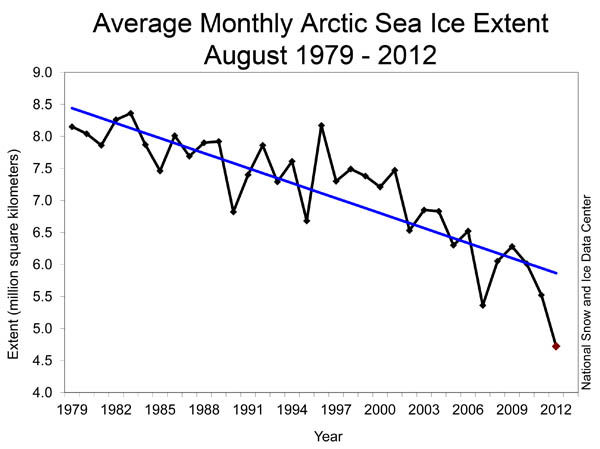
The August Arctic ice cap has had its ups and downs in the last 30-plus years, but the trendline is rather clear

But whatever you think of Wadhams' bona fides, he can't be faulted for the data and analysis provided by the US National Snow & Ice Data Center, with which he is not affiliated. According to NSIDC's latest report, issued Wednesday:

Following the new record low recorded on August 26, Arctic sea ice extent continued to drop and is now below 4.00 million square kilometers (1.54 million square miles). Compared to September conditions in the 1980s and 1990s, this represents a 45% reduction in the area of the Arctic covered by sea ice. At least one more week likely remains in the melt season.

Of particlar interest in the NSIDC report is that multi-year ice – ice that has survived more than one year of the seasonal melt-refreeze cycle – is melting along with the Arctic cap's more-vulnerable first-year ice.

The last few summers, NSIDC reports, have seen increased losses in multi-year ice. "Between mid-March and the third week of August," the report concludes, "the total amount of multiyear ice within the Arctic Ocean declined by 33 per cent, and the oldest ice, ice older than five years, declined by 51 per cent."
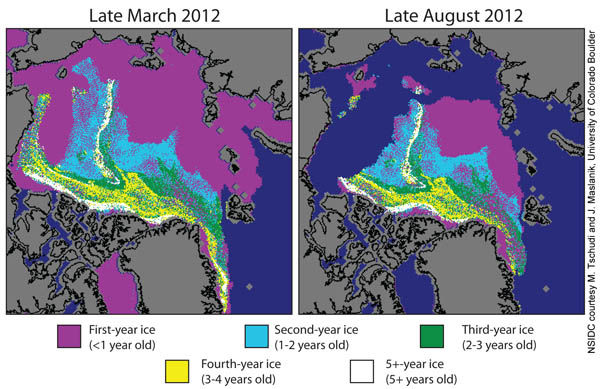
As hardier multi-year ice melts, it's replaced in the winter by more-meltilicious first-year ice

The younger the ice, the thinner it tends to be; the thinner it tends to be, the more likely it is to melt during the Arctic summer. The less multi-year ice, the more the Arctic ice cap as a whole will tend to disappear in summer.

The smaller the Arctic sea-ice extent, the more solar energy will be absorbed by the ocean. And according to Wadhams, the greater the CO2 equivalent of global-warming potential.

In 1980, he told the BBC, summer Arctic ice covered about 2 per cent of the Earth's surface – that percentage has now been halved. "Over that 1 per cent of the Earth's surface you are replacing a bright surface which reflects nearly all of the radiation falling on it with a dark surface which absorbs nearly all," he said.

"The difference, the extra radiation that's absorbed is, from our calculations, the equivalent of about 20 years of additional CO2 being added by man," Wadhams concluded.

Of course, if you're an AGW skeptic, you doubt that CO2 caused by human activity has had a significant effect upon the Earth's global climate. But if you're an AGW believer, that's a sobering conclusion, indeed. ®

Customer Success Testimonial: Recovery is Everything

Re: Climate-change sceptics

This straw man is getting tiresome. Let me summarize the position of most reasonable skeptics.

1. Is the global climate changing? Yes, that's it's inherent property.

2. Is the global climate warming? Yes, there's sufficient data to that effect.

3. Is the warming caused by CO2? Significantly, but it's not that straightforward. CO2 effect would be most prominent in the dry regions (e.g. deserts) and would be negligible in humid regions, dwarfed by effects of water vapor. Linear relationship that IPCC and alarmist try to present is bullshit.

4. Are we causing the change? We significantly contribute, but precise extent is not clear.

5. Is the change beneficial or harmful? That depends on specific regions. Warming may benefit fauna enormously. Harmful effects are also likely. However, the alarmism and politics has basically shut up moderate scientists and polarized the debate.

6. Can we reverse or stabilize the trend? Maybe. More importantly should we? Again, question 5 needs to be studied. The basic point is the answer to that is not an automatic Yes. Perhaps we should let things change? How many people considered that?

7. If we decide to prevent more warming (and the debate shouldn't have reached this point yet, given miserably incomplete climate models), what's the most efficient way to do it? This is where even most reasonable advocates of preventing climate change fail miserably. Carbon is simply too expensive to address by preventing the use of fossil fuels. There are 2.5 billion people in China and India and they want to have the same quality of life that you have. That takes energy, and thanks to the previous crusade by 'environmentalists' (people who have actually done most harm to the environment with their ignorance) nuclear was off the table for 2 decades. That only leaves fossil fuels. Whatever CO2 output can be reduced by Western countries at enormous expense to their economies, it will be dwarfed by India and China. That takes CO2 emission reduction at best stupid and at worst counter-productive. Western economies that adhere to some environmental standards are shot in the foot, while manufacturing moves increasingly to China to escape CO2 regulation.

51
16

Climate-change sceptics

It still baffles me how anyone with a brain could believe something like 97% of scientists are engaged in a mega-conspiracy to defraud the public to gain research grants, and refuse to even CONSIDER the possibility that the people who make Billions selling oil and gas could be the ones lying to try to protect their profits.

Maybe that's not the case, maybe all the climate-change sceptics are just people paid to sow doubt...but it does seem that there's plenty of people around utterly convinced that oil barons are decent, honest people, and it's the climate scientists who are the greedy, money-grabbing liars. Very weird.

54
26

> Gas 2.2p, Nuclear 2.3p, Coal 2.5p, Onshore wind 5.4p, Offshore wind 7.2p

> With those figures in mind I say lets get fracking.

I say let's get building nukes. And I consider myself a 'green'.

20
0

More from The Register

Boffins find evidence Atlantic Ocean has started closing
'Embryonic subduction zone' that flattened Lisbon headed for Blighty
Google launches broadband balloons, radio astronomy frets
A careless Loon could blind the square kilometre array
New material enables 1,000-meter super-skyscrapers
Before you read on, see if you can guess how the new stuff will be used
 breaking news
You've seen the Large Hadron Collider. Now comes the HUGE Hadron Collider
International Linear Collider ready to rock and roll
Headbangers have a gas, gas, gas in mosh pits
Boffins say heavy metal crowds behave like The Vapours
Hubble spies unlikely planet being born in hostile neighborhood
Hoovering a cloud of sand 7.5 billion miles from a tiny star
 breaking news
Jaguar to open new car-making factory in Blighty (virtually)
Britain still makes stuff, it's just not real any more...
 breaking news
China's second woman 'naut blasts off for coupling in HEAVEN
Wang and pals test the cosmic waters for Chinese space station
Scientists investigate 'dark lightning' threat to aircraft passengers
One stormy flight could give lifetime radiation dose
 breaking news
Chinese 'nauts prep for next coupling in Heaven, clear way for new station
Second woman taikonaut and pals test tech for China's own orbiting platform