


This article is more than 1 year old
Pegasus rocket lofts NuSTAR X-ray telescope into orbit
Black hole scanner air launch successful

NASA has confirmed the Nuclear Spectroscopic Telescope Array (NuSTAR) X-Ray telescope has successfully made it into orbit after an airborne launch over the Pacific Ocean.
NuSTAR was launched at 9am Pacific Time in a Pegasus rocket slung under a L-1011 “Stargazer” aircraft flying at 39,000 feet above the Kwajalein Atoll in the western Pacific. The rocket fell for five seconds before igniting and boosting the telescope into orbit where it successfully deployed.
Drop launch for NuSTAR
"NuSTAR spread its solar panels to charge the spacecraft battery and then reported back to Earth of its good health," said Yunjin Kim, the mission's project manager at NASA's Jet Propulsion Laboratory in a statement. "We are checking out the spacecraft now and are excited to tune into the high-energy X-ray sky."
The telescope is designed to examine the higher-energy X-Ray emissions from near the heart of black holes to understand how light and matter behaves in such extreme environments. NuSTAR will also look at the relatively early remains of supernova explosions – indeed NASA said it was hoping for a new supernova nearby and could have the telescope reorientated within hours if one occurred.
It is 100 times more sensitive than NASA's Chandra and the European Space Agency's XMM-Newton high-energy X-ray telescopes, and it will make images that are 10 times sharper. Chandra and XMM-Newton can detect X-rays up to 10,000 electron volts (eV); NuSTAR can catch them at up to 78,000 eV.
But the new telescope is a fraction of the payload of its predecessors, thanks to technology developed on the International Space Station. To catch X-rays the telescope's detector needs to be distanced from its mirrors to focus, making for potentially a very large payload. A team on the ISS developed an extendable arm designed to operate in zero-gravity, so that the telescope can unfold to the required 30 feet distance. This will begin in five days and the telescope will begin scanning in a month's time if all goes well
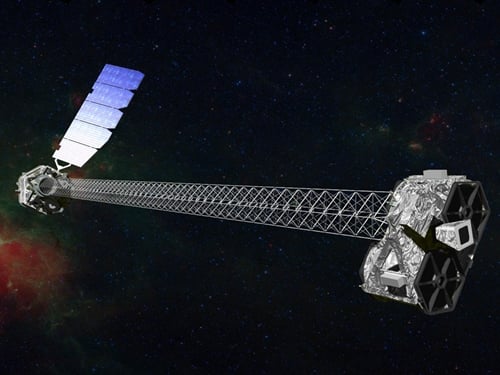
Light-weight design opens a host of options
NuSTAR's lighter design also enabled the air launch, which frees the operators from the expensive business of pushing a rocket (and the fuel it needs) through the initial stages of the earth's atmosphere. It also allowed the satellite to be launched as close as possible to the equator to minimize the effects of the Earth's magnetosphere on NuSTAR's delicate instruments.
"NuSTAR will help us find the most elusive and most energetic black holes, to help us understand the structure of the universe," said Fiona Harrison, the mission's principal investigator at the California Institute of Technology. ®
 Biting the hand that feeds IT

