LG pitches £7k 55in OLED TV, again
Thin telly requires fat wallet
LG showed off its 55in OLED TV at the Consumer Electronics Show (CES) in January, and despite demo'ing the device again this week, this time over here, it's still vague about the release date.
While it will start appearing in showrooms in July, just in time for Olympics footage, and LG will happily take your order, the best delivery date it can offer is sometime before Christmas.
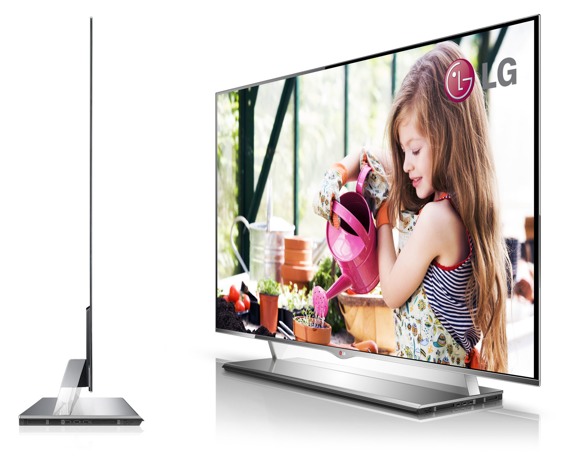
LG didn't talk about pricing, but past comments from the company have suggested it'll be in the region of €9000 (£7200) so it's not like World+Dog will be beating a path to its door.
The near bezel-less telly is a mere 4mm thick - all the bits that do the actual work and all the ports are in a separate unit at the base of the stand - and each pixel's hue is formed from four colours rather than the customary three. In addition to red, green and blue, the OLED TV has a white sub-pixel.
LG says the set has an "infinite" contrast ratio.
Samsung also unwrapped a 55in OLED TV at CES and, likewise, recently showed it off in Europe. It is expected to release the set sometime in the second half of the year for a very similar price. ®
Regcast training : Hyper-V 3.0, VM high availability and disaster recovery
COMMENTS
Re: Exercise in pointlessness
"Also, white as a 4th sub pixel, wouldn't yellow have been a better option?"
Certainly not. RBGW is the complement of CYMK used in printing, because you're dealing with transmitted (or generated) light rather than reflected light. The point of the white subpixel is that you can get a purer white than by mixing all the colours, just as Key gives you a purer black in printing. You get yellow by mixing red and green.
Exercise in pointlessness
So long as you need to be able to plug cables into these things then making them arbitrarily thin is just an exercise in extracting cash from wankers. The T.V. in the article is only "kinda 4mm thick" in that all the gubbins has been shoehorned into the decidedly ticker than 4mm base.
Call me back when you can stick them up with wallpaper paste.
Also, white as a 4th sub pixel, wouldn't yellow have been a better option?
They're almost lying.
By definition, image contrast is the difference between the amount of light coming from a "black" patch, and that coming from a "white" one. If there's no ambient light, then an OLED display *may* have infinite contrast in an ideal world, but in the real world it doesn't (like all LEDs, OLEDs emit a tiny, tiny amount of light in their "off" state).
Add ambient lighting, and the screen material comes into play. Now the "black" level depends on the amount of ambient light reflected back off the screen. Use a glossy screen, and you can redistribute this reflection, to make it look better when shadowed by the viewer (like in a shop, for instance), but you're only rearranging the problem, not solving it. [I'm typing this on a glossy-screened Apple product, with just such a stupid shiny screen, and I absolutely hate the display.]
Other manufactures using LED/OLED just quote insane contrast ratios, like 10,000,000:1, which are about right for an OLED panel.
Also, the reason for the fourth, white pixel is that this is most likely to be a Pentile display matrix (not the same one as used in phone panels). Here, the large white subpixel deals with the baseline illumination of the whole pixel, with the RGB trio there to colour it. A true RGB set gives better colour reproduction, but is susceptible to more noticable colour shift as the cells age.
I remember the first plasma sets coming in at this price, but then, they were competing against CRTs, which were utterly impractical at sizes over 30". Still, we have to start somewhere -- I'll look at them when my LCD set needs to be replaced, in about seven or eight years.

IT infrastructure monitoring strategies
Requirements Checklist for Choosing a Cloud Backup and Recovery Service Provider
Cloud based data management
Enabling efficient data center monitoring
Agentless Backup is Not a Myth