Computer prices down 8.1% per year … since 1984
Computer and mobile phone now a “relative necessity” for Australian households
Steps to Take Before Choosing a Business Continuity Partner
The price Australian consumers pay for audio visual and computing products has fallen an average of 8.1% every year since 1984, according to the new AMP.NATSEM Income Report.
The new report (PDF), titled Prices These Days – The cost of living in Australia, says audio visual and computing products are one tenth of their 1984 prices. The report uses Australian Bureau of Statistics (ABS) data to make that assertion, and notes that the rapid pace of change in technology means comparisons can be hard over 28 years.
But the report also notes that computing and communications devices are becoming more important to Australians, and consuming more of the household budget.
Again leaning on ABS data, the report says computers, mobile phones and a CD player are all ”relative necessities” for Australians. That means a PC and mobile are of less important necessities like housing, food, energy and public transport, but of greater priority than discretionary items include booze, smokes, food someone else cooks and holidays.
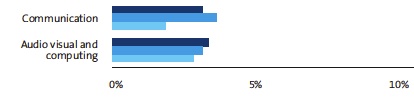
The report also notes that despite audio visual and computing products experiencing more deflation than any other category of goods, Australians spend more on them than ever before as a proportion of the household budget. The report does not divulge exact spending levels, but the graph above shows the trends.
The overall conclusion of the report is that current Australian political debate discourse focussing on curbing cost of living increases does not reflect market realities, as “price inflation in Australia and living costs appear to be relatively benign and have been for the past two decades.” Incomes have generally risen and “The average family is ahead by $224 per week ...”
Perceptions of higher living costs, the report concludes, are largely derived from the fact that Australians are now “spending more money on a whole range of new goods and, in particular, services that are either aspirational in nature or necessary in dealing with the demands of a modern society.” ®
COMMENTS
Re: Cost of living increase benign?
Sure house prices have rocketed, but just look at those houses.
Average house sizes in Oz have gone from approx 150sqm (1500sq ft or so) to over 240sqm (2400 sqft) and the ponciness has increased too. Flashy expensive kitchens, bathrooms etc . Air conditioning was once sneered at as being upper class snobbery and is now considered a basic necessity.
Hardly and apples-to-apples comparison.
Cost of living increase benign?
Bollocks. Electricity has gone through the roof over here - South Australia now has the most expensive electricity on the PLANET. Not only that, but housing prices have also exploded, to the point where a normal suburban home will set you back around half a million dollars. Rents have increased accordingly. Most working class people are now spending more than the recommended third of their income on housing because of the insane property prices in this country. and these increased costs have had a flow-on effect to everything else.
Basic foodstuffs have remained relatively stable, as have consumer electronics, although how I don't know, considering petrol, energy, housing and everything else have gone nuts over here.
I can't believe that's the actual conclusion of the report
Now I haven't read the bugger (and probably won't find the time) but the "perceptions of higher living costs" are mostly down to it costing more to live. It doesn't matter if you're lifestyle has changed or you've taken up an expensive drug habit - it costs more to live.
Let's see, in 1984 (or close enough to) I was paying a half share of $120 a week rent, petrol cost 60c a litre, a schooner of beer cost under $2 and I was making about $350 in hand a week. In 2012 that same house would rent for just under $500 a week, petrol costs $1.50 a litre, a schooner is around $5 and someone in my position then would be doing well if they take home $600 a week. But hey, it all works out even 'cause mobile phones and big TVs are cheaper...
I think I just spotted the problem here - the report was authored by AMP rather than any sort of credible source. For those not familiar with the Australian retail investment market, these guys are probably the biggest financial services company in Aus. I can well imagine that the price of German sedans, Japanese electronics and Colombian cocaine is of more concern to them than rent or food.

IT infrastructure monitoring strategies
Requirements Checklist for Choosing a Cloud Backup and Recovery Service Provider
Cloud based data management
Enabling efficient data center monitoring
Agentless Backup is Not a Myth