Agentless Backup is Not a Myth
Enter Schmidt
Oracle adds that during this period Google hired key Sun Java personnel, who were working under former Sun executive Eric Schmidt. Schmidt had joined Google in 2001. While this is true, the implication is that Google needed these stars to create its “Java OS”. In fact, key Sun staff drifted to the Chocolate Factory throughout this period, preceding Google’s interest in Android. But the testimony of one defector has attracted the most coverage.
Tim Lindholm, a Distinguished Engineer at Sun, helped write the original Java VM, and joined Google the same year Google acquired Android. In 2010, with Android a huge hit, Larry Page asked him to explore alternatives to Java.
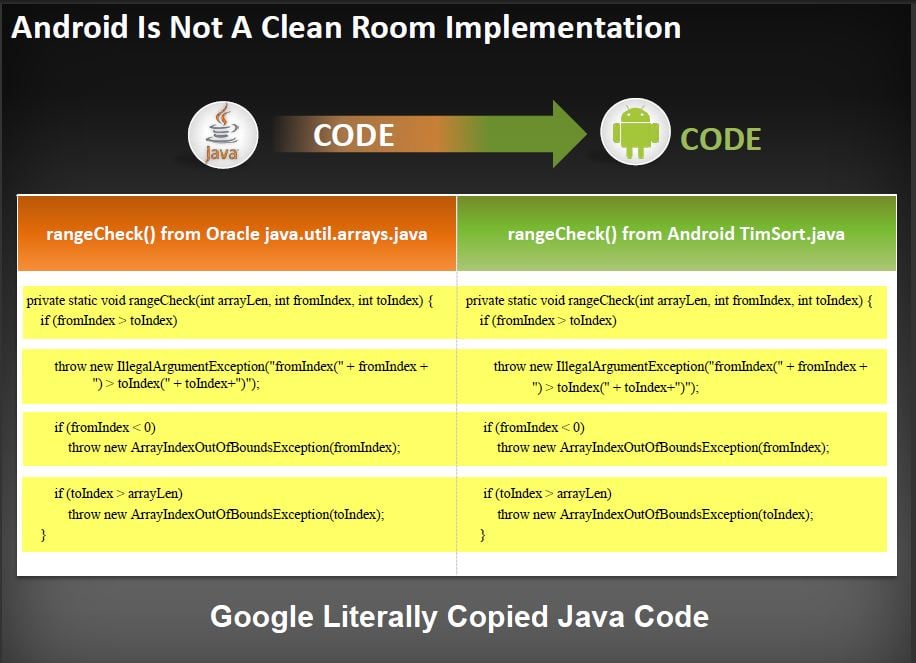
Lindholm concluded that all the alternatives “suck[ed]” and “we need to negotiate a license for Java”. Google fought a long, hard but ultimately unsuccessful battle to keep this email out of court. This week Larry Page couldn’t recall who Lindholm was, or making the request. Oracle details the code copied from Java into Google. This makes it difficult for Google to argue it was any kind of clean-room implementation of the key Java libraries (classes). Private classes were copied verbatim. And Android remains the only Java system in the world that doesn’t have a Sun/Oracle Java licence.
For its part Google has shown the court statements by Sun’s last CEO, talkative Jonathan Schwartz. Schwartz “applauds” Android and vows to support it, in 2007. It’s thin stuff, though. As Florian Mueller points out in his analysis, Schwartz’s comments cut little ice with the Judge.
That’s the meat of Oracle's copyright case - the trial is still ongoing. Patents will follow in the weeks to come. In court this week, the exchanges were largely theatrical. Lindholm was hung out to dry by lead lawyer David Boies (which is all Boies had to do). Google executives including Page have adopted the Clinton-Gates defence of not really being able to remember anything that was going on.
So... it doesn’t look great for Google. The principle is if you use someone’s stuff you pay for it, or invent your own. But as I pointed out earlier this week, it’s a peculiar situation. Oracle’s victory might not get it the damages it wants – the judge has consistently scorned the size of these claims – and it may extend copyright into new areas, causing huge confusion for the industry. But the case falls into a murky area where simple, clear sensible law should exist. When that happens, the lawyers are the biggest winners. ®
Related link
Oracle's case in slides (PDF)
COMMENTS
Google didn't need a license & others have taken one either.
So much wrong in so few words.....
There is _no_ license required to build/use Java the language, nor Java the JVM. You _do_ have to acquire a license to the test suite (TCK) if you want to call your result 'Java' or Java compatible.
It's in the TCK that Sun (now Oracle) hid such nastiness as the dreaded Field Of Use (FOU) restrictions that among other things prevents you from running what you've built in the mobile space.
The Apache Foundation never accepted the FOU for the Harmony project. They never took a license from Sun, didn't need to. Still doesn't need to.
HP doesn't have a license for their ChaiVM or their MicrochaiVM implementations.
Google wrote their own VM Dalvik. It's _not_ a JVM. It can't run Java programs. Google wanted a programming language that many programmers already knew to write code for Android. The apparently went with Java_the_language. To be compatible with Java_the_language they based the language on Java as documented by the freely available API's. They started with the Apache licensed Harmony project and adjusted it to create code that they felt was more appropriate to mobile development and compiled to code that would run under their Dalvik VM. Dalvik byecode won't run under a Java VM and Java bytecode won't run under the Dalvik VM. The only part of Java that android uses is Java_the_language.
Most people, I would have said all but obviously Oracle doesn't agree, agree that you can't copyright a language. Courts in the US have already ruled that having a copyright on a system does _not_ give you any rights on a subsequent implementation of that system.[Baker v. Selden, 101 US 99 (1879)]. The only parts that are identical are those _required_ to be identical for compatibility. (Yes, I realize that there were a couple of cases of literal copying, but that's a different issue that the one here. Google's already removed them and they may face a small fine for that mistake.)
Oracle's stance is that since they literally own the copyright to the book the defines the Java API's that you need a license to implement any system that uses them. Unfortunately the courts have never actually ruled on the applicability of Copyright to API's. Up until this point no one ever thought that they needed to. It makes as much sense as having to get a license from Webster to use the English language simply due to the fact that they hold the copyright to an English dictionary.
Is a shame that Oracle's sunk so far.....
Strange. Read the dissection at Groklaw and you get a totally different perspective.
The general view there is that this is largely about whether or not Google need a licence to use the JAVA library API, so this largely rests on whether or not an API can be covered by "copyright" as a creative work. Just because an ex-SUN engineer thinks that Google DO need to acquire a licence is entirely irrelevant: he is not a lawyer and probably doesn't know what he is talking about. The context of that statement is likely to be risk aversion and playing "fair" to his prior employer.
Most of the examples of supposed "copying" are debatable, although not necessarily without merit.
Re: Again : Mueller
No it doesn't make him corrupt but it puts a huge slant on anything he says - something that Andrew fails to point out in his article
"As Florian Mueller points out in his analysis, Schwartz’s comments cut little ice with the Judge" has a very different meaning if he's being paid by Oracle - "As an Oracle paid consultant points out in his analysis, Schwartz’s comments cut little ice with the Judge"
It's a big difference.


IT infrastructure monitoring strategies
Agentless Backup is Not a Myth
Steps to Take Before Choosing a Business Continuity Partner
Enabling efficient data center monitoring
Requirements Checklist for Choosing a Cloud Backup and Recovery Service Provider