The Register® — Biting the hand that feeds IT

Feeds

The Hardware Hacker's Guide to Home Automation

Doctorin' the house

Gizmo Week

Reg Hardware Gizmo Week logo small

The home of the future is a staple of both speculative fiction and comedy. Back in the 1970s, Frank Spencer caused havoc in an automated home during an episode of Some Mothers Do 'Ave Em.

For some of us, the enduring image of home automation is either Michael Crawford chaos, worthy but dull X10 electric curtain openers, lights that turn on and off when you’re not there, or high-end systems that can manage everything from lighting and audio to collecting the post for you.


Oooh, Betty
Source: BBC Worldwide on YouTube

Most of us, of course, can’t afford the money for the kind of top-of-the-line installations offered by a company like Grahams, but that doesn’t necessarily mean that home automation has to be limited to a few remotely controlled lights and power sockets.

These days, it’s much easier than many people imagine to achieve a fairly wide degree of home automation of one sort or another, without breaking the bank of leaving your visitors so confused when trying to figure out how the AV system that they end up lying on the sofa in the dark listening to the radio instead.

In the beginning

One of the most well known – if rather long in the tooth – technologies for home automation is the X10 protocol. Developed almost 40 years ago in Scotland, it sends control data over mains wiring during the zero crossing points of the mains signal. There’s a radio version too.

But with its 16 "house codes" and a maximum of 16 devices per "house", for a modern home with mood lighting, sensors and plenty of devices to control, the effective limit of 256 items that X10 can handle may cause problems for the more teched-up of us.

Set against that, there’s now a huge range of X10 modules available from suppliers such as UK Automation.
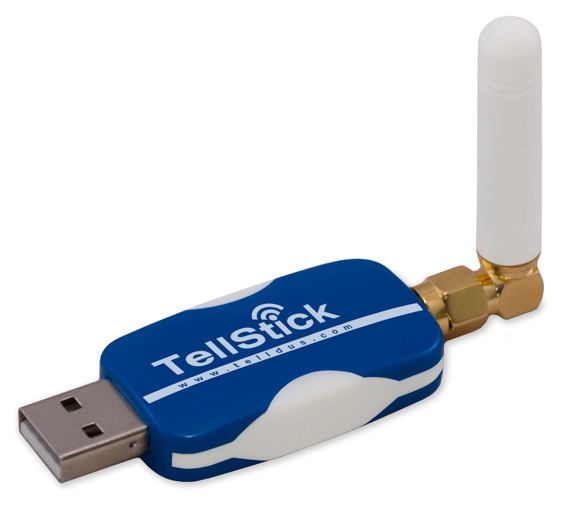
Telldus Technologies' TellStick

Tune in to your devices with wireless add-ons like Telldus' TellStick

By comparison – especially for the UK – there’s still a fairly limited selection of modules for some of the more modern X10 alternatives, such as the mesh radio-based Z-Wave or the newer Lightwave RF.

Then there are the various remote control power sockets, switches and dimmers that you can find in DIY stores. You might think that these are standalone, but in fact a reasonable number of them can be controlled using devices like Telldus Technologies’ £50 USB TellStick, with iOS and Android devices operating as touchscreen remotes.

Next page: But what’s it for?

Slowly creeping in

I started reading this thinking "Oh god, another Tomorrow's World special on things that will never happen".

Then I realised, we already have a signal-man that uses an accoustic sensor to monitor the level of oil in the tank and calls the oil company for a re-fill if it gets too low. I didn't even pay for that - the oil company supplied and fitted.

And, when we got our new oil-fired boiler three years ago they threw in a wireless controller. So the heating is fully programmed and, for example, I can stick it in the youngest's room overnight (which tends to be the coldest) and it will ensure the room never drops below 16C.

I also have a £15 all-in-one remote which, from a single button press, will turn on the TV and blu-ray and switch the TV onto HDMI-1 (amongst other things).

And, whilst not automated yet, we get our shopping delivered each week by Tesco. I can use my Android phone, during the week, to take a snap of the barcode of anything I've emptied (cereal boxes etc) and they just get added to the list. On a Monday night I then log in to the current order where it tells me what I ordered last week, what I usually order and if there are any specials on things I've ordered in the past. It takes about 10 minutes to complete the list and it gets delivered Tuesday night. I can see that process becoming more and more automated over the next few years.

Home automation isn't just coming. It is here. But it is here in ways that we tend not to notice - which is surely the whole point.

6
0

Re: Who's it for?

Assuming you were being serious and not just trolling;

How am I supposed to measure the contents of a fully sealed oil tank by "getting off my fat arse"?

How am I supposed to stop my son's bedroom dropping below 16C by "getting off my fat arse"? Do I get up every 30 mins during the night, take a temperature reading and either turn the heating on or off?

Or, for the example someone gave above of dumping excess solar energy into the immearsion, should he remain at home all day to do this or do you advise running home every few minutes to switch the relay manually?

Tit!

2
0

Re: Remember,,,

That control freak product does not match my specific 'value' test. £299 on ukhomeautomation for what is basically a Sheeva plug with the software preinstalled. AND you still have to buy the X10 computer kit to connect to it.

However, the rfxcom devices look clever and deserve some further research.

2
0

Open Energymonitor

A shout out to openenergymonitor.org should be given here as it's a DIY open source energy monitor based on Arduino, and very cool. Built one up myself a short while ago.

I also have a tellstick, and it works great (nice to see a mention - almost invisible over here) and a load of remote sockets I bought at 3 for a fiver at Asda. also got a bunch of 1-wire sensors around the place, and some cheap PIR sensors on order to try and put some room sensors together. All my stuff runs on a £50 pogoplug with a webserver.

The big problem is that a lot of the mainstream commercial stuff has no external controlability - the new stat we bought with a boiler from a certain large gas firm has no network control, neither did anything else the sales guy offered - surely not that much to build it in now.

2
0

Re: *still* not there

I have exactly the same problem. Best I've come up with is a Marmitek AWM2P to send a signal when the amp powers up and any one of a number of simpler X10 blocks to switch the sub. Great. That'll be £100 for the blocks and another £60 for the computer interface to use just once to program them up. Then there's the time that I simply don't have to learn to use the system and wire in the blocks.

Given the number of very effective switchers out there how can £160 and a load of grief be the best available option to simply to slave the power of device B off device A?

2
0

More from The Register

The iWatch is coming! The iWatch is coming!
Reports: Apple's wrister to have 1.5-inch OLED, test units being built
MYSTERY Nokia Lumia with gazillion-pixel camera 'spotted'
With 20Mp sensor - NOW will you try Windows Phone 8?
US boffin builds 32-way Raspberry Pi cluster
Beowulf cluster built for the price of a single PC
 breaking news
Dell's PC-on-a-stick landing in July: report
Wyse up, suckers, could this be a new set-side-stick?
Review: HP Pavilion 14 Chromebook
All roads lead to Chrome?
Borked your iDevice? Pay EVEN MORE to have it fixed by Applecare
Or scream at their hapless techies on their forums
Review: Sony Xperia SP
The new mid-range marvel? Oh yes.
Euro PC shipments plummet into bottomless pit of DOOOOM
11th quarter of decline, 20pc drop on last year - Gartner