Last year's iOS sales surpassed all Macs ever sold
If at first you don't succeed, go mobile
Agentless Backup is Not a Myth
Apple sold more iOS devices in 2011 than the total number of Macs sold in all 28 years since the original Macintosh 128k first hit store shelves in late January 1984.
"The iOS platform as a whole reached 316 million cumulative units at the end of last year," Horace Dediu writes on his Asymco blog. "The iOS platform overtook the OS X platform in under four years and more iOS devices were sold in 2011 (156 million) than all the Macs ever sold (122 million)."
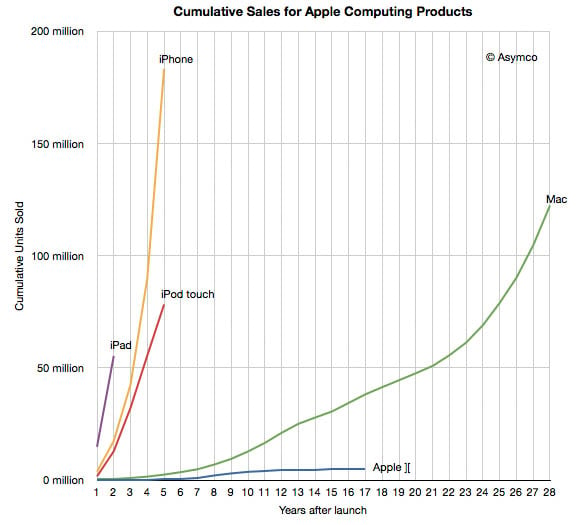
In this race, the hare is trouncing the tortoise (source: Horace Dediu, Asymco)
Looked at another way, when 2011 drew to a close, cumulative iOS sales – which began when the original iPhone became available on June 29, 2007 – had reached nearly 260 per cent of total Mac sales.
Of course, an investment in a Mac can range from $599 for an entry-level Mac mini to multiple thousands for a tricked-out Mac Pro, while iOS devices are significantly cheaper. That said, a glance at Apple's earnings for its 2011 fiscal year show how significant iOS devices have become to Apple's bottom line:
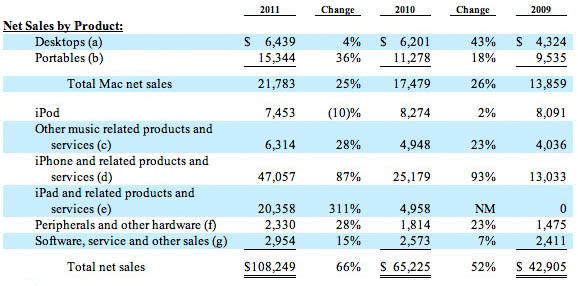
Love 'em or hate 'em, you can't deny that Apple is kicking fiscal hiney
With fiscal 2011 Mac sales totalling a "mere" $21.7bn out of total sales of $108.2bn, it's unarguable that the iPhone and its follow-ons have fundamentally transformed Apple (née Computer) into the company that Steve Jobs described in 2010 as "a very high-volume consumer-electronics manufacturer."
And with Mac OS X – oops, Apple now prefers it to be called simply OS X – turning more iOS-like in its upcoming Mountain Lion iteration, expect the iOSification of Apple to continue.
If "iOSification" didn't sound so much like "ossification", this longtime Apple fanboi would be a wee bit less worried about strolling through a Cupertinian garden whose walls are more fortified with each operating-system release. ®
COMMENTS
Personally I think this democratisation of technology has been a very good thing.
Catering to the masses has forced the IT companies who used to cater to geeks & nerds, (disclaimer - I am one), to cater to ordinary people, making things easier & simpler to use for everyone. And please don't think that being simple to use makes it simple under-the-hood - it takes skill to do it properly and iOS sales show that the fruity one is on the right track. This can only be a good thing as it now forces others to up their game.
Whether the tech-heads like it or not, using facebook, surfing the web, watching cat videos etc etc are all legitimate uses of a computer, which is after all nothing more then a tool.
The day when I am no longer the default support contact for my family & friends merely because I "work in computers" is drawing closer every day :-)
Oh, and OS X may "look" more like iOS but it'll still be a "proper computer" for those that need it to be. Apple needs the developers to keep making the apps, which in turn brings in the "normal" people to buy their hardware.
Re: "OS X may "look" more like iOS but it'll still be a "proper computer" for those that need it.."
Hardly....I read recently that even AutoCad is coming out with a Mac OSX version. Mac's are still strong and getting stronger in the tech world. iOS just dominates the computing realm (that includes smartphones and tablets). It makes sense to apply some of the iOS stuff into OSX but OSX will always be OSX. Adding things does not mean they are removing other features and functions.
Mac will live long and prosper...as will iOS!
I kinda hafta disagree. I ran to Apple to escape the Microsoft world back in 1998. As the years went by I was able to more and more tell family, friends and colleagues that my Microsoft skills were diminished and they should look elsewhere. Now I am getting more and more family, friends and colleagues asking Apple questions. Still, it was a great trade off. I only get 5% of the questions I used to get and the answers and a simple sentence or two.
Gotta love Apple tech for consumers! Which, frankly, is the majority of computer users these days.

IT infrastructure monitoring strategies
Agentless Backup is Not a Myth
Top 10 SIEM implementer’s checklist
Steps to Take Before Choosing a Business Continuity Partner
Enabling efficient data center monitoring