


This article is more than 1 year old
HP Pavilion dm1-4125ea 11.6in netbook
AMD's Atom smasher

Review Now that everyone and their dog has or wants a smartphone or tablet, the recent drop in netbook sales can hardly be a surprise. Yet does this mean there is no space for a small, cheap laptop? Of course not and HP’s recently refreshed Pavilion dm1 is a fine example of why I hope the breed never dies.
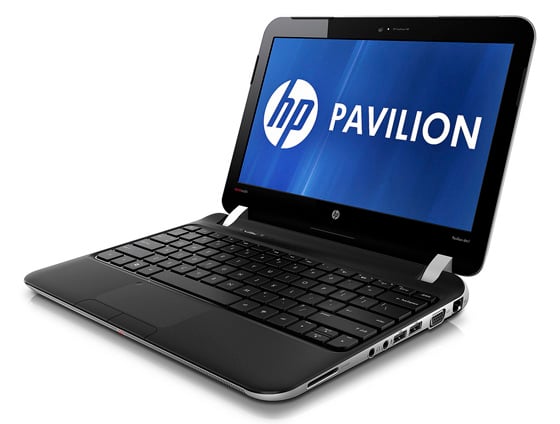
HP's Pavilion dm1-4125EA: the death of the netbook has been greatly exaggerated
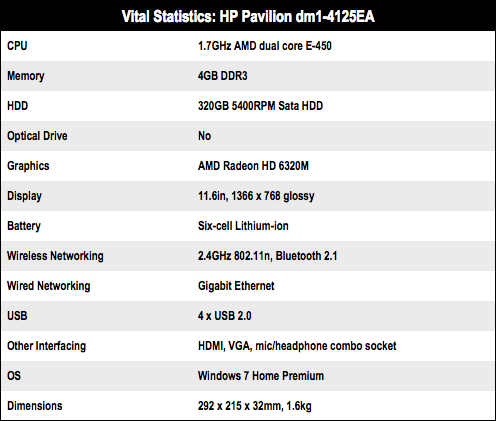
Down from a RRP of £549, HP’s on-line store asks for a perfectly reasonably £350 and in return you get a smart little machine with an 11.6in 1366 x 768 screen. It features proper graphics card that can easily handle 1080p video, a spacious and solid if unlit chiclet keyboard, Gigabit Ethernet and an full-sized HDMI port.
Eschewing the wholly plastic construction of many netbooks, HP has gone for a metal banding around the Pavilion dm1 which helps make the body and everything else – the lid, the keyboard, the nicely responsive trackpad – feel reassuringly solid.
At 1.5Kg and 292mm x 215mm, the Pavilion dm1 is petite enough to go into even the smallest rucksack without a problem. Admittedly, 32mm is twice the thickness of some Ultrabooks, but I’ll happily forgo the difference in order to get a decent selection of ports and a profile I can hold onto with a human hand.
Driving everything is the latest version of AMD’s E-series Fusion APU which pairs the E450 1.65GHz dual-core chip with an AMD Radeon HD6320M graphics card. This combo supports 1333MHz rather than just 1066MHz DDR3 memory on the slower and older E350 chip.
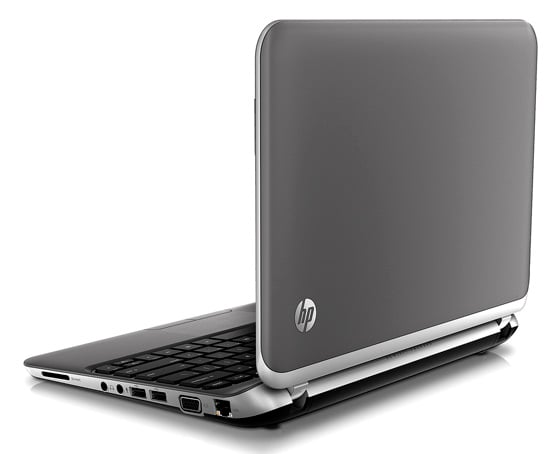
Looks good and puts in a decent performance too
It’s a marriage that delivers the sort of performance Intel Atom netbooks can only dream about. For the sake of comparison with Windows Starter-running netbooks, I ran the PCMark05 benchmark test and got a score of 3,320 which is nearly double the best score I have ever seen from an Atom netbook.
 Biting the hand that feeds IT

