The Register® — Biting the hand that feeds IT

Feeds

Boffins crack superconducting graphene's melting mystery

Next-gen high-speed transistors go 3D to slash leaks

Cloud storage: Lower cost and increase uptime

Scientists in Manchester appear to have solved a problem with graphene that has plagued the super-material's fans since it was sliced into being in 2004.

The breakthrough takes the wunder-material one step closer to being the new silicon, and powering a new wave of computers.
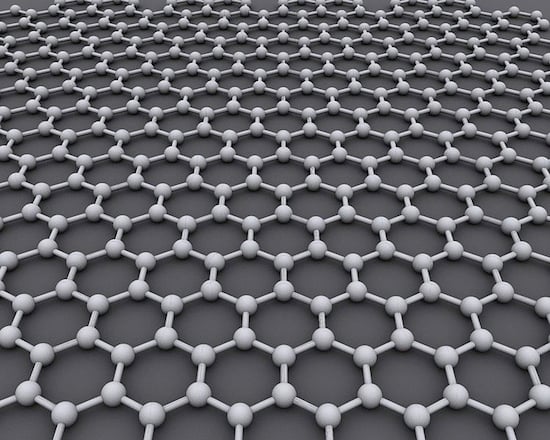
Graphene lattice, credit AlexanderAlUS, via Wikimedia

Graphene's incredible properties - including superconductivity - made it almost too conductive to work with computers. Graphene transistors packed densely in a computer chip leaked too much current and instantly caused the chip to melt.

Russo-British scientists Professor Andre Geim and Professor Konstantin Novoselov – who jointly won the 2010 Nobel Physics Prize for their work in graphene – seem to have got around that problem.

Their innovation was aligning the graphene atoms vertically rather than laterally (in plane) - moving into the third dimension. They used graphene as an electrode from which electrons tunnelled through a dielectric into another metal (a tunnelling diode). Then they exploited a truly unique feature of graphene – that an external voltage can strongly change the energy of tunnelling electrons. As a result they got a new type of a device – a "vertical field-effect tunnelling transistor" in which graphene is a critical ingredient.

"It is a new vista for graphene research and chances for graphene-based electronics never looked better than they are now," said Professor Novoselov. To make the transistors, the team came up with the idea of using a layer cake of atoms: layering graphene between atomic planes of boron nitride and molybdenum disulphide.

Dr Leonid Ponomarenko, who spearheaded the experimental effort, said: "We have proved a conceptually new approach to graphene electronics. Our transistors already work pretty well. I believe they can be improved much further, scaled down to nanometre sizes and work at sub-THz frequencies."

Earlier this week the British government announced a £50m grant aimed at keeping the UK as the leading research centre on graphene. Most of the funding will be focused in Manchester. ®

The research paper Field-Effect Tunneling Transistor Based on Vertical Graphene Heterostructures was published this week in Science.

Customer Success Testimonial: Recovery is Everything

Oww

That image makes my eyes water and swim.. anyone else?

13
1

From my experience of physics

This is high end physics / chemistry and the whatnot and but as I almost got an O'level in physics, I think its time that I point out their errors and also how graphine should be used and how those pesky scientist are doing it all wrong.

See, the molecular shape of graphene is such that blah blah blah, and they should have thought of that, blah blah blah. I would have blah blah blah and then under normal room temperature we could have blah blah blah blah and that could then be used for blah blah. Remember that I'm a little rusty of course. Now for those of you without my understanding, what this all means is blah blah blah blah and thats really important and useful, IF they listen to my advice.

Even though I'm not an acknowledged world expert, I really think they missed a trick that any schoolboy would have spotted.

11
1

Huge Government Investment in British Tech

£50m over 3 years!

Ok, how much does intel invest in nudging the corners of existing silicon tech evey year.?

Look forward to yet another discovery made in britian and exploited by every but the UK.

7
0

More from The Register

New material enables 1,000-meter super-skyscrapers
Before you read on, see if you can guess how the new stuff will be used
Boffins build headless robo-kitties
Soft kitty, warm kitty, cuddly little ball of wire kitty
 breaking news
You've seen the Large Hadron Collider. Now comes the HUGE Hadron Collider
International Linear Collider ready to rock and roll
 breaking news
Latest NASA ASTRONAUT class is HALF FEMALE
Newbie 'nauts include lady Marine fighter pilot, male doctor
Boffins find evidence Atlantic Ocean has started closing
'Embryonic subduction zone' that flattened Lisbon headed for Blighty
Google launches broadband balloons, radio astronomy frets
A careless Loon could blind the square kilometre array
Hubble spies unlikely planet being born in hostile neighborhood
Hoovering a cloud of sand 7.5 billion miles from a tiny star
 breaking news
Jaguar to open new car-making factory in Blighty (virtually)
Britain still makes stuff, it's just not real any more...
 breaking news
Spin doctors brazenly fiddle with tiny bits in front of the neighbours
Quantum computer address bus just nanometres wide
 breaking news
China's second woman 'naut blasts off for coupling in HEAVEN
Wang and pals test the cosmic waters for Chinese space station