


This article is more than 1 year old
Red Hat guns for VMware with RHEV 3.0
Linux virtualization – that's Shadowman's home turf

Scaling fatter memory and more cores
Thanks to RHEV 3.0 being based on RHEL 6.2, the free-standing hypervisor can support up to 160 cores, which is the maximum supported in an eight-way, ten-core Xeon E7 server these days. The RHEV 3.0 beta was based on RHEL 6.1, which topped out at 128 cores, and RHEV 2.2 topped out at 96 cores. A single instance of the RHEV 3.0 hypervisor can, in theory, span as many as 4,096 cores.
In terms of memory addressable by the hypervisor, RHEV 3.0 tops out at 2TB, double the limit of RHEV 2.2, but lower than the 64TB theoretical limit embedded in the hypervisor's design. In terms of guests, RHEV 3.0 partitions can span as many as 64 virtual cores (which can be physical cores or threads if you are using Intel's HyperThreading) and up to 512GB of virtual memory. That's four times the cores and twice the main memory of RHEV 2.2, but that memory limit is significantly lower than what was expected.
It is all a matter of what has been tested and certified by Red Hat so far. The guest partition for the underlying RHEV can, in theory, span the entire theoretical server of 4,096 virtual cores and 64TB of virtual memory, should some server maker actually build such a box.
Thadani tipped his hand a little bit in his presentation, showing how RHEV 3.0 stacked up against VMware's ESXi 5.0, showing the expected limits coming with a future RHEV release, presumably 3.1, which is due this summer:
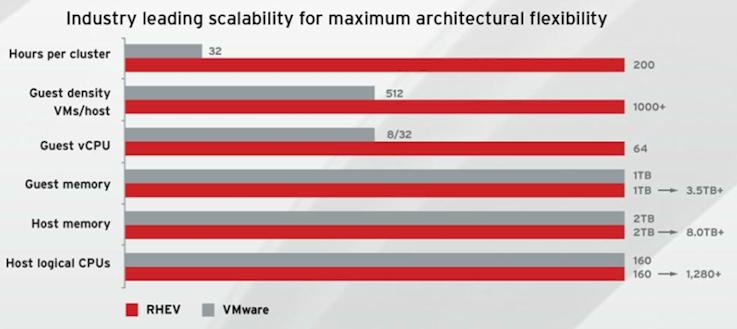
RHEV 3 versus VMware ESX 5 maximums (click to enlarge)
It looks like that future RHEV 3.1 will support 1,280 cores – which is coincidentally half the number on a fully loaded Silicon Graphics Altix UV 1000 shared memory supercomputer, which SGI has been pitching as a big bad Windows box. It looks like host machines with that future RHEV release will support 8TB of main memory and guests will support up to 3.5TB of virtual memory.
Among the many important features in RHEV 3.0, support for transparent huge pages is a big one, which allows for the hypervisor to dynamically create, destroy and swap huge pages, which is important for heavily loaded servers running lots of virtual machines. The hypervisor also includes the X2apic virtual interrupt controller, which reduces guest overhead, and sVirt, which brings mandatory access control to hypervisors and their guests.
RHEV 3.0 also supports vhost-net, which moves the network stack from the Linux userspace into the Linux kernel, which boosts network throughput, lowers latency, and cuts back on context switches and VM exits on virtual machines. Improvements in asynchronous I/O can yield as much as a 20 per cent boost in performance on I/O heavy workloads such as databases.
The new hypervisor also sports a new BIOS-alike text-based interface, the use of local disks to store hypervisors and VMs (instead of on shared storage such as Fibre Channel and iSCSI SANs), has an embedded version of Jaspersoft's open source JasperReports Server reporting software, and a tech preview a new Web administration console for Windows users and a Linux command line interface, based on Python, for scripting and automation.
With RHEV Manager 2.2, the control freak was certified to babysit 100 servers against a theoretical limit of 400 servers. With RHEV 3.0 Manager, the tested limit is up to 200 host servers for a single control freak. In addition to the expanded juggling capability, RHEV Manager has a new RESTful API set, a power user portal that offers more options than the prior self-service portal for end users, but less than what server admins get to see in the full-on screens.
The one thing that has not changed between RHEV 2.2 and RHEV 3.0 is the price of the hypervisor's support contract from Red Hat. RHEV costs $499 per socket per year on servers with standard business hour support and $749 per socket per year for 24x7 premium support. Unlike VMware, Red Hat is not charging for virtual memory and RHEV Manager is bundled into the support contract. ®
 Biting the hand that feeds IT

