


This article is more than 1 year old
NAS door gives drag-n-drop access to linear tape vault
Head transplant for the tape monster

With StrongBox Crossroads has built a NAS head for tape libraries that combines disk access speed with tape's low-cost and longevity, and can cut file storage costs by 90 per cent.
That's Crossroads' boast, although the NAS head is our term, and Rob Sims, Crossroads' president and CEO clarified it by saying: "It's a NAS head on top of LTFS storage."
The arrival of LTFS (Linear Tape File System), which adds a self-describing file system interface to tape and software which talks LTFS can present an LTO-5 tape through a file/folder structure with a drag-and-drop method for adding or retrieving files from it. Crossroads has built StrongBox to take advantage of the LTFS tape interface.
StrongBox and LTFS
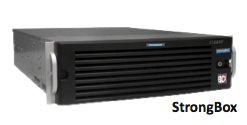
Crossroads Strongbox 3U enclosure
The background to this, in Crossroads' view, is that tape is the lowest-cost long-term storage medium for data but is complex to use, with its lack of a file/folder access structure and offline nature of cartridges in a tape library, amongst other things. Disk on the other hand is great for being online but expensive when bulk data has to be stored. Enter LTFS and the situation changes.
Crossroads has reacted to this by building a combined disk and tape archive facility, actually a dedicated filer appliance with archive software and an LTFS method of talking to an attached tape library. Supported libraries include HP's MSL2024, MSL2048, and ESLG3 libraries, and IBM's TS3100, TS3200, and TS3500 products. The set of supported libraries is being expanded and we're told that StrongBox should work with most LTO-5 supporting libraries.
StrongBox hardware is a 1U or 3U rack enclosure running on a Xeon sever and supporting 5.5TB (T1 small box) or 14TB (T3 big box) of disk storage, meaning 200 million or 5 billion files respectively. It talks NFS or CIFS to app-running servers. The little box connects to its tape library by dual 6Gbit's SAS ports while the big box offers 4-port 6Gbits SAS or 8Gbit/s FC to the back-end tape library.
File I/O
The software makes StrongBox provide a caching facility. The first part of a file can be stored on disk with the latter part on a tape cartridge. When a user requests the file it can be transmitted from disk initially, while the tape cartridge is fetched, mounted on a drive in the library, and the file located. Then the rest of the file can be streamed from the tape through StrongBox to the user, making it appear as if the file was online all the time. Files are read in from tape at full tape speed and sent out to the requesting user at the speed of the link.
When a file is written to StrongBox it is written to disk, into an ingest buffer sized at 1TB by default. A copy is written to tape, with perhaps a second copy for surety, according to settable policies, which can also specify replication to a remote StrongBox. When the file has been written to tape the disk copy's size will be reduced to the amount needed for read caching. This is set at 512KB by default. Files are aged out of the disk cache, as it fills up, on a least-recently-used basis.
LTFS-format tapes can be ingested into StrongBox and made available on a network share. Any LTFS-format tape exported by StrongBox should be readable by any receiving LTFS-capable library. This represents a way of transporting very large volumes of data, volumes that would be too slow and/or costly to send across a network.
Data security and StrongBox implementation
The StrongBox software generates and verifies a hash code for every file so that users can rely on file content integrity. There is also ongoing monitoring of the storage drives and media, with files on at-risk media rewritten to known good media automatically.
David Reine, a senior contributing analyst at The Clipper Group says of StrongBox: "[It] presents a paradigm shift in the use of tape that is cost effective and energy-efficient, lowering the TCO of the storage infrastructure for the enterprise. It separates tape from its legacy relationship with backup applications. By using LTO-5 and LTFS, StrongBox has the capacity, scalability and flexibility required for use as an active archive."
Crossroads says no agents, backup software or application modifications are required when you install StrongBox, and organisations gain a persistent view for all files on tapes stored in the library. Customers can use an existing tape library and dedicate it or a partition in it to StrongBox.
Crossroads channel partners are also extending their ability to offer all-in-one bundles of StrongBox plus a tape library. Sims said: "CIBER, for example, is a value added reseller that works with Crossroads. We also have strategic partners that will provide the complete package. Those are not yet announced."
Capgemini has deployed StrongBox in its Netherlands data centre to archive data for one of the largest Dutch department stores. An existing optical storage-based archiving system was replaced by StrongBox, which also expanded Capgemini’s managed data vaulting services and SAP archives. Capgemini is also developing a new StrongBox-based archival service.
Frank Huiskes, Capgemini's global chief technology officer of infrastructure transformation services (and a man with-a-very-long-title) , said StrongBox: "clearly provided the most compelling pricing per gigabyte, while also offering a new set of ‘always online’ capabilities that have the potential to greatly expand our archiving services."
Sims says StrongBox is: "priced by Terabyte: StrongBox T1 is approximately $21,000 and StrongBox T3 approximately $31,000, and [it] can scale."
You can stick StrongBox in front of an existing LTO-5-supporting library and get LTFS advantages that way, bringing a caching, disk-based filer front end to it. Or you could install a new StrongBOx/tape library combination to replace ageing optical archiving and provide online access to tape-based archiving that should be cheaper, substantially cheaper, than retaining the data on disk. The Capgemini example clearly speaks to possibilities for cloud service providers.
In this era of ever-proliferating unstructured data growth, giving tape libraries a NAS head transplant, and so cutting demands for increasing disk array capacity, could be a really smart move. ®
 Biting the hand that feeds IT

