
OnLive Game System cloud gaming console
Server-ance play
Review The OnLive cloud gaming service was launched in the UK in September, and I was impressed by the fact that it allowed me to play a wide range of PC games on my Mac – without requiring Boot Camp and a copy of Windows, or any virtualisation trickery.

The USB ports are for charging wireless controllers
That’s possible because OnLive runs your games on its own servers up there in the cloud and just squirts the game’s video signal down to a PC or a Mac over a broadband connection.
And now you don’t even need a computer at all. OnLive has come up with its own low-cost Game System that allows you to play on your HD TV instead.
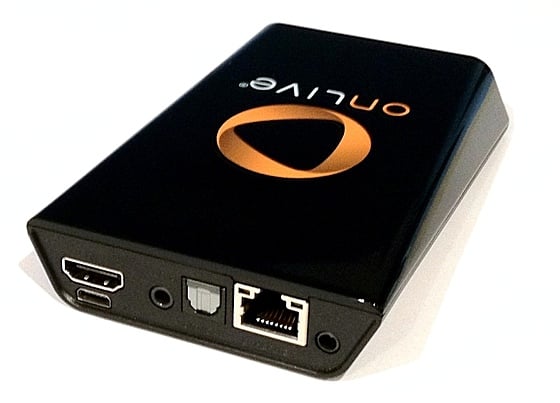
HDMI, digital and analogue audio, and Ethernet round the back
Priced at just £70, the Game System consists of a "microconsole" and a wireless game controller. The microconsole is a compact, glossy black box that looks very much like a portable hard disk - although it doesn’t have an internal drive of its own. It’s equipped with an HDMI interface for your TV, plus analogue and optical digital audio, and a pair of USB ports.
Network connectivity is provided by an Ethernet port, but there’s no wireless option at the moment. My home network runs on powerline kit, so I had no trouble setting up the Game System in my front room, but the need for a wired connection might be a problem if your router is too far from your telly.

The bundled controller is wireless
The controller is quite conventional, but it’s solidly built and, despite the low cost of the kit, includes a rechargeable battery. The power pack should last for more than 30 hours, but the controller can also run off two AA batteries if required. You can connect up to four controllers, or use a USB keyboard and mouse if you prefer.
Next page: Turn it up cloud
COMMENTS
I just don't see why
The little console thingy is £70 and buying a game costs the RRP and is unlikely to drop.
For that you're tying yourself to a service that may not last forever and you never actually own your game.
Why not just buy a second hand xBox 360 (I got a 2009 model Elite for £80 last year)? You can then hunt around for the best prices on new releases and pick up plenty of cheap old games. Or just rent them the old fashioned way.
No mention of the subscription fee. Is that still around or did they decide it was silly?
Oh god, it's you!!!
I keep having this recurring nightmare where you corner me at a party and never stop talking...
Bandwidth usage
Interesting thread here about the bandwidth used by OnLive:
http://onlivefans.com/showthread.php?3691-How-much-bandwidth-does-OnLive-use-I-have-the-answer.
In summary, I don't think this is going to be compatible with most UK ISP deals.
GJC
And how much does a decent PC cost?
And how much exactly does a decent PC with a decent Nvidia card to play it cost nowdays?
North of 600.
And how much exactly does a decent PC usable for daily non-gaming use cost nowdays?
South of 350.
That is without taking into account power consumption, etc.
If you do the _FULL_ math the numbers end up in favour of the onLive for anyone who plays less than 4h a day. If you are playing more than 4h a day... Well... Can you tell me who is your employer, I would like a job where I can spend 4h+ a day playing too.
Question...
It does look like this sort of thing is the future, but if everyone starts using this will the infrastructure handle it?
Sure the data speeds may be fast enough in a lot of the country to deliver this now (although not in many of the greener bits!), but you are talking about adding potentially millions of new users continuously streaming high quality video. Most providers already throttle torrents for large portions of the day, not for any copyright reason, but for 'fair use'.
If everyone that currently plays XBox, PS3, Wii and PC games was basically streaming HD video continuously any time they were playing anything that would take a huge amount of capacity - It would dwarf the stress put on the infrastructure by say catch-up TV and the ISPs were already up in arms about that...
