


This article is more than 1 year old
Texas Memory Systems gets some enterprise street cred
High availability flash array here at last

Texas Memory Systems (TMS) is getting some enterprise cred – by introducing a high-availability, shared-access RamSan flash array.
Competitors such as Violin Memory have criticised TMS RamSan flash SAN arrays for not having high-availability (HA) features that enterprises require when running business-critical applications.
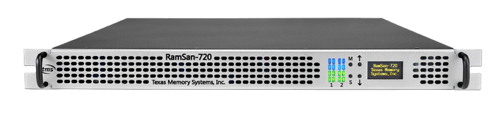
RamSan-720
The RamSan-720 comes in 6TB and 12TB versions, using single level cell (SLC) flash in a 1U enclosure, and delivers up to 400,000 random read IOPS (4K blocks) and has up to 5GB/sec sequential bandwidth with less than 100µs latency. There are four host connectivity ports which can run 8Gbit/s Fibre Channel or quad data rate InfiniBand.
Concerning latency and wattage, TMS says it has lowered latency by keeping all data flow operations in hardware and only using embedded CPUs for book-keeping operations. It uses low-power embedded PowerPC, which need only 2 watts each. These two features help it to build the RamSAn-720 in a 1U enclosure.
It requires 300-400 watts to run and TMS says it's the highest availability SAN flash array, the highest-performing one, the highest-reliability one, and has the highest SLC flash density, with no single point of failure. How is the HA implemented?
High availability features
First of all there are redundant hardware components; two Series-7 flash controllers per board, on both the primary and expansion boards, and two or four per module. The gateway interface has dual ports to the backplane. There are redundant management controllers, interfaces, cross-bar switches, data busses, power supplies, clock circuits and batteries.
Next there are two RAID controllers per system with dual external interfaces. RAID 5 is implemented within flash modules (9 data and 1 parity) and across flash modules (10 data + 1 parity + 1 active spare), which protects against a flash module failure. TMS calls this 2-Dimensional Flash RAID. The cross-module RAID is new to TMS.
Each flash chip has its own ECC (Error Checking and Correction) and TMS provides a variable stripe RAID inside the system as well. These two items along with the 2D RAID provides four layers of data protection and correction.
A TMS spokesperson described the HA features:
Previous RamSan products were very reliable with redundancies covering nearly all failure cases, but we recommend application-level high availability software for true high availability, or mirroring those systems to provide true high availability at the hardware level. The 720 boasts all these reliability features plus more to form a system with hardware-based high availability in the box.
Positioning and competition
TMS has said it aims to continue expanding its product range by expanding into storage management, building smaller systems and more powerful systems.
We asked TMS to position the RamSan-720 and -710. The general idea is that the 710, limited to 5TB of capacity and with no fewer HA features, can be used for small apps and the 720 for multiple apps and/or larger ones.
Is there any comparison with power needs for competing systems, such as the Huawei Symantec OceanSpace, Dorado 2100, Kaminario K2 Flash, and Violin Memory 3000 and 6000 arrays? TMS said: "The closest competitors to the 720 are the Violin SLC arrays, where both systems require three to four times the power and physical space of the Texas Memory Systems product—but get less performance due to architectural design."
Concerning the Violin systems: "The RamSan-720 provides similar capacity yet better performance than Violin but at 1/3 of the power, in 1/3 of the rack size and at 1/3 of the complexity. Just compare the datasheets."
We asked about price, TMS said: "Street price: £13,500/TB. This means that the Flash price per TB in the RamSan-710 and RamSan-720 is the same, and competitive with Tier 0 disk storage. The overhead is also the same price; in other words there is no extra charge for the HA."
The RamSan-720 will be available at the end of January. ®
 Biting the hand that feeds IT

