


This article is more than 1 year old
US boffins unleash piezoelectric insect cyborg
'Leccy-generating beetle for hazardous missions

Scientists from the University of Michigan's College of Engineering have developed a prototype insect cyborg with an eye to one day using electricity-generating six-legged critters to venture forth into potentially hazardous environments.
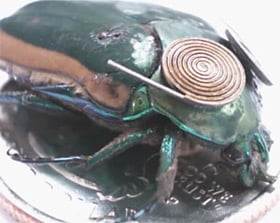 Professor Khalil Najafi and doctoral student Erkan Aktakka mounted a couple of spiral piezoelectric generators on a Green June Beetle (Cotinis nitida - pictured) and harvested the resulting juice during tethered flight.
Initial tests on a couple of piezoelectric generator types yielded 11.5 and 7.5µW from 85 to 100Hz wing strokes, although simulated tests indicate the total beetle output can be raised to a sizzling "45µW of power per insect".
This, the scientists reckon, might be enough to power a range of "energy scavenging" beetle backpack devices carrying "cameras, microphones and other sensors and communications equipment".
Najafi explained: "We could then send these 'bugged' bugs into dangerous or enclosed environments where we would not want humans to go."
Perhaps unsurprisingly, the research was funded by the Defense Advanced Research Projects Agency (DARPA) under its unsettlingly titled Hybrid Insect Micro Electromechanical Systems programme. Expect exploding assassin wasp cyborgs in due course.
There are more details on Energy scavenging from insect flight in the Journal of Micromechanics and Microengineering (payment required for the full-fat version, abstract here). ®
 Biting the hand that feeds IT

