The Register® — Biting the hand that feeds IT

Feeds

Hubble snaps mystery green death nebula in NGC 1846

Curious case of dwarf galaxy's possible member loss

Cloud storage: Lower cost and increase uptime

NASA's Hubble Space Telescope has captured an image of the death of a star in a nearby dwarf galaxy.
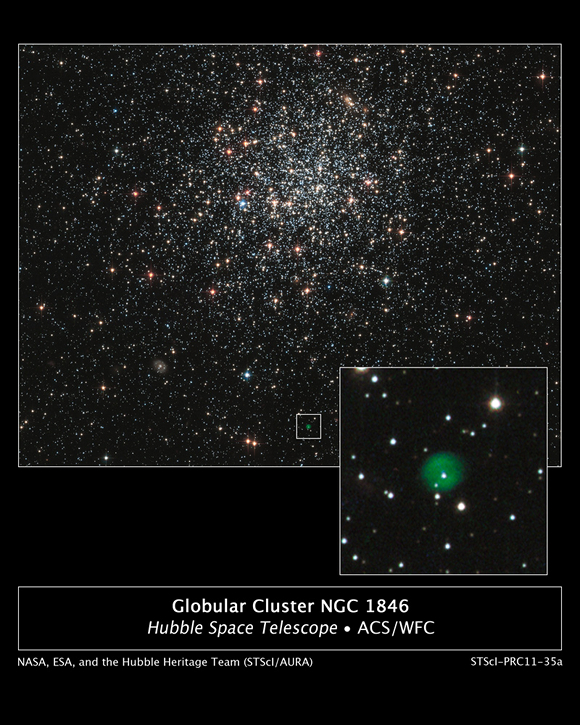
Death of a star in the Globular Cluster NGC 1846

Hubble snapped the shot of the cumbersomely named Globular Cluster NGC 1846, a collection of hundreds of thousands of stars in the outer halo of the Large Magellanic Cloud, in January 2006.

The shot captured the faint green of a planetary nebula, which space boffins aren't even sure should be there.

Aging stars show up in reds and blues, while the middle-aged stars – several billions of years old – are the ones that are whitish in colour. The green bubble in the bottom centre of the picture, however, is the aftermath of the death of a star and a burned-out central star can be seen inside the bubble.

The space agency said it was "uncertain" whether the nebula is a member of NGC 1846 or if it is just in the line of sight of the telescope when the 'scope is pointing at the cluster.

"Measurements of the motion of the cluster stars and planetary nebula's central star suggest it might be a cluster member," NASA said.

Globular Cluster NGC 1846 is around 160,000 light years away from Earth. ®

Customer Success Testimonial: Recovery is Everything

"in a nearby dwarf galaxy"

So that's where they come from..

2
0

If it is a cluster member,

what's the failover mode?

2
0

Green

There are a few stars that look green(ish); the colour largely reflects temperature and there are many blue and red stars, not to mention yellow (in most cases its easier to see the colours in a telescope).

Note that colour is only partly correlated with age - some stars start off red and then just fade away

(providing a fine example to M. Hucknell).

1
0

More from The Register

New material enables 1,000-meter super-skyscrapers
Before you read on, see if you can guess how the new stuff will be used
 breaking news
You've seen the Large Hadron Collider. Now comes the HUGE Hadron Collider
International Linear Collider ready to rock and roll
 breaking news
Latest NASA ASTRONAUT class is HALF FEMALE
Newbie 'nauts include lady Marine fighter pilot, male doctor
Boffins find evidence Atlantic Ocean has started closing
'Embryonic subduction zone' that flattened Lisbon headed for Blighty
Google launches broadband balloons, radio astronomy frets
A careless Loon could blind the square kilometre array
Headbangers have a gas, gas, gas in mosh pits
Boffins say heavy metal crowds behave like The Vapours
Hubble spies unlikely planet being born in hostile neighborhood
Hoovering a cloud of sand 7.5 billion miles from a tiny star
 breaking news
Jaguar to open new car-making factory in Blighty (virtually)
Britain still makes stuff, it's just not real any more...
 breaking news
Spin doctors brazenly fiddle with tiny bits in front of the neighbours
Quantum computer address bus just nanometres wide
 breaking news
China's second woman 'naut blasts off for coupling in HEAVEN
Wang and pals test the cosmic waters for Chinese space station