Ellison's cloud conversion is good for business
Skeptic turned evangelist to win CIOs
Regcast training : Hyper-V 3.0, VM high availability and disaster recovery
Open...and Shut For those agnostics who continue to doubt the reality of cloud adoption, there are two clear signs: the adoption of Amazon's public cloud and Larry Ellison's public cloud creation. The first is a sign of the appetite for cloud while the latter is a suggestion that even the cloud laggards have eventually found their way to their seats. Now if someone would just tell the CIOs...
CIOs, after all, have been telling analysts that they're not quite ready to embrace the cloud. Symantec surveyed 5,300 organisations and found (warning: 18-page/2.1MB PDF) that "while interest in cloud is high, few organisations have crossed the finish line, despite tremendous interest (and media coverage)."
Why? Because these executives worry that their staff aren't qualified, and that security and uptime are suspect. Similar findings emerged from surveys done by SWC Technology Partners, Colt Technology Services and Vanson Bourne, among others.
And yet somehow business consulting firm Bain & Company found that this apparently tepid cloud adoption would quadruple by 2020, dramatically outpacing spending on legacy hardware and software (the firm approximates it will grow six times as quickly). What gives?
The discrepancy largely derives from asking the right questions of the wrong people.
Just as happened in open source, the CIO is generally the last to know what's actually going on within their IT organisation, as Billy Marshall has pointed out. Down in the bowels of enterprise IT, developers – the new kingmakers, to quote Redmonk analyst James Governor – are actively embracing the cloud, moving more and more workloads to both private and public clouds.
This is clearly evident from Amazon's reported S3 usage, now at 566 billion objects:
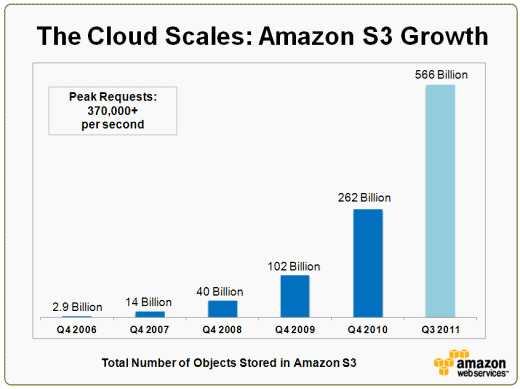
As GigaOm highlights, the pace of S3 volume is accelerating fast. Developers have added 304 billion objects to S3 in the past nine months, with the rate of transactions increasing by 28 per cent. There's no way to explain away that growth except by acknowledging that cloud adoption is real and getting faster all the time.
Even Oracle's chief executive Larry Ellison agrees. The man who once pilloried cloud computing as nothing more than "water vapour" and simply a new name for "everything we already do" now is singing a new tune.
At his company's OpenWorld conference this week, Ellison introduced the Oracle Public Cloud and, true to form, took the time to deride the Salesforce cloud as a "false cloud." Apparently, a false cloud is one that isn't built with open standards and which embraces lock-in.
But this is no time to carp on such little details as truth and accuracy. For CIOs not convinced by the Amazon numbers, and too ignorant of what's going on with their engineering staff, Ellison has made it clear that the cloud is now mainstream. After all, he now has one to sell to them. ®
Matt Asay is senior vice president of business development at Strobe, a startup that offers an open source framework for building mobile apps. He was formerly chief operating officer of Ubuntu commercial operation Canonical. With more than a decade spent in open source, Asay served as Alfresco's general manager for the Americas and vice president of business development, and he helped put Novell on its open source track. Asay is an emeritus board member of the Open Source Initiative (OSI). His column, Open...and Shut, appears twice a week on The Register.
COMMENTS
All Hail The King Of Nonsense
If only because I like the title. However, let's not forget that matt is now an executive type, or nearly so. Along with the pointy hair that means an outlook wildly different from the usual techie fare. One might speculate that most executives don't have the field of view to support looking that far and that the resulting strain on their poor brains means their sense gets distorted something fierce. But that doesn't change there's a substantial difference in viewpoint any way you look at it (insert obligatory groan here) and that it's very often more about perception, about spinning it this way or that way, that counts for success (among the politicking and in-fighting peers). This is practicality in an imperfect world speaking because politicking among managers is baaaad, hmkay (and a clear sign the machine needs greasing because all that effort spent infighting could've been spent making money instead), but it does happen a lot.
And, yeah, you have a point that's often overlooked or ignored by them for this reason or another and that is that without real control over the assets critical to your business, the company is dancing under a ceiling full of swords hung by a single horse hair each. But boy what an experience, eh?
It is, however, worth the read if only to try and understand just how broken brass-level thinking tends to be. Even if he doesn't pinpoint it himself (we do that), it does get out, and having seen it, readers can perhaps do something useful with it. Knowing where they come from one ought to be able to tell the brass in a way they understand just where they're taking the company.
Cynically speaking failure and even high failure rate isn't much of a problem as long as it's recoverable. "Everyone knows" that things go pear-shaped now and then, and it's more important to recover than to have it never fail in the first place. Especially if you can justify the failing way with lower costs, conveniently disregarding "unquantifiable" costs of recoveryfrom (actually entirely predictable) failure. Even if the actual TCO (as opposed to the projected one usually used) turns out to be higher because a non-failing solution doesn't need expensive fixing. But that would be at the price of opportunities to shine and reap promotions. And if you-the-executive are quick enough, you've buggered off to greener pa$tures before the failures resulting from your (possibly deliberately, I'm sure I couldn't say) poor decisions turn out to be catastrophic enough to take divisions or even the entire company down with them.
For honestly now, was not the executive racing rat its core business the taking of risks?
Yet more cloud Nonsense, from El Reg's king of Nonsense
If you want a crappy Hosting agreement running on VMs that are outside of your control, with no guarantee of security (Physical or otherwise), not available for inspection, and with no compensation when the whole system inevitably fails (like Amazon's does rather frequently) other than a nicely worded email to the effect of "Sorry, we messed up. Oh by the way, your lost data isnt recoverable. Here's a month free, have a nice day. PS: Sorry about you losing your job", then the so-called "Cloud" is for you.
Its the dumbest idea Ive heard in a long time, and given that companies like Amazon, Oracle and Microsoft are hyping it, it tells me all I need to know. Its just hype, and it sickens me how many supposed professionals are diving into it without thinking.
Seriously, get out a piece of paper, write down the definition of "Cloud" computing and read it to yourself. If it sounds like a good idea to you, PLEASE find a different line of work.
I wouldnt go near it with someone else's 10 foot pole.
The articles, since the move from UBUNTU, read more like the INFORMANTIONS on Television?!
It was enjoyable reading your thoughts on software and related topics. Lately, for me, they lack useful, informative, unbiased, columns.
It would be nice to read columns similar in content and nature, that you penned during your tenure with UBUNTU/CANONICAL.
May you be well and happy.

IT infrastructure monitoring strategies
Requirements Checklist for Choosing a Cloud Backup and Recovery Service Provider
Data control in the cloud
Cloud based data management
Enabling efficient data center monitoring