The Register® — Biting the hand that feeds IT

Feeds

Outbound space probe looks back at tiny Earth and Moon

Space snap puts things in perspective

Cloud storage: Lower cost and increase uptime

Pic NASA's space probe Juno, outward bound for Jupiter, has sent pack a pic of the Earth-Moon system from 6 million miles away.
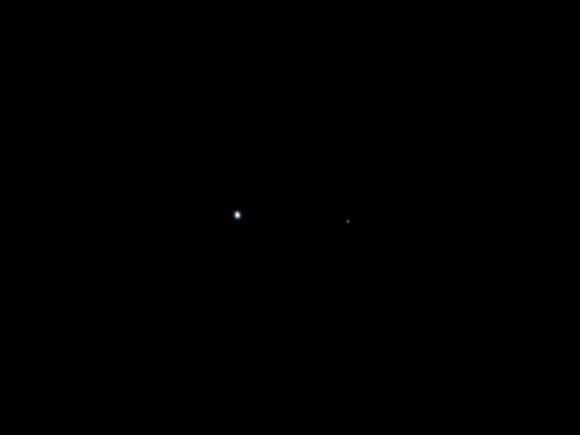
The Earth and Moon, seen from the Juno spacecraft 6 million miles out. Credit: NASA/JPL-Caltech

I can see the pub from here

According to NASA, Juno was further away than the Moon within a day of being launched on 5 August. Despite its speed, the craft will take another five years to reach its Jovian destination 1,740 million miles further on. The pic above was snapped using the probe's camera, known as JunoCam, as part of engineering checks by NASA ground controllers.

"This is a remarkable sight people get to see all too rarely," said Scott Bolton, top boffin on the Juno push. "This view of our planet shows how Earth looks from the outside, illustrating a special perspective of our role and place in the universe. We see a humbling yet beautiful view of ourselves."

Juno will be the first solar-powered spacecraft to go so far from the Sun: previous missions to the outer solar system have required nuclear power sources. NASA reckons that large modern solar panels, combined with a planned track that will keep Juno in sunlight at all times and avoid the worst of the radiation hazards around Jupiter, will do the trick. This is the more so as Juno has "modest" power needs, being intended to power up its instruments for only six hours of each 11-day orbit around the giant planet.

The probe, following in the recent tradition of crewing space missions with suitable toy figurines (established first in the Register's own space programme) also carries three specially-crafted aluminium Lego people (well, technically deities in two cases).

The NASA photo release is here, and there's more on Juno here. ®

Customer Success Testimonial: Recovery is Everything

Dammit...

I wasn't smiling, can you take it again?

12
0

Too true

What tends to get forgotten in all the climate change debates is that climate change almost certainly won't destroy the planet, it *might* make it uninhabitable for *us* and a fair chunk of other "higher" lifeforms, but if we're wiped out by it then the planet and something like 90% of life will continue on quite happily - probably much more happily than it is at the moment.

Still, it'll finally put the Apple vs Android vs Samsung debates into perspective.

8
0

that's just peanuts to space...

I'll just leave this here....

http://www.scaleoftheuniverse.com/

8
0

More from The Register

New material enables 1,000-meter super-skyscrapers
Before you read on, see if you can guess how the new stuff will be used
 breaking news
You've seen the Large Hadron Collider. Now comes the HUGE Hadron Collider
International Linear Collider ready to rock and roll
 breaking news
Latest NASA ASTRONAUT class is HALF FEMALE
Newbie 'nauts include lady Marine fighter pilot, male doctor
Boffins find evidence Atlantic Ocean has started closing
'Embryonic subduction zone' that flattened Lisbon headed for Blighty
Google launches broadband balloons, radio astronomy frets
A careless Loon could blind the square kilometre array
Headbangers have a gas, gas, gas in mosh pits
Boffins say heavy metal crowds behave like The Vapours
Hubble spies unlikely planet being born in hostile neighborhood
Hoovering a cloud of sand 7.5 billion miles from a tiny star
 breaking news
Jaguar to open new car-making factory in Blighty (virtually)
Britain still makes stuff, it's just not real any more...
 breaking news
Spin doctors brazenly fiddle with tiny bits in front of the neighbours
Quantum computer address bus just nanometres wide
 breaking news
China's second woman 'naut blasts off for coupling in HEAVEN
Wang and pals test the cosmic waters for Chinese space station