The Register® — Biting the hand that feeds IT

Feeds

OS X Lion paves way for "Retina Display" monitors

Jaggies-be-gone

Mac OS X Lion incorporates support for displays packing four times as many pixels as they do today.

Right now, the so-called "HiDPI" mode remains inaccessible unless you've downloaded Apple's Xcode software development tool. It contains a graphics test application called Quartz Debug and it enables HiDPI modes in Lion's Displays control panel, MacRumors reports.
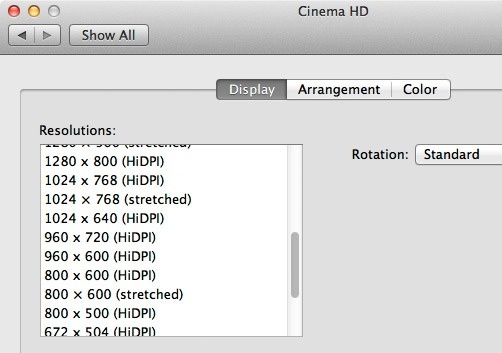
OS X Lion HiDPI

Source: MacRumors

The notion is that developers will be able to code apps able to support resoutions of 3840 x 2160 and beyond. Vector-based images and fonts will scale up already, but bitmapped UI elements will need to be rendered at double their current pixel dimensions to ensure they appear on screen at the same size as they are now.

But with double the pixel density, images would appear a darn sight smoother than they do now.

In short, we're talking the desktop equivalent of the so-called "Retina Display" Apple currently builds into the iPhone and is expected to equipping the iPad with in due course.

In iOS, retina-ready graphics are suffixed @2x, and the OS automatically uses these images over un-suffixed ones when rendering content on retina screens.

OS X's HiDPI mode presumably works in the same way. Coders build apps for a nominal resolution - say, 2560 x 1600 - leaving the OS to realise that it's actually working with a 5120 x 3200 screen and use the difference to improve the look of the picture rather than simply treat those extra pixels as more screen real estate.

Equipping Lion to cope with HiDPI screen - and providing developers with the tools they need to get their apps to support such resolutions without making UIs suddenly appear a quarter of the size - is one thing. Actually shipping machines with such screens is another.

But, as with mobile devices, high pixel density monitors certainly will come to market. ®

Oh look, Apple just got bitten by an eleven-year-old dog

OS X had an excellent resolution-independent graphics engine from the very beginning in the shape of Quartz. At its introduction, the devs proudly claimed that it would allow OS X applications to be totally resolution independent.

Meanwhile, instead of building the UI controls out of vector instructions, Apple UI "designers" put together a UI using Photoshop and (rather ironically) Flash/Shockwave.

Because this design was a. personally vetted by SJ ("I don't care about how it works, I just want it to look amazing for the five minutes they'll play with it in the store"), and b. was entirely bitmap-based, it was unfeasible to translate it into code and gain proper resolution-independence, or to change it in any way that might have helped, and the opportunity was lost.

When I started looking into Symbian^3 development last year, I was quite surpised that it uses SVG for its icons, thus making its UI fully scalable (shame about the font scaling, though). MacOS X, with its PDF support, should have had this from the get-go, instead of making devs ship big fat PNGs. I remember just after OS X shipped, a friend of mine remarked that he'd just created an icon bundle that was larger than the original Macintosh ROM...

2
0

But aren't our retinas insufficient?

Does it really matter having these super-resolutions when you sit 1-2 feet from a monitor? I thought the whole "magical" thing about the retina display was it was pretty close to maximum resolvable pixel density when held at a distance that you use the phone? As any fule no, the further you are from an image the lower the acceptable / discernible resolution required. Hence magazines are higher dpi than billboards. You see the same effect in reverse when you sit too close to your friend's massive HDTV and see all the jaggies.

So the only need for such high densities and resolutions are if you are sitting close to a massive display?

2
0

Isn't this the OS's job?

Back when I first starting programming for Windows (when you had to deal directly with memory handles etc), the whole point was you programmed in a resolution-independent way. Has this skill been lost, or is Apple just catching up with the real world of device-independence? Shouldn't Display PostScript have provided this already to OS X?

2
0

oh god, not again.

leave it to apple to "rebrand" something everyone has been able to do for years, but now that apple do it, it's new and fantastic.

2
0

Wow

204dpi according to Wikipedia. Impressive, especially for a 10-year old product. Must've cost a fortune then, of course (even by Apple's standards! :)

Why Apple had to invent a special case for "x2" resolutions is beyond me. Every other OS has a few different icon sizes for use at different DPIs, adjustable according to user preferences.

2
0

More from The Register

Android is a mess and needs sprucing up, admits chief
Can Google really fix it? It isn't in control any more
New Lumia 925: This, loyalists, is the BIG ONE you've waited for
Nokia veep drills high-end master plan for El Reg
Android device? Ooohhhh, you mean a Samsung phone
Koreans nabbed nearly all the Q1 profits – more even than Google
Review: HP Pavilion 14 Chromebook
All roads lead to Chrome?
Borked your iDevice? Pay EVEN MORE to have it fixed by Applecare
Or scream at their hapless techies on their forums
Euro PC shipments plummet into bottomless pit of DOOOOM
11th quarter of decline, 20pc drop on last year - Gartner
MIT takes battery-powered robot cheetah for a gallop
Biomimetic big cat needs no power cord, just a walker