Sony calls time on 8mm video format
And... cut
Sony has pulled the plug on another iconic format from yesteryear, calling time on the 8mm video format.
While it will continue to produce 8mm tapes for the time being, from September, Sony will cease production of 8mm digital VCR recorders, the GV-D800 and the GV-D200, Japanese-language AVWatch reports. It stopped making 8mm videocameras in 2008.
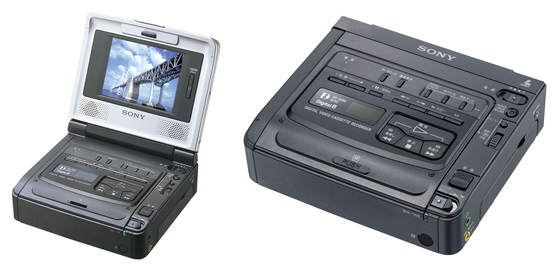
The company says the reason for discontinuation lies in the rise of Flash memory and demand for high-definition video. Another casualty in the fast-paced world of tech, then.
Sony helped to launch Video8 in the 1980s, propelling it forward as the format of choice for amateur camcorder owners. Video8 was later upgraded to Hi8 to compete with the rival Super-VHS format and both remained dominant in the market for the next two decades until being overtaken by DV.
Last year, the classic cassette Walkman made way permanently for the digital players of today, while just a couple of weeks ago, the company killed off its MiniDisc Walkmans too. Times they are a-changin'. ®
COMMENTS
Format shift like your life depends on it!
I know what you mean, had something similar. 6 years of video tapes including some of my late mother. The unit packed up and I had to fish through eBay to get a camcorder that could play them. It was straight conversion to DVD, while they were playing no matter what was on them! Had one tape bunch up and almost rip itself up but I managed to save it. Some hairy moments, but all the vids are safe, both on DVDs and in high-quality video format files on another hard disk as well.
I learnt my lesson that you must keep format shifting or you risk losing all your precious memories.
The one good thing to come out of the exercise was that it spurred my father to get all the old family cine-films out and get them sent off for conversion to DVD. Even though I am in them, 40 years ago aged only 9 months, I had never seen them before and to see my late mother nursing me as a baby was one of the most emotional moments I have had and it could have been so easily lost forever.
Don't put it off, sort out those memories today or you may regret it.
Time moves on
I remember saving up for and then buying a Sharp 8mm camcorder in 1993. Did a great job. Then in 2000 I bought a digital8 camcorder, which was pretty damn good (manual exposure, white balance tuning, not just pointing it at a wall, ridiculously long zoom lens). Bought a Canon DV camcorder a few years later - what a load of rubbish! Picture looked like a bad NTSC to PAL conversion!
I'm tempted to bu one of the flash video cameras now, but don't really have a use.
The only thing I didn't like about 8mm was all the whirring and clicking necessary to get the tape going, even just putting it in rewind and the servos would start whirring and clicking!
Sony Stuff
Has it really been a year since the Walkman announcement was made? (The answer is no, not quite.)
Earlier this year, I was introduced to minidisc for the first time, with a Sony MDS-JE510 component unit--the first minidisc-anything I'd ever seen in many years of seeking out assorted pieces of audio equipment. (It's a slippery slope and I recommend not ever getting started. The stuff only multiplies!) It required near-heroic efforts to get it working again because I assumed it had worked from the factory. So many bad solder joints and the replacement of a few bad parts later, it came to life. It's still running today.
All I can say is that it is really too bad minidisc didn't really make it. It is everything cassette tape wanted to be when it grew up. Titling, full random access...really the only thing not to potentially like (other than the SCMS infestation) was the ATRAC compression and to my ears it never caused any problems. Then again, maybe I would like it. I'm still making mixtapes on high-bias cassette (remember those?) with a 1981 or 82 era Technics cassettte deck.
I'm also a latecomer to the 8mm video format. I never used conventional Hi8 machines, but I have a somewhat low end Sony Digital8 Handycam that I purchased secondhand not all that long ago. Despite its being a relatively low end model, it does a phenomenal job and has some nice features (slow frame rate recording, time lapse recording, stereo microphone, a light, some onboard video effects). If the Wikifiddlers are to be believed, Hi8 tape is actually a "safer" storage medium for the DV datastream that all Digital8 machines use due to its wider tracks. I gather that most of the modern Handycam product offerings don't do half of the stuff this one does (no Nightshot in particular). From what I've seen, today's flash-memory based cameras might be "better" due to no moving parts, and they might shoot HD video (something I have no interest in), yet many of them don't do as good of a job as the old Digital8 Handycam does. The cheap ones in particular tend to be fairly nasty, especially in lower light conditions. At least the 8mm tapes remain available and reasonably priced.
I'll get my coat. It's the one with the book of technological wonders that never made it, and a DAT Walkman in the pocket.
Stuff VHS
A few people had them but it was fun to show how poor they were.
Even Panasonic lost
Even took on S-VHS and won on colour reproduction.
My Weapon of choice
Sony Super Beta deck - SLHF950
A real interesting example was during some celebrations in the mid late 1980s something Royal. Anyway I recorded some and so did another local chap, he used a Compact VHS portable, I used a Sony Beta portable.
Firstly he had quite a strong green tinge, secondly his edit master copy was worse than my duplicate copy, in other words his second generation VHS was worse than my third generation Beta, and I was showing my edit master.
This was pre 950 so later tapes were even better quality!
Digital and quality
There is a difference between the cheap and expensive gear, not always obvious, but the picture from the first top end decks was definately better than the budget, I think it was a Pioneer model everyone raved about, the first cheapy was a Samsung.
Cameras and video cameras
Lenses are now important as are the sensor chips, so you will get a better recording from a 3 CCD semi pro camera than a budget 1 CCD cheap lens camera.
