
Smartfish Whirl Laser Mouse
Rocking rodent
Review Smartfish reckons our mice, and other peripherals, don't have enough life of their own, so it has successfully produced a mouse that wobbles in the interests of reducing RSI.
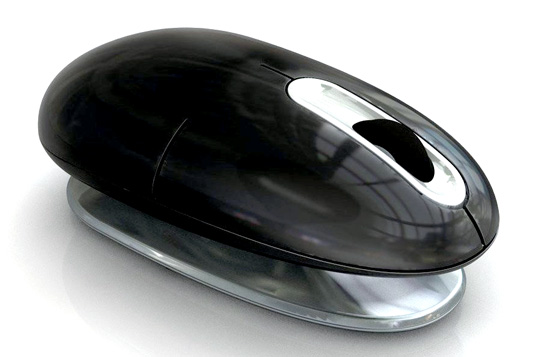
Twisted thinking: the Smartfish Whirl Laser Mouse
The premise of Smartfish's "Ergomotion" technology is that the static nature of our wrists is what causes pain, and ultimately damage, to our hands. So the Smartfish Whirl mouse teeters atop a post, enabling it to tilt into the linear and lean into the curves too, in order to provide a bit of variety for the propelling wrist. It works too, though it's a bit small and plasticky for the price.
The leaning of the mouse is immaterial to cursor movement – that's achieved by sliding the rodent around the desk in the usual way. The flanged foot of the pivot contains the laser tracking common to most mice these days, and the tilt is only there to stop the wrist remaining locked in the same position, to force it into being actively involved in the process.
Smartish promises a keyboard based on its Ergomotion principles – apparently it shuffles the keys around while you type – which will presumably perform better than it sounds when it appears. Back in the here and now, the mouse comes in full-size and mini versions, though I found the full-size version to be quite mini enough for my hands.
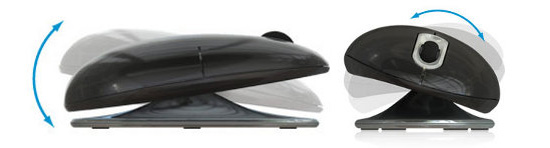
Once you start using it, you don't really notice the leaning
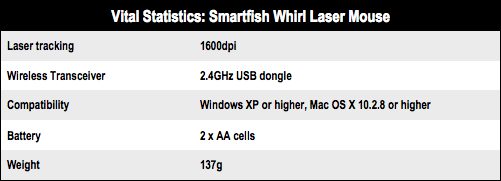
Both versions of the Whirl have a tiny USB transceiver clipped in the flanged plate underneath it for safekeeping when not in use. To get going, once the supplied batteries have been dropped in, you simply plug in the transceiver into a suitable USB port and it all works seamlessly. It's a proprietary protocol; Bluetooth would have been nicer, particularly if the Mini was to be used with a laptop.
Next page: Strain relief
COMMENTS
Boingggg!
Looking at the side-on photos of this thing, I'm reminded of one of those 'sucker-n-spring' novelty toys I used to play with as a kid. It looks as though you should be able to press the top down onto the base and have it leap off the desk a couple of seconds later.
@Some Beggar
Thus speaks someone who's never suffered from it.
Who claims?
It's for the manufacturer to justify their assertion. Industry in general isn't above designing ridiculous junk and selling it as a disability aid or cure, often at an inflated price. An interesting consequence is that made-for-gaming hardware can be cheaper and more useful to us cripples than purpose-designed aids are.
My own experience of RSI - not carpal tunnel, I don't know what it is really but if I use a keyboard then my forearms hurt with a burning pain for a couple of days, or if I do more then worse happens, I'm tapping this with a stylus on touchscreen and the FITALY software - my experience, I say, is that rapid frequent control actions are bad (and often unavoidable), and a device that lets you perform the same action with less effort, and in more than one way, is good. I'm not sure how this one rates, but if you can also perform fine movement by rocking INSTEAD of moving the mouse, that seems worth trying. But changing to a completely different pointing technology is liable to be better.
@AC
Thus speaks the medical profession:
"Repetitive strain injury remains a controversial topic. The term repetitive strain injury includes specific disorders such as carpal tunnel syndrome, cubital tunnel syndrome, Guyon canal syndrome, lateral epicondylitis, and tendonitis of the wrist or hand. The diagnosis is usually made on the basis of history and clinical examination. Large high-quality studies using newer imaging techniques, such as MRI and ultrasonography are few. Consequently, the role of such imaging in diagnosis of upper limb disorders remains unclear. In many cases, no specific diagnosis can be established and complaints are labelled as non-specific." The Lancet, Volume 369, Issue 9575
I expressed no opinion one way or the other; I simply asked what research had been done to determine whether this device has any medical benefits.
