How I learned to stop worrying and love SSDs
An upgrader writes ...
When, last year, the price of decent SSD drives veered towards £1-a-gigabyte, I decided this was no longer the enviable domain of the hot-rodder. Concerns about data integrity were enough to keep me hesitant. But finally, I took the plunge. It was a revelation.
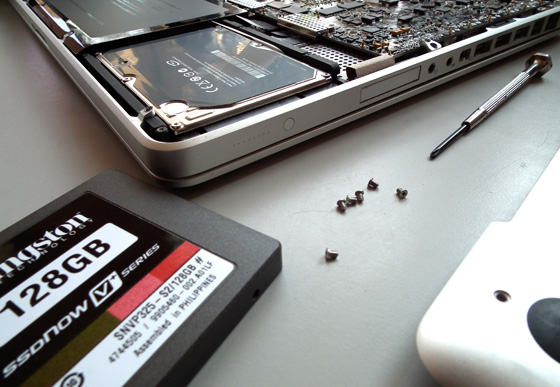
Currently an upgrade for most laptops, SSDs are destined to become standard issue
In twenty years of trying to eke a bit of extra performance from my machines, nothing has made quite such a dramatic difference, although there have been some reasonable performance boosts along the way.
I'm often called out to fix something, and for the last 15 years it's been fairly easy to fix somebody's ailing machine. If it's on fire, grab a damp tea towel. If it's clicking, they need a new hard disk. For the rest of the time, adding a bit of memory to a grinding system has usually made the difference between torture and comfort, and been doable on the cheap.
Apple in particular had a period where it moved to a much more demanding OS, but chronically under specified the amount of memory shipping by default. It didn't help that the Motorola-supplied chips were way behind the market (and we realised how much when it moved to Intel), and that the demanding Quartz compositor really needed a decent GPU, which, of course, the consumer laptops didn't have.
The technically savvy punter would place an order for the extra memory alongside the order for the new Mac, and may not have noticed these shortcomings. However, much of Apple's vast consumer market – ordinary people who expect the computer to just work – simply took it on trust.
Next page: Cheap fix
COMMENTS
You've miss-understood your roll
You, or I, as a consumer exist purely to put money into the pockets of the manufactures.
Allowing us to upgrade our systems means that we do not buy new systems as fast as they need us too. If you run the standard spec on the kit you will probably be forced to upgrade within 2 years.
If they let you upgrade the memory (2 generations on my experience) and the hard drive (I seem to do this 3 times in the life of a laptop) then your might not fulfil your primary - ney Only, function for as long as 7 or even 8 years.
Where's the point in that?
How are these poor people going to make a decent living?
write-mostly
For desktop users, there's a nice trick you can do with (at least) Linux software raid - "write-mostly" mode. Put an SSD and an old-fashioned hard drive together in a mirrored pair (RAID1), and set the conventional drive to "write-mostly". Then, all reads happen from the SSD, but all writes are made to both disks. You get the read speed of SSD without the reliability worries. Write speed takes a hit, obviously, but, you know, it's a trade-off.
To Answer the questions....
1) Yes and No. SSD awareness is more of an operating system feature. Windows Vista/7, newer Linux versions (don't remember the kernel version number), and yes, even MacOSX (to some extent) recognize SSDs and behave differently (ie: pass TRIM commands to the drive). As far as MBR and the like, yes, works the same.
2) Read my #1 response.
3) It's not imperative, but definitely SSD-debilitating if your OS "defrags" your SSD regularly. Debilitating, meaning reduces lifespan (unnecessary writes) and can cause your drive to run in a "dirty" state, like an unTRIMed drive.
Best bet is to run a TRIM-capable SSD and OS, or at least have garbage collection capabilities for the SSD.
A few other notes:
1) Glad the author used a V+100 Kingston drive. Their older counterparts (the SSDNow 64GB and such non-V+100 drives) are horrific performers compared to other like-priced SSDs.
2) "There's just one fly in the ointment – the age of the upgradeable computer is vanishing." - I would just like to refute this concept outright. Most PC laptops come with easy component bays for hard drives and RAM. They're even making it /easier/ to access such components. It's the world of Apple that you are seeing the "upgradable computer" vanish. They go so far as to (attempt to) require Apple-branded marked-up SSDs (via drivers) to support TRIM. This quote is from the skewed perspective of an Apple user.
forgot a little bit of info
when ssd's do fail most (if not all of them) just lock the write capability meaning that all the data on the drive is still readable and can then easily be imaged onto a new replacement drive.
running ssd as boot drive here (with whatever HD hungry game I am playing a lot of) and a pair of 1tb drives as main storage.
palm misinformation
You are totally wrong about Palm, it was a pretty robust OS that had simple multitasking. Some of the 3rd party apps were flakey yes, and these could take down the OS due to the basic hardware which didn't have an MMU.
