


This article is more than 1 year old
Office workers: 'The best way to upgrade a PC is to smash it'
One in four desk jockeys prefer upgrade by sledgehammer

More than one in four European office workers believe that the quickest way to get a replacement phone or laptop is to destroy the one provided to them by their employer, according to a new study by online-backup provider, Mozy.
"Shockingly, over a quarter of the office workers surveyed feel that the quickest and most efficient method of replacing outdated technology, such as laptops and mobile phones, is to deliberately destroy or irreparably damage them," concludes the study, which surveyed 600 IT managers and 3,000 employees across the UK, France, and Germany.
The reason for this determined destruction, according to Mozy, is that office workers are saddled with aging PC, laptops, and phones. "Across Europe as a whole," Mozy says, "just 40 per cent of companies had met their upgrade plans."
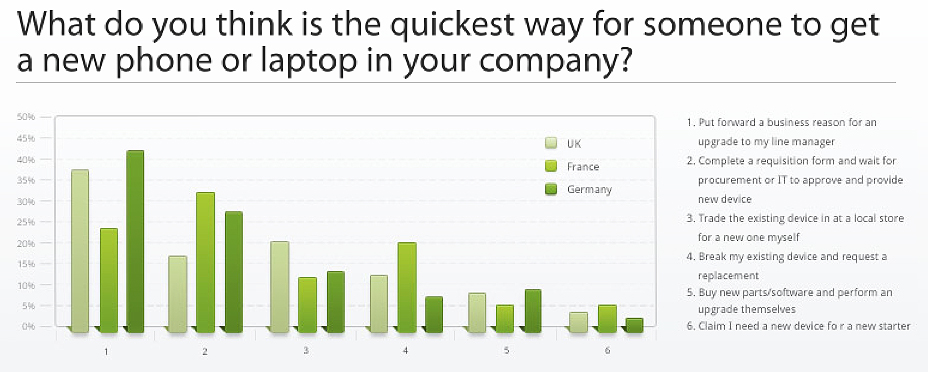
Trusting Germans, destructive French (source: Mozy – click to enlarge)
Of the three coutries surveyed, the "Past-it PC" problem, as Mozy calls it, is particularly acute in Blighty. "In the UK, the average workplace computer should have been thrown on the scrapheap over two years earlier and is twice as old as the average computer used in Germany," the survey says.
"The average age of a work computer in the UK is over five years old," Mozy contends, "much higher than in France (three years and two months) and much, much higher than Germany, where computers are, on average, only two years and seven months old."
Despite being saddled with more past-it PCs than others, UK office workers are far less likely to take a hammer to their phone or laptop than their Gallic peers. While around 13 per cent of British workers said they would destroy their device to get a replacement, over 20 per cent of French workers thought doing so would be the quickest way to get an upgrade.
This French penchant for digital demolition may be due in part to those workers having little faith in their management. While well over 40 per cent of German workers believe that simply stating the business case for an upgrade would get prompt results, fewer than one-quarter of French workers agree.
Those disgruntled briseurs d'ordinateurs, by the way, are far less likely to take matters into their own hands in a less-destructive manner: only one quarter as many French workers think it more efficient to upgrade their own laptop or phone rather than smash it, while more German workers would perform their own upgrades than go after their aging PC with some sort of WMD. ®
 Biting the hand that feeds IT

