


This article is more than 1 year old
Why Nokia failed: 'Wasted 2,000 man years' on UIs that didn't work
For want of a nail, the Kingdom was lost?

No quick fix
Nokia wanted a "quick fix" to remove some of the worst UI niggles from Symbian, for the next release, Symbian^3. It wouldn't make it a modern-looking experience, but it would have removed some annoyances. Some things you had to tap once, others twice, for example. But Symbian^3 became delayed as more features were added. Wilcox calls it "the slowest 'quick fix' in history".
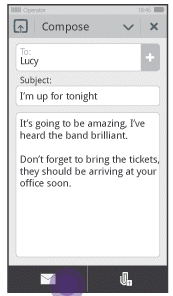
Shades of grey: Meego's Touch UI
Ironically, by the time Elop was unveiled as new CEO in September, Nokia finally had its developer story sorted out. At least on PowerPoint, if not in practice, with QML as a quick and easy way of writing applications that really do run on both Symbian and Linux, and a slick environment called Qt Quick. Nokia retains this strong team of core Qt gurus (it hived off its Qt services business, aimed at in-house developers this week). But it's all now rather moot; the platforms are "burning". Meego is a research project and Nokia (somewhat optimistically, perhaps) envisages a twilight era for Symbian during which Nokia expects shift a further 150 million devices.
You may disagree with one aspect of Wilcox's excellent account. He says the creation of the Symbian Foundation didn't add significantly to the delays. "There's a common misconception that Nokia wasted a lot of time opening the source to Symbian while Apple and Android were running away with the market. This is simply nonsense. The IP checks and configuration management changes would have taken at most a couple of weeks on average for every developer in the Symbian development organisation," he writes.
Accounts differ. The fact is, open sourcing the code required (in Wilcox's own words, from the foreword to one of his books) "disentangling third-party technology from the platform" and "sanitizing the code base", and this took two years of painstaking legal processing, by which time nobody was interested in licensing Symbian. In addition, there really was no "Symbian development organisation". The Foundation was an administrative and support unit, while Nokia had several thousand Symbian developers. So there were really huge costs to the spin-out. If nothing else, an independent Symbian (as it was from 1998 to 2008) may have been able to execute more quickly away from the shadow of Nokia's bureaucracy.
But aside from that, there can be little arguing with Wilcox's contention that management was ultimately to blame for allowing the infighting to continue for so long.
There were consequences, just when Nokia needed a coherent developer story. Developers were advised to write to the old S60 APIs - the only API guaranteed to be supported across Nokia's Symbian phones. The Ovi services and simpler applications (widgets) were written to a simpler, but cruder "web run time", or WRT. It helped to contribute to the market reaction to Nokia's 'iPhone-killer' the N97, backed with an enormous global marketing budget, in the summer of 2009. Hardware decisions giving the device insufficient memory, or an old-fashioned screen, didn't help. But with a flood of more modern and attractive Android devices arriving on the shelves, many Nokia loyalists voted with their feet.
Wilcox adds: "This was a horrific management failure in both not breaking down the technology strategy even a couple of levels to the point where everyone was on the same page and not recognising the problem and fixing it much, much sooner in the development process."
Another developer familiar with the in-fighting writes to us:
"Nokia's culture was steeped in hardware. It thought software happens magically, or in a software factory, or something like that. If all Nokia's upper managers are like that, then it is obvious that they had no clue about the implications of different UI APIs. They should have been fired for gross incompetence."
With both Linux and Symbian platforms, 80 per cent of the code did not need to change to make Nokia competitive once again. With Symbian, the code had been written over many thousands of man-years, and only the top 20 per cent (at most) needed to be refreshed. Yet Nokia couldn't deliver this. For want of a nail, the kingdom was lost. ®
Related link
Mark Wilcox's 'What Happened to Nokia Software?'
 Biting the hand that feeds IT

