


This article is more than 1 year old
Oracle: 'Eight Android files are decompiled Oracle code'
Google OS based on 'hundreds of copyrighted Java files'

Oracle has claimed that Google derived its Android code from the specifications for "hundreds" of Oracle's copyrighted Java files, and that at least eight Android files are actually decompiled Oracle object code.
Last week, Google asked a federal court to consider dismissing the copyright portion of the patent and copyright infringement suit that Oracle brought against Google and Android last August. But Judge William Alsup rejected Google's request, following a letter from Oracle strongly defending the copyright claims.
Previously, Oracle had laid out a portion of its copyright case. But it went a few steps further in its letter (PDF) to the court. Well-known open source watcher Florian Muller called it "the single most interesting document in this whole lawsuit to date as far as the copyright part of the case is concerned ".
Oracle says that in the case, it has identified fifty-one Java API packages – about a third of Java's APIs – that contain numerous class files under Oracle copyright. All told, the company has pinpointed 14 Java copyrights infringed by Google, and it "expects" that case discovery will reveal more. "Thus, contrary to Google's 'we only took a little bit' argument, Google derived its Android code from the specifications for hundreds of Oracle’s copyrighted Java files," the letter reads. The emphasis is Oracle's.
Google's efforts to get the claims dismissed, Oracle's letter continued, did not address "the demonstrable fact that at least eight Android source code files are actually decompiled Oracle object code". Oracle apparently presented one of these files in its amended complaint against Google, and Muller seemed to identify six others in much-discussed blog post last month.
Oracle shared the file it identified with the court. It covers six pages of code:
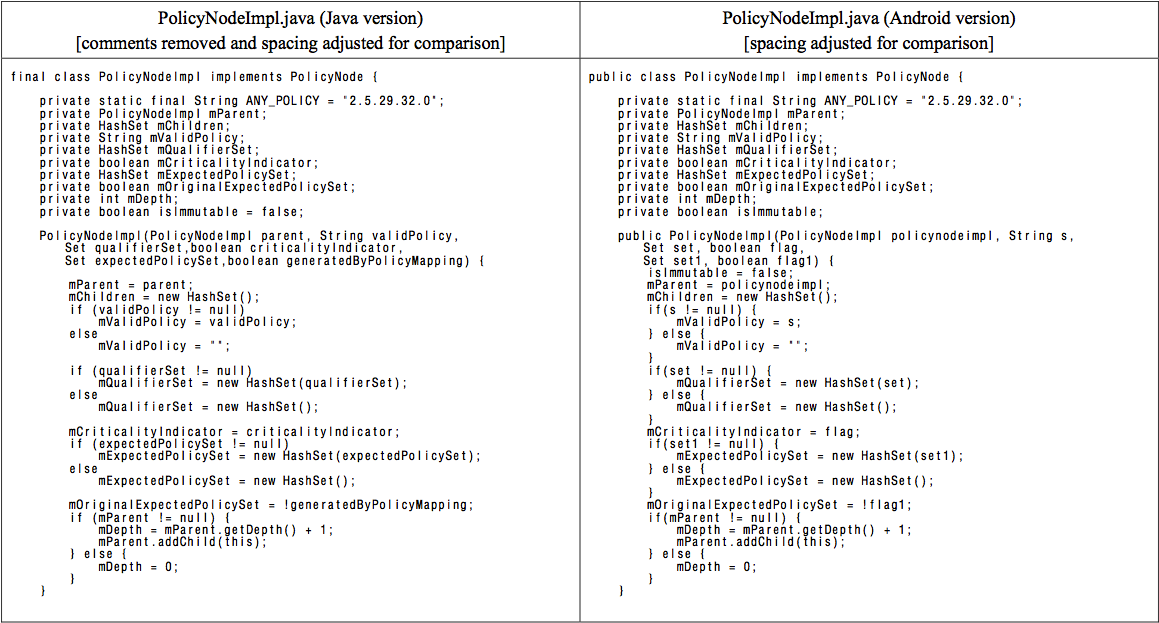
Oracle accuses Google of code lifting (click to enlarge)
The seven files - one identified by Oracle, six by Muller - were from the "unit test" area of the Android open source code tree. Unit test code doesn't typically ship with a final product, and the files have since been deleted from the tree. But they were apparently open sourced by Google under a license incompatible with Java's. And as Muller points out, some source packages from major Android OEMs, including Samsung, LG, and Motorola, included these files as well.
"The fact that Oracle successfully opposed Google's motion and the statements made by Oracle in that context certainly show that I had a point about the copyright part of the case. That said, the patent part is the one that Google must be more worried about," Muller says. Many had dismissed his claims because the files were found in Android's unit test area.
Android's Dalvik virtual machine is based in part on code from Apache's Project Harmony, an open source implementation of Java that Oracle has not granted a license for use on mobile devices. But Apache has pointed out that the file pinpointed by Oracle is not part of Harmony.
Oracle's letter indicates that more copyright evidence will be revealed later in the case. "Oracle’s copyright infringement contentions ... represent only a snapshot of our case taken at the time they were submitted," it says. "Google has not yet produced all of its source code – and none of its proprietary code. Nor has Google produced the requested change log for its source code repository.
"Moreover, when we take depositions of Google’s developers, we anticipate uncovering the full scope of Google’s copying."
Oracle says that some Google developers were previously at Sun or otherwise had access to proprietary Oracle materials. "A plaintiff may prove copying by showing that a defendant had access to the copyrighted work and that the accused work is substantially similar to it," the letter says. And it cites as precendent the 1994 Apple v Microsoft case in which Apple tried to prevent Microsoft and HP from using GUI stuff similar to the Mac and Lisa. Apple's case, it should be noted, was largely unsuccessful.
But Judge Willliam Aslup will hear both the patent and copyright portions of Oracle's case. Google had asked to file a summary judgment in an effort to dismiss the copyright claims. But Aslup didn't bite. "Plaintiff Oracle opposes Google’s request on the grounds that the proposed summary judgment motion 'is neither ripe nor well-taken'," he wrote.
"Having considered both parties’ submissions, this order finds that good cause has not been shown to engage in a summary judgment battle at this time. Google’s request is DENIED without prejudice to renewal after a more complete evidentiary record has been developed through discovery.
The denial came just hours after Oracle's letter was filed. ®
 Biting the hand that feeds IT

