Apple rips mobile PC crown from HP
Fondleslabs included
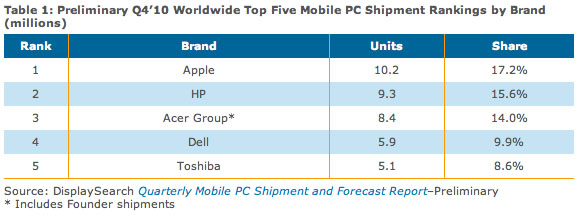
Apple has vaulted to number one in worldwide mobile-computing market share in the fourth quarter of 2010 – leapfrogging both HP and Acer – thanks to the surging popularity of its "magical and revolutionary" fondleslab, the iPad. At least that's the word from one research outfit.
"While we anticipate increased competition in the tablet PC market later this year with the introduction of Android Honeycomb-based tablets," said analyst Richard Shim when announcing the DisplaySearch study that named Apple as number one, "Apple's iPad business is complementing a notebook line whose shipments widely exceed the industry average growth rate."
Sharp-eyed Reg readers will notice that Shin said "tablet PC", not merely "tablet". Although there may remain some disagreement among many as to whether tablets should be counted as PCs, DisplaySearch displays no such doubt.
Is Apple's iPad a 'Mobile PC'? We report, you decide
You'll also notice that Shin gave props to Apple's MacBook, MacBook Pro, and MacBook Air lines, as well: the DisplaySearch study notes that sales-growth rates of Apple's notebooks continue to "exceed the industry average".
Apple's winning 17.2 per cent market share is no squeaker. Its 10.2 million units sold in the quarter are nearly one million above HP's 9.3 million, and a full 1.8 million above Acer's 8.4 million. Number-four Dell sold a comparatively weak 5.9 million mobile PCs, and number-five Toshiba came in at exactly half of Apple's sales.
Apple's sales grow was rapid. In the third quarter of 2010, Apple sat in third place in market share at 12.4 per cent, behind HP at 17.3 and Acer at 16.5.
Acer's numbers, in fact, were juiced by sales resulting from its partnership with the Chinese manufacturer, the Founder Technology Group, which it entered into last May to give it a leg up in the Middle Kingdom.
In the fourth quarter of 2010, overall mobile PC sales hit 59.6 million, the highest since DisplaySearch started counting them in 1999. That number represents a 17 per cent growth year-on-year, and a healthy 8 per cent growth in that iPad gift-giving holiday quarter alone.
But it was tablets – well, the iPad, actually – that fueled that growth: notebooks grew an anemic 1 per cent year-on-year.
Apple has clearly benefitted from what DisplaySearch calls its "first-mover advantage", essentially owning the tablet market by itself. Sorry, fans of the Samsung Galaxy Tab and Dell Streak, but you know it's true.
This year, however, will be different as the Motorola Xoom, HP TouchPad, RIM PlayBook, and a host of others jockey for some of that worldwide tablet (PC) action.
Whether the numbers look different by this time next year, however, is anyone's guess – and we're guessing "Yes." ®
COMMENTS
Virus proliferation
It's funny that people genuinely believe Mac/Linx/UNIX's security must be the result of security by obscurity. The security comes from the OS creator's worldview. Operating systems that have multiuser lineages will inherently have greater security than those developed from a single-user, not networked history. UNIX and its derivatives (Linux, Mac OSX, etc.) limit the user to a specific set of resources, directories, applications without limiting the user experience. Those functions, files, applications to which a user is authorised operate precisely as the permissions allow while great restrictions are applied to everything else. Basically, restrict everything that isn't explicitly allowed.
Windows and Mac OS 9.x and below operate under the premise that the system user should have unfettered access to everything at all times. Viruses/trojan horses can proliferate because all is permitted except that which is explicitly forbidden. It's the "you can opt out, but we'll just turn this on for you" mentality that exists in Facebook as well.
The evidence does not support the obscurity argument. At the launch of OS X ten years ago, the Mac's share of the PC market was around 3.5%, which is a little less than half of today's, yet there are somewhere around 100 identified viruses that attack OS 9.x.x and below, but fewer than five bona fide OS X viruses/worms. There are certainly weaknesses to any OS, but the core weakness to Windows is the mentality of its origin. Windows 7 has finally improved the situation to some extent, but still defaults to a userstate with full control.
---
This message contains the linux virus. Please mail it to your contact lists, then use superuser permissions to delete all your data :)
You can make numbers say anything you want
Such dramatic language - 'rips' - is intended only to garner readers.
Notebooks are hardly on a par with tablets/pads particularly when you consider Cupertino products are crippled in both content and their use.
No one tells the millions of owners of non-fruit products what they can and cannot do so comparing them as whole genres is pretty pointless.
It's like Michelin, BF Goodrich or Goodyear counting rubber wheels for tea dolleys and claiming their production was more than a competitor. Or auto manufacturers counting pick-up trucks as passenger vehicles.
Still analyst Richard Shim and DisplaySearch have maintained their positions on the free sample, special access and by invitation only presentations which really throws the value of the information into doubt.
iPad mobile computing?
Well, let's face it, if the iPad is a mobile computer, then what would make the iPod touch not a mobile computer, and to that extent the iPhone? If so surely Apple took this title years ago!
What i would like to see apple do now, is a dual boot laptop (iOS and OSX) with a touch screen, that can be manipulated to be a tablet. The best of both worlds :) You can boot into iOS as a tablet in order to play Angry Birds, or which ever game of choice you wish to play (well, lets face it, rarely do i ever see an iPad used for anything different!), then boot up into OSX as a laptop to actually do some work.
Hand up
>as the Motorola Xoom, HP TouchPad, RIM PlayBook, and a host of others jockey<
So where in tarnation are all these iPad beaters, the notion ink in particular. With the recent rise in even more Apple evilness I'm starting to feel a bit dirty owning an iPad... I would (and will) sell it, but only when something better comes along.
I want to support any company other than Apple but they're not making it easy for me.
Nokia are number one
Nokia are the number one mobile computing company - it's unclear why tablets that run a phone OS are included, when smaller (hence, more mobile) smartphones are not.
And when Apple's share inevitably falls due to the arrival of many Android tablets, are we going to have endless doom and gloom articles (even if they're still the alleged number one)? That's how it's always reporteed for Nokia, after all...
