


This article is more than 1 year old
Microsoft and HP Frontline marriage births appliance iron
Anything Oracle or Cisco does, we can do better

Hewlett-Packard and Microsoft have started rolling out server appliances configured for specific jobs while also lifting the veil on future appliances due later this year.
Almost precisely a year ago, HP and Microsoft dedicated $250m to create a partnership nicknamed Frontline to come up with stacks that married HP's x64-based servers and various storage and networking devices with Microsoft's Windows operating system and various add-on server programs for running particular workloads.
The idea is to provide finished products geared for precise workloads and specific numbers of end users rather than having customers size and integrate hardware and software themselves as they have done in the past.
The Frontline partnership came in the wake of Oracle buying Sun Microsystems and talking up its own integrated hardware/software systems, and Oracle dropping HP as its hardware partner for its Exadata V2 online transaction processing and data warehousing appliances.
It was also a reaction to server wannabe Cisco Systems teaming up with hypervisor juggernaut VMware and its storage-heavy parent, EMC, to peddle virtual hardware and software stacks as integrated products.
What HP and Microsoft did not do with the Frontline partnership is come up with memorable names for the appliances, which all sound the same and that skip right off your skull.
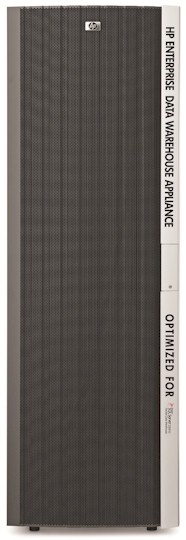
The first product of the HP-Microsoft alliance was the HP Enterprise Data Warehouse Appliance, which was previewed in November last year. The EDW system pairs HP's ProLiant servers, its StorageWorks disks, and various switches with Microsoft Windows Server 2008 and SQL Server 2008 R2 Parallel Data Warehouse, a parallel clustering add-on to SQL Server that came from Redmond's acquisition of Datallegro.
The HP Enterprise Data Warehouse spans from 38TB to 500TB of usable data capacity, a control rack and between one and four data racks that have up to 40 ProLiant DL360 G7 two-socket Xeon servers managing the data stored on MSA P2000 arrays. Control nodes in the cluster, which are in a separate rack, are based on a mix of BL360, DL370, and DL380 G7 rack-mounted servers and PS2000 G3 storage arrays. The HP EDW has a starting price of just under $2m for a base configuration and is shipping today. The price includes three years of support.
HP and Microsoft are also putting out an adjunct node for this clustered data warehouse, called the HP Business Data Warehouse Appliance, which links back to the mother data warehouse in a spoke-and-hub fashion, allowing for departments and lines of business at larger organization to have a subset of the data stored back on the mother data warehouse be dispatched to a local appliance for further dicing and slicing.
This appliance is based on HP's ProLiant DL360 G7 servers as well, but tops out at between 3TB and 6TB of local data storage. It runs Windows Server 2008 and the plain vanilla SQL Server 2008 R2 database management system and will ship at the end of this quarter. Pricing information was not available for this baby BDWA appliance or its EDW mother.
One of the new Frontline appliances that was announced Wednesday - and which is shipping now with a price even - is the HP Business Decision Appliance. This appliance is based on a single ProLiant DL360 G7 server with two Xeon 5650 six-core processors, 96GB of main memory, and eight 300GB SAS disks for a total of 2.4TB of disk storage.
This appliance is equipped with Windows Server 2008 R2, SQL Server 2008 R2, and SharePoint 2010 and it hooks into the PivotPoint feature of SharePoint that allows end users to work from within Excel to dice and slice data stored in the appliance.
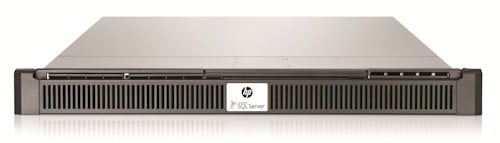
The Microsoft-HP Business Decision Appliance
Doug Leland, general manager of product management for the business platform marketing group at Microsoft, told El Reg that the base hardware for the Business Decision Appliance runs at $28,000, and that a setup with licenses for 50 users to hammer on the SQL database to do what-if scenarios from within Excel would cost just under $60,000.
Leland said this was a "very aggressive" price compared to alternatives out there in the market. This appliance is shipping today, although I wonder why this took a year to come to market. The box cannot be clustered and run in parallel to boost its performance or capacity. You can see a demo of it here.
The HP E5000 Messaging System for Microsoft Exchange Server 2010 is another appliance that will be shipping before the end of this quarter. This appliance is ready-to-go to run Exchange Server email and groupware workloads, and can support from 500 users with 1GB mailboxes up to 3,000 users with 2.5GB mailboxes. The exact feeds and speeds of this Frontline appliance and its pricing were not divulged by HP and Microsoft.
HP and Microsoft have also cooked up an appliance with the name of the HP Database Consolidation Appliance, which plunks Windows Server 2008 R2, the SQL Server 2008 R2 database, and the Hyper-V R2 server virtualization hypervisor onto ProLiant servers, tosses in Systems Center management tools, and is designed specifically to consolidate "hundreds of databases" onto a single machine.
The precise configuration of this appliance was not divulged, nor was its pricing. It will be available in the second half of 2011, when HP and Microsoft plan to say more.
This last appliance is not to be confused with the private-label versions of the Microsoft Azure platform-as-a-service cloud that HP and Microsoft are working on. Dell and Fujitsu are working on such private Azure clouds as well, and all three vendors will be offering hosted versions of Azure clouds distinct from the official Microsoft Azure cloud at some point this year.
The channel partners of both HP and Microsoft are able to peddle these current and future Frontline appliances, but they have to get training first. So far, Leland said, more than 1,000 channel partners have participated in the training and are eligible to chase deals. ®
 Biting the hand that feeds IT

