
LG Optimus 7 smartphone
WinPho 7 handset with a DLNA difference
Review One of the problems with the recent raft of Windows Phone 7 handsets has been trying to tell them apart. Microsoft has kept such a tight rein on the specification for each handset running its reborn operating system that there isn’t really a great deal of room for manufacturers to manœuvre. They’ve all got a minimum of 8GB of onboard storage, a 1GHz processor, a large touchscreen and at least a 5Mp camera. Still, LG has had a go a diversifying by including it DLNA networking capability in its Optimus 7 E900 handset.
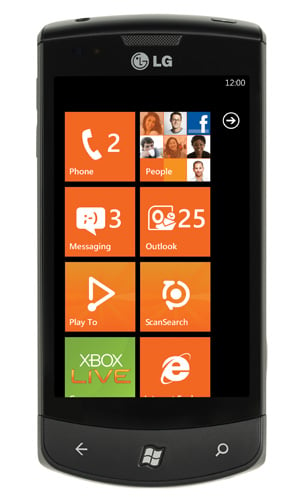
Trying to be different: LG's Optimus 7
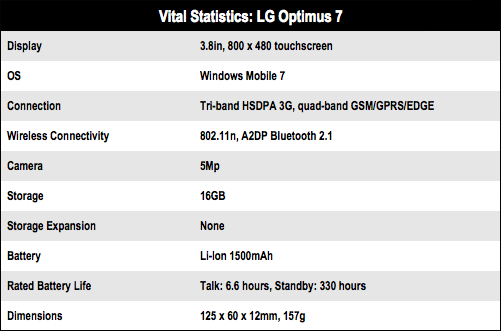
Measuring up at a fairly chunky 125 x 60 x 12mm, the LG Optimus 7 weighs 157g. The weight is due at least in part to the metallic casing, which gives it a bit of a premium feel. Unfortunately, the same can’t be said for the raised Windows button on the front which feels a little loose and cheap in contrast to the rest of the casing.
Around the sides are a volume rocker and camera button, with a micro USB power/sync slot covered by a plastic grommet. On top is a 3.5mm headphone jack and a teensy power/lock button. On the back is the camera lens, flash and self-portrait mirror encased in a neat little roundel on the aluminium back plate.
The 3.8in LCD screen includes multi-touch capability and is fast and responsive in use. It’s a goodly size – though it doesn’t cover as much ground as the HTC HD7’s 4.3in – and while it offers 800x480 resolution, it doesn’t quite match the AMOLED display on Samsung’s Omnia 7 for contrast and sharpness.
WinPho 7 is proving to be an interesting compromise between the flexibility of Google’s Android and the restricted ease of use of Apple’s iOS. Out of the box, the tile-based system is straightforward to get to grips with and while you can rearrange the tiles to suit yourself, there are no power-hungry widgets to drain your battery.
Next page: One way network
COMMENTS
@Monty Burns
...not sure about that, but it's not like MS only wrote one set of drivers - OEMs can obviously still select the size of the screen, camera type & quality (e.g. the Mozart has a xenon flash at 8mp, whereas others have an LED flash and 5mp), amount of on-board memory (up to 32Gb is doable, apparently) presence of a physical keyboard (or not) etc. as well as non-driver related things like the style & quality of the phone's case.
AFAIK, Just about the only thing I think the OEMs don't choose (at the moment) is the processor, which has to be a Snapdragon (though it seems future releases will support a broader range of processors).
The real shame is that the OEMs didn't go all-out, though their lack of faith in WP7 at this stage is sorta understandable.
@AC
"Severly scarred by operator customisations"... I know what you mean, but have you actually used one? I have a WP7 on Orange (though it's a Mozart rather than an Optimus) and any Orange apps I don't like get booted off the "Start" screen in a jiffy (they'll stay in the list of apps in case I ever need them - it turns out the Orange Wednesdays app is actually kinda nifty). Similarly, you can change the Orange default colour scheme (though the Orange apps will remain their original colour).
... the bottom line is, WP7 was designed so that any network operator or OEM add-ons (e.g. the HTC hub) can be retained by the user if they're useful, but can't "force" themselves onto the user's Start screen if he doesn't want them there. Hence "scar" is probably the wrong word. "Creased" is mre like it.
Is this the same Apple...
... whose "fully rounded product" wasn't correctly designed for the human hand?
LG may have fallen short of perfection here, but at least when trying to design a wonderful, stylish phone they realised that the "phone" part was the most important.
Buttons
The buttons on this phone were the reason that I opted for the HTC trophy.
DLNA
Not sure DLNA is a particular selling point, as Android does DNLA - at least my HTC Desire does (Menu > Select Player in Music, and I can push straight to a Sonos device for example)
