
Arcam Solo rDac wireless digital-to-analogue converter
Stream spirit
Review Wireless music systems are commonplace nowadays, but some folk still prefer to use a standalone digital-to-analogue converter to liberate their digital music library, and these are the punters Arcam is pitching its Solo rDac at.
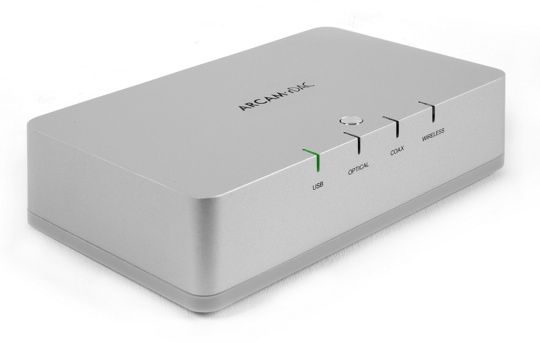
Arcam's rDac: minmalist styling
As you might expect from an up-market British audio kit maker like Arcam, the rDac's look is minimalist, with no controls other than a power switch at the back and a few status LEDs on the front. It's well made, though, with a very solid aluminium shell.
Round the back you will find type-B USB - for feeding the gadget from a computer, rather than a USB Flash drive - plus optical Toslink and gold-plated SPDIF coaxial inputs, making the rDac a piece of cake to connect to a wide range of sources. Output is via two gold-plated RCA phono sockets.
One other input is invisible: the rDac can take a wireless feed from Arcam's rWand and rWave. The rWand connects to your iDevice's 30-pin dock connector, while the rWave is a USB dongle. Both are sold separately for around £70.
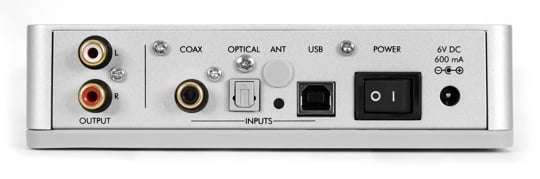
No shortage of portage
Connected wirelessly, the rDac will only support files encoded at 16-bit/44.1kHz, but use the coaxial socket and those numbers increase to 24-bit/192kHz. In between, cabled USB tops out at 24/96 and optical at 24/48.
Next page: Dynamic audio
COMMENTS
Audiophile stuff
I for one am highly suspicious of statements about quality being an "order of magnitude" better, which has a mathematical, not subjective definition. It's quite amazing that when properly set up double-blind testing is carried out, a lot of these differences suddenly become undectable.
As for gold plating digital connections. Well, I suppose it looks pretty and if you keep your audio equipment in a damp cellar, then it might prevent corrosion, but it makes sod-all difference to sound quality. It will basically either work or not without much inbetween, like pretty well all digital communication.
Not to say that bad DACs don't exist, but if they do, then it's objectively measurable with proper instrumentation. Any properly equipped audio lab would be able to measure how accurately the analogue output tracks the digital data for a lossless feed. However, obhective measurements like that don't sell over-priced electronics to gullible members of the public...
From the second link
"extremely precise dacs can be very unforgiving and too-controlled sounding, while other dacs can be extremely musical."
<sarcasm>Yeah, and my arse can be extremely musical too.</sarcasm>
Testing
Not entirely sure I don't prefer a reviewer to use his or her ears when testing audio kit. A string of numbers, stats and oscilloscope screen grabs may get some of you all moist but at the end of the day all most normal people are interested in is how it does the job and how does it sound compared to other similar devices. I'd say the Reg got both those boxes ticked quite succinctly.
It's all down to the quality of the interconnects...
'Swapping the rWave dongle for a USB cable didn't have any noticeable impact on sound quality'
That does surprise me. Especially when you consider that the sound quality would be adversely affected by the quality of the air you are using.
For future tests, might I suggest you try using cleaner air? 'Air dusters' that 'dust' the air for you can be bought from places like Maplin. Expensive, but well worth the cost IMO.
USB
"the rDac uses audio specialist Data Conversion Systems' (dCS) asynchronous USB system"
Err, all USB audio is asynchronous. It has to be, otherwise it doesn't work. I suspect it's actually just a Texas Instruments USB<->I2S chip, and an upsampler chip by dCS.
