The Register® — Biting the hand that feeds IT

Feeds

Flash is not that reliable

Fails slightly more often than hard drives

  • print
  • alert

Magic Quadrant for Enterprise Backup/Recovery

Flash fails more than disk. Mac Observer cites a French website showing hard disk drive failure rates (1.94 per cent) were slightly better than solid state drive failure rates (2.05 per cent).

Hardware.fr obtained its component failure rate statistics from an unidentified retailer's repairs and returns database. The hard disk drive and solid state drive (SSD) failure rates were extracted from this data and overall failure rates calculated.

The source data showed the supplier, capacity and model of disk drive, but only the supplier of the SSDs, not their capacity. Also the type of failure was not revealed; some disk drives may have been repairable.

When higher capacity disk drive failure rates were compared to the SSD rates, the findings reversed: HDDs failed more often than the flash drives. We have graphed 2TB disk drive failure rates against those of the SSDs and, with one exception, the SSDs failed less often.
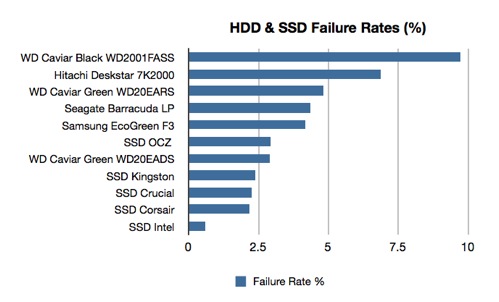
HDD_SSD_Failure_rates_with_2TB_HDD

SSD failure rates compared to 2TB HDDs

The picture is less clear-cut at the 1TB disk drive level. If we had graphed the 1TB disk drive failure rates these would have shown seven disk drive products failing less often than the worst SSD, the OCZ, with a 2.93 per cent failure rate.

This is just one retailer in just one country, so, although it shows that generally SSDs fail more often than disk drives – except with higher capacity drives – and that Intel's SSD failure rate is markedly lower than its competitors, the data should be taken as indicative and not gospel. ®

Agentless Backup is Not a Myth

Dissapointed

I was looking forward to an article detailing how Adobe Flash causes drives to fail.

9
0

Err... What is defined as a failure?

What is defined as a failure?

Brick/Doorstop style failure? Uncorrectable read error, but otherwise relocatable (by SMART) sector with the user returning it because they do not know how to fix it? Or what?

IMO even the 1TB WD Caviar Green EADS which is one of the better performing 1TB drives has waaaay higher sector deffect rates than many drives of old.

Out of the two I have in my home server, one has already produced 26 sector relocations within 1.5 years. For a comparison the 2 x 250GB Maxtors I had before that had 0 relocations in nearly 3.5 years and are still trucking along in their 5th year and counting.

5
0

Apples and Oranges

Without knowing the size of the SSDs this is meaningless. If I've got 2TB of data to store then for a meaningful comparision I need to know what is the chance of a failure occuring somewhere in the big pile of SSDs I'd need to store that data. Without knowing the SSD capacity I don't know how big that pile is...

2
0

More from The Register

SCO vs. IBM battle resumes over ownership of Unix
Zombie lawsuit back and wants to suck the brains out of Linux
 breaking news
You don't need phone lines or cable for ANYTHING, says Dish
The satellite-dish man can sort you out with phone and broadband over the air too
 breaking news
What's HP got under wraps? Looks awfully flash and tape shaped
What happens in Vegas won't stay there - we've got the details
AMD lifts the veil on Opteron, ARM chip plans for 2014
Not much action going on in 2013, though
Microsoft borks botnet takedown in Citadel snafu
Stupid Redmond kicked over our honeypots, wail white hats
IBM's $1bn layoffs latest: Now axe swings in US, Canada - reports
Union claims 121 storage bods canned after dismal sales
NetApp musters muscular cluster bluster for ONTAP busters
Storage array OS overhauled to juggle more nodes, go down on you, er, less
HP adds 'Haswell' Xeon E3s to entry ProLiant servers
Gussies up MicroServer for SMBs, adds baby switches