
Samsung Omnia 7
Big display for Redmond's redial
Review Samsung's Omnia 7 is one of a handful of Windows Phone 7 devices that have gone on sale this month, and is certainly one of the largest owing to its impressive 4in touchscreen. Yet, there's something about the 1980s to the look of this phone.
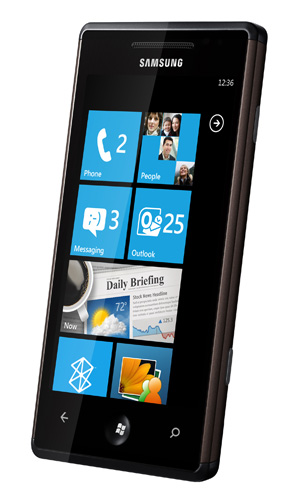
Quite a handful: Samsung's Omnia 7
Maybe it’s the bevelled edges with their sharp drop off, or the very squared corners. Still, the bevelling makes the handset feel a lot smaller than its 62.4mm width would imply. The back is more gently curved, again making the handset feel less bulky, which is to be applauded given that it's a very large handset, even for the smartphone world.
Most of the specifications are laid down by Microsoft and – rather than go over them again in this review – they are covered in detail in my recent Windows Phone 7 OS appraisal here. Using the Omnia 7, this feature covers most of the handset's smartphone functions. Part of the spec is a screen resolution of 800 x 480, supporting capacitive touch for up to four fingers. Indeed, there’s not much innovation permitted, as all the buttons, controls and interfacing is laid down by Redmond. Suffice to say that Windows Phone 7 on the Omnia chugs along nicely.
The centre, Start, key is physical on the Samsung, but the Back and Search buttons (also on the front of the phone) are touch panels which respond smoothly. Side-mounted buttons manage volume, power and the camera – just as on all the other Window Phone 7 handsets. On top there's a standard microphone socket, and a small sliding door covering the micro USB socket used for charging and connecting to a PC.
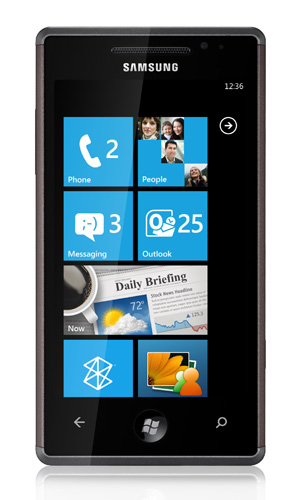
Robust and responsive
The back is part metal and part plastic – not the cheap wrapping that blights the back of the Galaxy S – being a rather more robust plastic that feels a lot more solid in the hand. A clip slides back to release the battery cover and Sim slot, though no removable storage – apparently Microsoft doesn't approve of such things.
Next page: Wireless invention
COMMENTS
FYI
For the information of the reviewer, Microsoft DOES allow SD cards and some phones such as the Focus and Dell Venue Pro do indeed have SD card slots supporting up to 32GB, which, combined with the 8GB internal storage, yields a mammoth 40GB in total.
The Omnia 7 does not have an SD card slot, but that was Samsung's decision, not Microsoft's. Please get your facts right. You're the professional, I'm just a punter. If I can get it right, so can you.
@whiteafrican
"And what on earth are you doing on your phone that requires frequent use of copy-and-paste anyway?"
smart phone can do much more than talking to mother on it, you should really try it
seriously ... come on !
Viewing an email, want to take a paragraph to text it to someone
picking up a phone number to paste in a mail or a note
taking a picture to compose a nice little blog entry
picking up a url to add to a twitt message
swapping text in general between several apps
Don't bother using a smart phone if you never needed once to copy and paste.
New test framework?
I could be wrong - it's not unheard of - but I'd say that the Reg's audience is likely to use some of the more powerful aspects of this (or any) smartphone: the email capability, the internet, texts and so on. Rather than having a page of sample photos, could you tell us how useful (or otherwise) it is for more power users; and whether for lighter users it has sufficiently low-brow things like Facebook and Twitter covered well enough? (All IMHO, of course, and reflecting what aspects I'd tend to look for in a smartphone)
standarised
Im confused; with Microsoft imposing a strict feature set on their partners, how any of them are going to differentiate themselves - as effectively they are all now competing for the same niche in the market.
Standard MS business practice
Commoditize the hardware and make your OEMs compete on price. If you have a working monopoly this is great because you can charge what the market will bear for the OS and let your OEMs battle it out to reduce purchase costs to the consumer while all the time you let the unknowing consumer believe that they are getting your overpriced and under performing product for free because they aren't aware of (and are not offered) whatever alternatives that may exist.
This is exactly how the PC industry works today.
It won't work here of course as MS don't have anything *like* a monopoly in the mobile market.
