
Panasonic TY-CC10W Skype camera
Video conferencing for couch potatoes
Review While purists might prefer a standards-based approach to Internet telephony, there’s no doubt that, for many people, Skype is much simpler to set up. Even so, with a few exceptions, most equipment is still tethered to a computer, especially if you want to use Skype’s video calling.
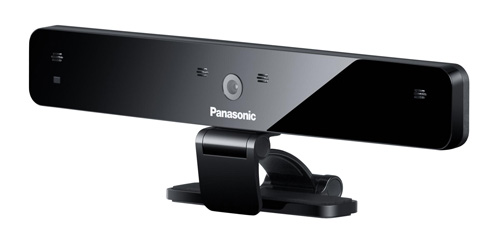
What's on TV? Panasonic's TY-CC10W Skype HD webcam
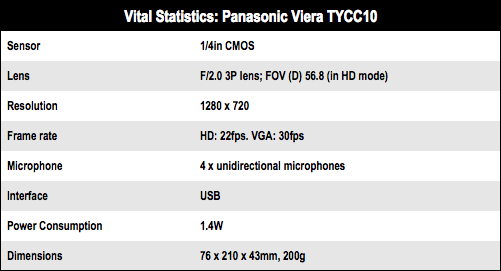
Panasonic’s Skype camera is intended to help make that less of an issue; combined with the latest VieraCast on some 2010 TV models, the camera brings video calling into the living room. It’s a wide, thin camera designed to sit on top of the TV, with a wide-angle lens and four microphones.
The idea is to capture everyone on the sofa, and provide decent quality sound, from a normal viewing distance, video-conferencing style. The camera connects to one of the USB ports on the TV, from a generously long cable, and the clamp-style base allows positioning on top of the set, or elsewhere.
Skype is accessed using the VieraCast button on the remote. After selecting the application, you can then configure it on-screen – including an option to start automatically. The main screens provide a list of options down the left, with familiar Skype icons for contacts, calling phones, settings and so on.
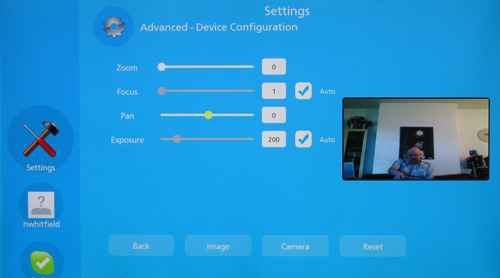
Alongside the usual Skype privacy settings, you can also pan and zoom the camera
Selecting an option gives more choices in the centre of the screen and, on the whole, it’s very easy to navigate using the remote. The camera – which worked, incidentally, when plugged into my Mac too – can be panned a little left and right, making use of the wide-angle lens, so you don’t need to shift the TV too much.
Next page: Picture this
COMMENTS
Ah - I see the internet's big brains are all over that idea...
ZDNet wrote an interesting blog about the convergence of facetime and this sort of webcam
http://www.zdnet.com/blog/government/facetime-could-be-apples-itv-killer-app/9311
So - how long before we see Apple TV with a similar plug in camera
Now we've seen the Apple TV tear downs exposing an A4 processor, decent RAM and 8GB of flash inside the Apple TV, isn't it only a matter of time before facetime hits the living room via a similar webcam device... interesting.
As someone who skypes often with my partner to other couples or family, I think sofa to sofa makes much more sense to me than having four or more people crowded around a couple of PCs so there is a really good usage case for this. A niche - but potentially a decent sized one.
This panasonic device and its like are likely the thin edge of a wedge.
Cool but meh
I recently acquired a panny plasma, though not the latest skype model, along with a sound system and an asrock 330 box which is running xbmc, and one of my first thoughts was how perfect this kind of setup would be for my technologically-challenged parents; Skype is in the middle of open-sourcing their interface for their linux client, and when that comes to pass it shouldn't be too difficult to include skype as a plugin for xbmc, and it being a proper computer means I would be able to hook up any combination of webcam/mic and video-call anyone and not just tv users (:
h264 codec
we have two of these, connected to panny plasmas in two offices
the camera has its own h264 encoder chip, and so you can only talk to clients with h264, which is why you can't talk to mac or linux and get video, only audio
the same problem exists, so I believe, with the samsung version
in theory the mac skype client will be sorted out some time
the skype client works OK, but there's none of the conferencing facilities of the full desktop client; you can add/delete contacts so you don't need to set up the account on a full computer first.
the camera is the same price in US$ as it is in GB£, so you can save a bundle if you know anyone visiting the USA.
@L1feless
Oddly, for someone who wears a metaphorical tinfoil hat, I've never cared whether Skype was encrypted or not. Maybe it's getting so used to assuming some guys in North Yorkshire have been running my conversations and email through patter-matching algorithms for years, or perhaps it's because I don't really care if anyone hears my usually inane babbling to my mates.
