
Olympus LS-5 linear PCM recorder
Sound idea?
Review The Olympus LS-5 is a solid-state stereo audio recorder with 2GB internal storage and support for SDHC card expansion up to 32GB. About the size of a domestic phone, it looks the business and also looks strikingly similar to the LS-10 Reg Hardware reviewed a couple of years ago. Indeed, the blue hue of the LS-5 is really the only giveaway here.
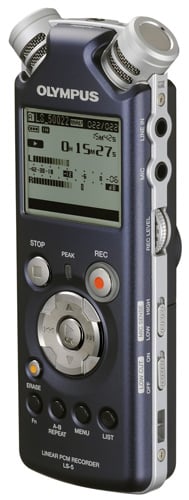
Listen again: Olympus' LS-5 portable audio recorder
So what’s the big noise about this recent addition then? As far as spec comparisons go, blink and you’ll miss it. The two recorders are pretty much identical in terms of operation and performance. The chunky built-in angled stereo mics can capture uncompressed WAV audio at 96kHz with a 24-bit resolution dropping down incrementally to 44.1kHz/16-bit.
For longer recording times, MP3 recording is available at 320, 256 and 128kbps. And if you really need to push it, there’s WMA at 160, 128 and 64kbps. New with the LS-5 though, is mono recording. This slices the file size in half, effectively doubling the recording time. Choosing mono will record the lowest resolution for the selected file format, alas, you can’t notch up a 96kHz/24-bit file in this mode, but with the internal storage alone, you can record for 26hrs 40mins in WMA mode, but would you ever listen back?
The LS-10 has a remote control as standard now, but the LS-5 goes without. It doesn’t include the protective zip-up pouch or Cubase 4 LE either, but instead comes with Sonority – Olympus’ own content management and audio editing application. As the modus operandi of the LS-series really owes a lot to the rather less ambitious voice recorders Olympus produces, don’t get too excited about Sonority.
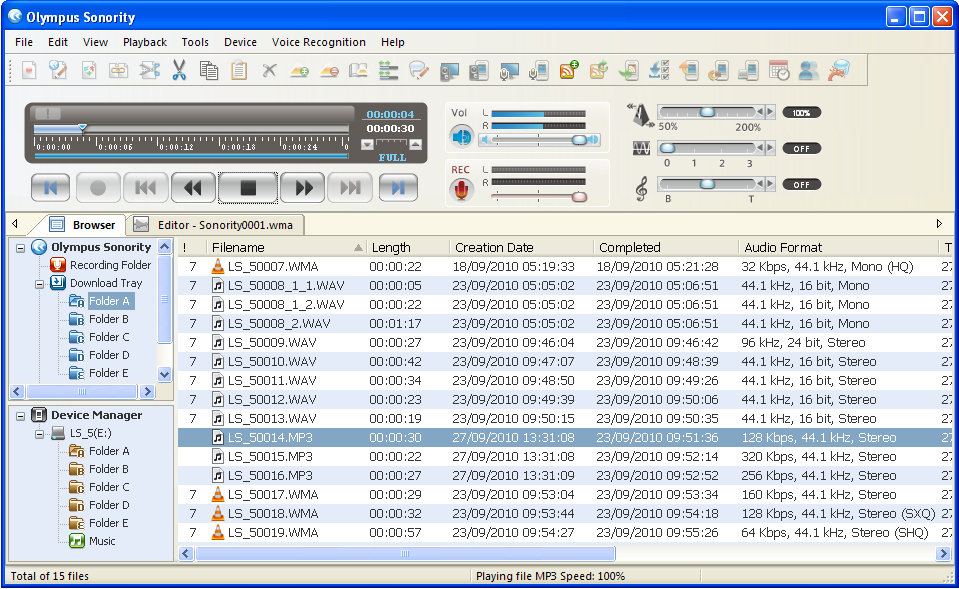
Still, it’s interesting to see that Olympus decided to go the extra mile with this application, as it supports both Macs and Windows PCs. A significant feature of the LS-5 is the device’s USB mode options: Storage and Audio. With the former, Sonority can access LS-5 files and transfer them – on the Mac, the internal storage also appears on the desktop, if you prefer to simply drag and drop.
Next page: Sound Check
COMMENTS
Re: "What a waste of effort"
If you want to make short, lossily compressed recordings on a dead medium, sure. *facepalm*
Yes, the H4n has balanced ins
It has balanced ins, with phantom power and reasonable mic preamps, a compressor/limiter too. It can also take hi-Z in (guitar etc), as well as 3.5mm mic in with plug in power support as needed. You can run it as four tracks- on-board mics and the two other ins also, if you want. As you'd expect, it works as a USB sound card too, or can mount as mass storage.. (though I prefer using a card reader). Stick a 4 gig SD card in and you're golden- there was one included free with mine.
My favourite use is to put it in "stamina" mode on a tripod (it has a tripod thread, and also a mic stand adaptor, as required), and leave it in sound activated mode (it has a short buffer, so you don't miss the start of any sounds)- can run for 24 hours like that, recording 44.1/16 wavs. Fantastic in places like woodlands, or near rivers (or even a roof in a busy urban area, if you like your city noise).
It's a great little unit for the price, for those of us who miss those broadcast grade Tascam DAT units of yesteryear.
comparing with Zoom
There are now 3 Zooms H4n, H2 and H1. Since they are designed for music recording, they might all be better for music than the Olympus range, which as the article points out, are for dictation.
The point on product improvement coming from reaction to criticism is well taken - maybe secretaries' don't get to have their voices heard?
Err
I am "industry", in one of the world's larger broadcasters. I am aware of what and what isn't used- and generally, we're weeding out shitty cascade coding where we can, and certainly MD isn't something we'd recommend.
Mono recording
WTF is the point of forcing mono recording to be at a certain bit depth/sample rate? As if people recording in mono don't want high quality sound? As if people - specifically musicians - recording in mono might not use this as a cheap 'n easy way to record both on and off speaker axis at the same time to get a richer, fuller sound? As if people recording in mono might not set the unit a good six to ten feet back to get a better spatial representation of whatever it is they're recording? Why would Olympus defeat having a mono mode by crippling it to a lesser quality? There's so much you could do with it!
What's the point here? "Oh, they're recording in mono, they must just want extra time! There's no way they're Phil Spector fans who think mono is tighter and punchier!" I'd say someone was asleep at the wheel here but - along with all the other idiotic design choices of this recorder - come off as Olympus biting their thumb at their customers.

