PARIS gets doped up
High as a kite on nitrates
Cloud storage: Lower cost and increase uptime
The model aircraft enthusiasts following our Paper Aircraft Released Into Space (PARIS) programme will be relieved to learn we've finally cracked the Vulture 1-X skinning poser.

Last month we spent a not inconsiderable amount of time faffing about with various methods of cladding our aircraft, including a PVA/water mix applied to tissue paper, laminated tissue paper and bog standard photocopier paper.
All of this got you lot protesting that we should get some shrinking dope and give that a blast, so that's exactly what we did.
We tried attaching the tissue paper to the test frame with both PVA wood glue and epoxy - the latter since we're a bit concerned about the performance of the former under extreme conditions.
Both worked satisfactorily for fixing the tissue paper, and here's a PVA-fixed section of skin after two coats of dope:
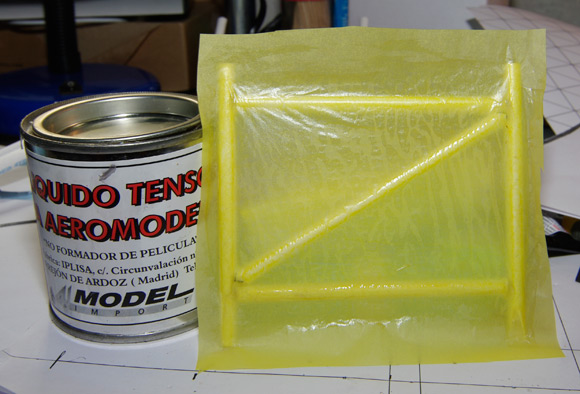
A pretty good result. For key areas requiring extra strength (tail, nose, wingtips, leading edges, etc), we're experimenting with bonding the photocopier paper to the structure with epoxy, and then doping it. Don't start moaning, about the weight - we're not talking about many extra grammes here.
Suffice it to say, though, we can now stop sniffing nitrates for a bit and get on with completing the Vulture 1-X structure. Our next challenge is to put together the tail and (shudder) the wings, which are proving challenging to say the least. ®
Additional PARIS resources
- Our dedicated PARIS section, with all previous updates, is right here.
- New to PARIS? We have a basic mission summary here (pdf).
- Our fledgling Flickr page, with all previous photos.
- Check out our YouTube channel - currently featuring a few camera tests.

COMMENTS
Reinforced tissue
I wouldn't bother with photocopier paper: its made of fairly short fibres, which means its weak, and full of inert fillers which are heavy and don't add any strength. Finally, nitrocellulose dope won't penetrate it very easily. The better answer is to dope on another layer of tissue when the first is dry. The dope in both layers will stick together and proper model covering tissue is strong for its weight due to the longer fibres in it. In the days when you could still buy both heavy and light modelspan we knew that double covering a wing with two layers of light modelspan was easier, stronger and lighter than using a single layer of heavy model span. As a bonus, you get a much smoother surface too. Some covering tips:
- don't use the dope at full strength. Thinning it 50:50 with cellulose thinners makes it a lot easier to work with because it wets the tissue more easily. Two or three coats of 50:50 dope will completely fill the pinholes in the tissue.
- wetting the tissue with a damp cloth or spraying it with water will make wrinkle-free covering much easier. Or, put the tissue on dry using dope to stick it to the framework. When the dope has dried, spray the tissue with water. Let it dry out completely, which gives a nice, smooth covering, and only then brush on the first coat of dope. Let each layer dry and the solvent evaporate before applying the next. One coat a day gives a much better result than two or three in a day.
- well doped tissue is extremely weatherproof - over the years balsa and tissue models have been flown on ice and in rain during competitions many, many times. If they are well doped you get little or no water in the wings even when its pissing down.
In case you're wondering, I'm not suggesting the above to save weight though it will. I still think weight is fairly irrelevant to your mission compared with the strength and torsional stiffness of the airframe. Properly doped double covering adds a lot of stiffness. You'll be surprised how much stiffer a tissue covered wing is compared with the bare structure.
Would FR-2 be cheating?
As in the stuff cheap consumer pcbs are made off? It's called "synthetic resin bonded paper" and according to me Wiki Powers the clue is in the title. Triangles and struts ahoy!!! Dammit - I want wee missiles under the wings - it might even help with the C of G and stability thing etc
Wet wet water...
That's the way to do it - gentle mist spray of water and let it dry to shrink the tissue, then (thinned) shrinking dope to taughten it, then (thinned) non-shrinking dope when it's tight enough. Too much shrinking dope though will crush the supports...
As it happens, just got back from the model shop with half a litre of various dopes and thinners.
On a side note - am I the only one concerned that there may be issues with the *electronics* pack cooling down too much? Batteries in particular? I rather think you may need at the very least insulation around the payload, and possibly a heating element too.
Who do you know with an industrial freezer? -20C minimum? Although... at high enough altitude the heat loss may be more from radiation than conduction/convection to air. Any experts here?

Agentless Backup is Not a Myth
Steps to Take Before Choosing a Business Continuity Partner
Requirements Checklist for Choosing a Cloud Backup and Recovery Service Provider
Cloud storage: Lower cost and increase uptime
SaaS data loss: The problem you didn’t know you had