The Register® — Biting the hand that feeds IT

Feeds

NASA's WISE eyes skies

Wraps first complete heavenly survey

SaaS data loss: The problem you didn’t know you had

NASA's Wide-field Infrared Survey Explorer (WISE) has completed its first survey of the entire sky, having spent six months snapping over one million images of the heavens.

Edward Wright, the principal mission investigator at the University of California, enthused: "Like a globe-trotting shutterbug, WISE has completed a world tour with 1.3 million slides covering the whole sky."

To celebrate the event, NASA has released a fine picture of the Pleiades star cluster - actually a photo mosaic made up of "a few hundred image frames":
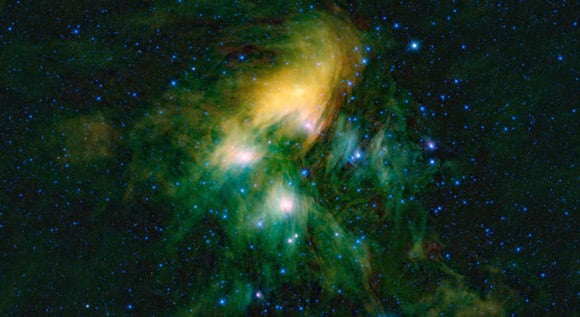
The Pleiades captured by WISE. Pic: NASA

The agency explains: "Color is representational: blue and cyan represent infrared light at wavelengths of 3.4 and 4.6 microns, which is dominated by light from stars. Green and red represent light at 12 and 22 microns, which is mostly light from warm dust."

Operating at an altitude of 525km, WISE passes over the poles 15 times a day taking a picture every 11 seconds through its 40-cm (16-inch) telescope. To date, it has captured over 100,000 asteroids, including more than 90 new near-Earth objects.

It's also peered at distant luminous galaxies and brown dwarfs, and will continue its mission until around October this year, when the hydrogen keeping its instruments nicely chilled finally evaporates away.

You can find more on WISE down at the University of Califonia here, or at NASA, right here. ®

Magic Quadrant for Enterprise Backup/Recovery

@ravenviz

Yes, but as any good conspiracy theorist can tell you, that picture isn't actually the *real* Pleiades, that's the laser-projected computer graphics NASA beams into space to cover what's actually in that part of the sky!

2
0

@Misunderstanding of chilled

Kind of my point, like Alaskans using fridges to stop their food freezing etc.

Though I do take on all the other comments - thank you all 8-)

0
0

Not just for radiating heat

CCD scanning devices generate picture noise during the long exposures. So if you can keep it cold you generate less noise on the final image.

Amateur astronomers have been using dry ice for decades to achieve the same thing.

0
0

More from The Register

 breaking news
You've seen the Large Hadron Collider. Now comes the HUGE Hadron Collider
International Linear Collider ready to rock and roll
Headbangers have a gas, gas, gas in mosh pits
Boffins say heavy metal crowds behave like The Vapours
Hubble spies unlikely planet being born in hostile neighborhood
Hoovering a cloud of sand 7.5 billion miles from a tiny star
 breaking news
Jaguar to open new car-making factory in Blighty (virtually)
Britain still makes stuff, it's just not real any more...
 breaking news
China's second woman 'naut blasts off for coupling in HEAVEN
Wang and pals test the cosmic waters for Chinese space station
Scientists investigate 'dark lightning' threat to aircraft passengers
One stormy flight could give lifetime radiation dose
 breaking news
Chinese 'nauts prep for next coupling in Heaven, clear way for new station
Second woman taikonaut and pals test tech for China's own orbiting platform
Boffins hide cute kitty behind invisibility shield
No polarisation or microwaves needed, yet the cat and fish disappear
 breaking news