Sharp claims mobile 3D, HD cam 'first'
Grabs stereoscopic images at 720p
Agentless Backup is Not a Myth
Sharp has claimed an industry first: a wee camera module capable of grabbing stereoscopic 3D images at 1280 x 720p HD resolution. The best bit: it's for mobile phones.
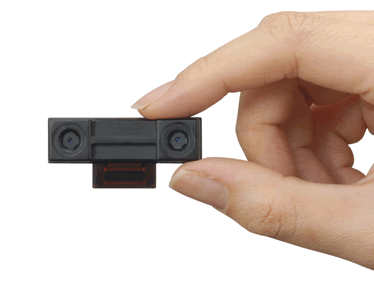
We say phones, but they'd be fairly chunky ones. The Sharp 3D module is small, but not as compact as a regular phone camera.
Sharp didn't provide much in the way of technical details, but it did say that the module contains two cameras plus the electronics needed to unify the colour palette, brightness and contrast of the left- and right-eye images they produce.
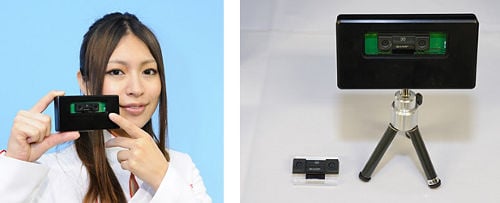
How much this technology will cost to add to a digital camera or a smartphone remains to be seen, but we should find out when Sharp begins mass-producing the module later this year.
Engineering samples - essential for prototyping shipping products - will be made available to camera and phone makers in July. ®
COMMENTS
HD *video*, I presume
Because Fujifilm released a 3D digital camera some time ago, with a resolution that's clearly better than HD (which is rather low resolution for still pictures these days), but which probably had only VGA resolution video.
Camera shake, anyone?
Filming on a mobile phone is always pretty shaky. Will I be constantly tilting my head to keep the stereoscopic image level relative to my eyes, or will the image be autocorrected to keep the line between the two cameras horizontal? Either way, motion sickness a-gogo!
maybe, maybe not
Well, it is only a prototype, though it might not hurt to pop them a quick email pondering on how close-set the CCDs seem to be. Particularly as the average phone is easily tall enough to cover most people's eyespan when turned landscape-wise. Problem is that the legacy of film cameras leads people to expect the lens to be roughly in the middle third, so they may end up holding it such to block one or both sensors if they're mounted at the extreme ends.
Shouldn't be, for example, too difficult to replace part of the solid PCB with a long ribbon cable so one sensor and the main electronics can be mounted at one end of the case, and the other sensor remote-linked at the other.
On the other hand it may either be that they're taking a reduced strength of effect as the price of compact packaging; plus as they're unlikely to be able to rotate in respect to one another, this is one way of optimising it for the close-range duties that phone cameras are better suited to and mostly used for - otherwise you may get enough of a disparity between the two images that the effect is lost altogether because there isn't ENOUGH overlap with near-field pics. (They may also be mounted with a pre-set non-parallel relative view angle that converges, say, 10ft away, and anything between 10ft and infinity therefore being separated by a certain amount in the OPPOSITE direction).
Don't worry, I'm sure the boffins are sorting it ;)
Very cool idea in any case - can has?

IT infrastructure monitoring strategies
Agentless Backup is Not a Myth
Top 10 SIEM implementer’s checklist
Steps to Take Before Choosing a Business Continuity Partner
Enabling efficient data center monitoring