


This article is more than 1 year old
Herschel 'scope peers into 'truly empty' space hole
None more black

The Herschel Space Observatory has spotted a gaping hole in space - a "truly empty" void which appears to have be formed by jets of gas from nascent stars.
The European Space Agency's infrared 'scope spotted the anomaly in a bright reflective cloud of gas dubbed NGC 1999. In visible wavelengths, the hole appears naturally black, but this is normally the case with similar phenomena which are dense clouds of gas simply preventing light passing through.
However, when Herschel set its sights on the region, the area remained resolutely black in the infrared, meaning it was "immensely dense or something was wrong".
Ground-based observations subsequently confirmed that there's absolutely nothing there. The hole is the black smudge in the green area towards the top of this image:
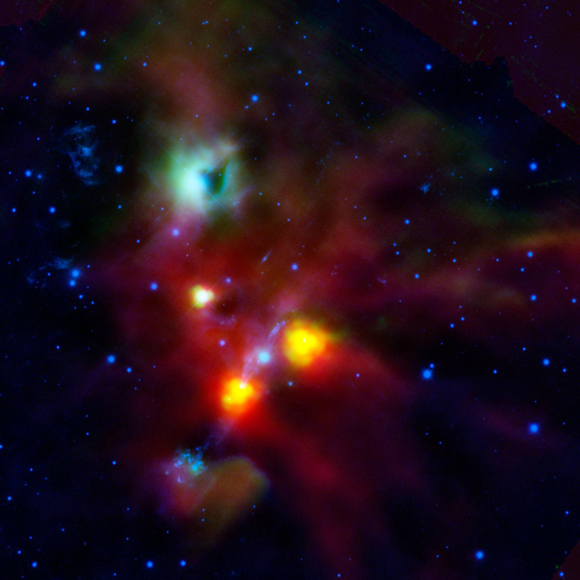
Principal investigator Tom Megeath, of Ohio's University of Toledo, said: "No one has ever seen a hole like this. It's as surprising as knowing you have worms tunneling under your lawn, but finding one morning that they have created a huge, yawning pit."
The tunneling worms in question may be narrow jets of gas from some of the fledgling stars in the region, coupled to "powerful radiation from a nearby adolescent star", which have "blown a hole right through the cloud".
Whatever the case, scientists hope the discovery will help them understand how new stars use jets of gas to "rip apart" the clouds of dust in which they're born. ®
 Biting the hand that feeds IT

