
Sharp Aquos LC-46LE821E 46in quad-pixel TV
Do yellow sub-pixels really make for a better picture?
Review While the rest of the TV industry goes romping off into the third dimension, Sharp has decided to do its own thing by focusing instead on the "fourth pixel". The "Quattron" technology in its new range of Aquos-brand LCD sets gives them yellow pixels in addition to the standard red, green and blue primary colours.
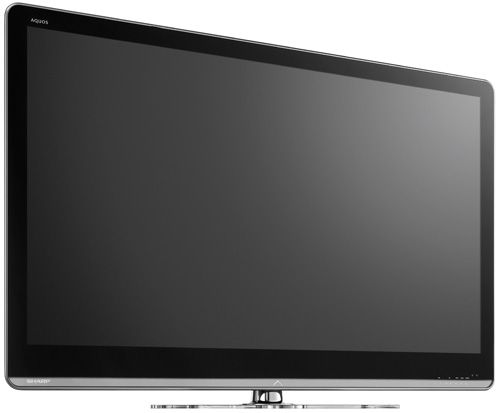
Sharp Aquos LC-46LE821E: pick of the pixels?
Sharp claims that this "quad-pixel" design produces a wider range of colours than conventional RGB models, resulting in a brighter and more realistic picture.
The Aquos is certainly striking to look at – even before you’ve turned it on. I was able to test the 46in model in the LE821 series, which measures only about 37.5mm thick and is finished off with neat silver trim. I also liked the translucent panel that runs along the bottom edge of the screen and glows as you press the touch-sensitive controls on the panel.
Sharp quoted a price of £1999, although I’ve seen it selling for £1600 on the net. There’s also a 40in model priced at £1599, and a 52in model on the way soon, as yet un-priced.
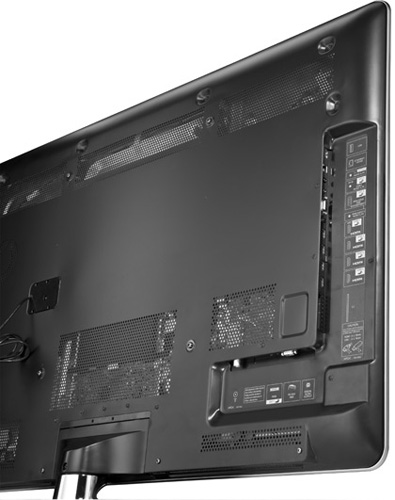
All the ports are well positioned for easy access
Apart from the yellow pixel, the 46LE821E is a standard HD television. It provides 1080p full HD resolution, with 100Hz refresh and panel-edge LED backlighting. There are four HDMI connectors on the left-hand edge of the unit, along with single Scart and RGB inputs, headphone and digital audio outputs, a USB port, CI slot, VGA connector for a PC, and an Ethernet interface.
COMMENTS
Sound
Why does every review ALWAYS comment on the built in speakers?? No one in their right mind would actually use them. If you're blowing the better part of £2k on a TV you're going to have/be getting a proper sound system too... or so one would hope! But interesting article and tech none the less, but I'll stick to my projector and substantially bigger screen for far less than a weeny 42" TV and that's WITH the sound system.
Errm...
> Maybe we should start thinking about cyan and magenta pixels as well.
> It worked for the photoprinter market.
To complete your idea, you'd want black pixels as well.
They missed the basics.
"The set supports DLNA networking, so you can connect it to a home network and stream photos and music from a networked media server – although you can’t stream video for some reason. There’s no internet connectivity or any kind of web-based service either."
(quoted from article)
What use is a TV that can't stream video?
I swear, I will not be buying another TV until someone comes out with one that has a built-in capability to stream DVD subdirectories from a NAS device (i.e. I can ditch my DVD player.) That will be either official support, or a modified firmware. I own a lot of DVDs, and I am beginning to view a DVD player in the same fashion as a floppy disk drive - yet another type of media to swap whenever I want to watch something new.
I basically want the lot on my NAS, my media in the basement, and my shelf space reclaimed.
more black thoughts
Fly in ointment "The contrast could have been a little better on deep blacks".
Next time they could add black pixels (although SONY might have patents), it helps to spot the black helicopters.
Not the first time
I remember when Sharp actually tried this early in the last decade with 4-color CRTs as well, with the fourth color being, surprise, surprise, yellow. They shelved it after a while for no reason. I'm surprised that it took them that long to reintroduce the technology to LCD.
As for why they're not interested in the 3D race, well, they already won it, in 2003.
http://www.pcworld.com/article/117303/sharp_ships_3d_monitor.html
And the technology has been improved since and will make it's first consumer appearance outside Japan on the upcoming Nintendo 3DS.
Black helicopter. Because 3D displays that don't need glasses are truly ahead of it's time.
