


This article is more than 1 year old
Newsnight tries banalysis 2.0 for Prime Ministerial debates
Tag clouds: Not in my name

Comment The obsession of the media and political worlds with pointless info-toys met a new nadir last night, during the webby part of Newsnight's otherwise respectable coverage of the first Prime Ministerial debate.
Reporter Justin Rowlatt was tasked with using the power of "tag clouds" - also known as Wordles - to offer insights into Gordon Brown, David Cameron and Nick Clegg's political philosophies.
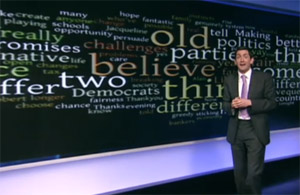
Rowlatt: Adrift in alphabet soup
The effort was part of a growing trend in news for "visualisations", which are meant to make complex stories more readily understood, and occasionally do, but more often just waste colour ink or pixels. They're like illustrations, but require less visual talent.
For the uninitiated, a tag cloud is a visual soup of words, usually in a bad font, with the size of each dependent on how many times it is used in the source document or speech. They are employed by many bloggers and, depressingly, some journalists, as a substitute for actual thinking or analysis, which there isn't time for between hearing or reading something and reacting to it on Twitter.
By demolishing what may have been coherent ideas or arguments into a fine rubble, the Newsnight tag clouds were supposed to offer instant comparative political analysis. Instead they made their user look like a spokesman for the Stupid Party. And they always do.
In the interests of political historians, here are the hapless Rowlatt's efforts at web-facilitated insta-terpretation:
Gordon Brown
So look here, we've got words like - interestingly - 'got'... I suspect that's a mistake. But 'schools', 'economy', 'future' - that's a key word, that's what people expect, to hear the word 'future'.
David Cameron
'Country', I suppose you'd expect that. He's saying 'change', 'together', um, 'great' there. Words I suppose you would expect.
Nick Clegg
He says 'old'! It's not a word you often associate with campaigns. 'Believe'... 'things', um, interesting word there. Um, and, 'politics'. Words there, I suppose, many that you'd expect in any speech.
In fairness to the Newsnight man, he grew increasingly aware of the farce as the item went on, suppressing embarrassed laughter and moving on sharpish. We'd be surprised if the feature made a reappearance following the second debate next Thursday.
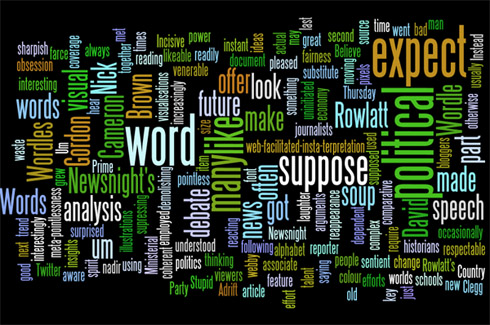
For sentient viewers that would be good news, but fans of tag clouds - they do exist - will be pleased to know that they can make their own here. And in the spirit of meta-pointlessness, here's one of this article. Incisive. ®
 Biting the hand that feeds IT

