


This article is more than 1 year old
Buyer's Guide: Colour Laser Printers
What to watch out for

Group Test On price alone, you might think there’d be no contest between inkjets and colour laser printers, but the strength of the latter lies in areas other than the monetary bottom line. The key advantages are all results of the technology itself: cleaner quality print, more robust documents and higher print speed.
In an inkjet printer, you're spraying liquid onto the paper. However finely you try to control this and however small you make the gap between the head and the paper, there is a chance of ink going where it's not intended to go, and for ink to run along the fibres from which the paper is formed.
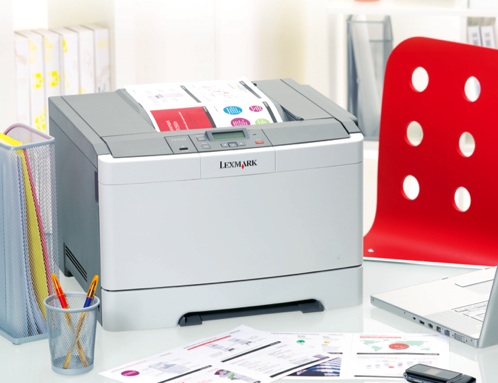
Laser printers use a completely dry process, where polymer-coated pigment particles are attracted to small electrostatic charges applied to specific points on the paper. Although it's still possible for toner to be placed unintentionally, usually because of the build up of stray charge, results are much more closely controlled. Laser printer characters, with few exceptions, are sharper and denser than those formed by even the best inkjets.
And because the colour pigments used by lasers don't have to be soluble at any point in their production or use, laser-printed documents can be fully water-resistant. They are also much less likely to fade in sunlight than inkjet pigments, as the particles are larger and more resistant to ultra-violet degradation.
Laser print is also a page-printing technology: there's no movement of a print head from side to side, across the page. The print drum holds the image of a good portion of the entire page on each rotation, which means the paper can be fed at much higher speed than than is the case with typical inkjets.

The speeds measured during testing vary between 9.5 page per minute (ppm) and 16.7ppm printing black, and between 4.6ppm and 10.3ppm printing colour. Even a business inkjet like HP’s OfficeJet 6000 can only manage around 9ppm in black, falling to 4.5ppm when producing colour pages.
 Biting the hand that feeds IT

