The Register® — Biting the hand that feeds IT

Feeds

Wreck of 1930s flying aircraft carrier dubbed 'historic'

Captain Scarlet style dirigible Cloudbase honoured

SaaS data loss: The problem you didn’t know you had

The US government has added the crash site of the most powerful flying aircraft carrier ever built to the National Register of Historic Places, 75 years after the event.
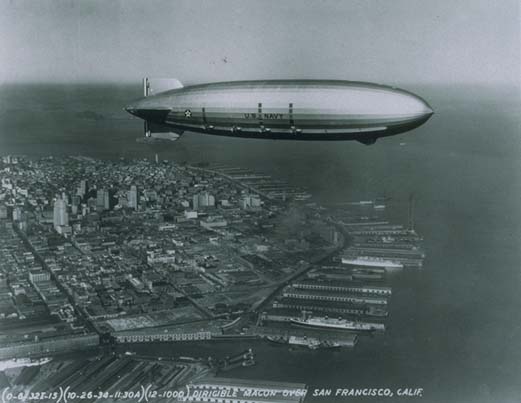
USS Macon above San Francisco

Fleet Week really meant something back then

The airship USS Macon - comparable in size to the even more famous and equally doomed liner Titanic - suffered storm damage and crashed into the ocean off Point Sur, south of San Francisco, exactly 75 years ago yesterday. The huge dirigible's remains and those of her embarked biplane fighters now lie 1500 feet below the waves in the Monterey Bay National Marine Sanctuary. However, all but two of the 83 men aboard survived the crash and were rescued by responding waterborne ships.

“The USS Macon and its associated Sparrowhawk biplanes are not only historically significant to our nation’s history, but have unique ties to our local communities, where public museums highlight the airship’s history,” said Paul Michel, Monterey Bay National Marine Sanctuary superintendent. “The National Register listing highlights the importance of protecting the wreck site and its artifacts for further understanding our past.”

The Macon and her sister ship Akron - also lost in a storm at sea two years previously - were unique even in the era of the great rigid airships in that they carried a force of fighter planes which could be launched and recovered in mid-air. A "trapeze" arm attached to a "skyhook" on the biplanes' upper wings swung the fighters out through a T-shaped door in the ship's belly. The airship was fast enough that the planes could match speeds with it in order to hook onto the trapeze again after a flight: there was no need for catapult launch, heavy arrester gear and jolting landings (or alternatively vertical-lift aircraft) as there is with ordinary seaborne aircraft carriers.

Magic Quadrant for Enterprise Backup/Recovery

Bah!

The nature of the medium these magnificent machines fly in - air, with pesky sudden dramatic changes in density (which drastically alters the airship's buoyancy) that we non-airship types call "weather" - along with the nature of their construction (very long horizontal. free-floating structures filled with individual gas cells) means they will always be troublesome to operate.

Very long horizontal, free-floating buoyant structures have a tendency to want to become very tall *vertical* free-floating buoyant structures, because once they start to tip up the changes in air density work to amplify the tendency. You then have to move fast because once the nose gas cells are high enough, they can burst, reversing the process to everyone's detriment.

Historically, the attempts to mitigate this (by spilling gas and/or ballast) caused catastrophic problems once the original problem was resolved because the aerostat was no longer aerostatic - it was out of balance and under-buoyant. That was if the entire structure didn't fracture due to the stresses of having one end in relatively still air and the other in possibly turbulent winds.

These machines look incredible, but the requirement to make them out of gossamer and goodwill means they are rather too fragile for the purpose. One satyric quote I liked from The Onion, concerning the Hindenburg, went something like "Once again one of these seemingly invincible leviathans of the air proves to be as durable as tissue paper soaked in gasoline".

But I would have liked to see the Hindenburg flying over New York. The sight must have been incredible, to judge by the preponderance of obviously Hindenburg-inspired effortlessly hovering spacecraft in the Flash Gordon stories and its imitators. Obviously, once you had seen it for yourself, you were suitably gobsmacked.

5
0

Zepps

I always wanted Max Zorin's Zepplin.

That was back in 1987, and I STILL want it!

Bring the gracious giants back to the skies please

3
0

bring them back!

If they can surmount the pesky safety record, I think it would be great if these came back into use, not just for lifting and moving freight over long distances cheaply, but also as cruise ship sint he sky. I think back to the Buenos Aires-Europe runs in the 1930s and think it must have been fantastic: quiet, slow-ish, elegant. Surely the bang-per-buck stacks up again now?

3
0

More from The Register

Boffins find evidence Atlantic Ocean has started closing
'Embryonic subduction zone' that flattened Lisbon headed for Blighty
Google launches broadband balloons, radio astronomy frets
A careless Loon could blind the square kilometre array
 breaking news
You've seen the Large Hadron Collider. Now comes the HUGE Hadron Collider
International Linear Collider ready to rock and roll
Headbangers have a gas, gas, gas in mosh pits
Boffins say heavy metal crowds behave like The Vapours
Hubble spies unlikely planet being born in hostile neighborhood
Hoovering a cloud of sand 7.5 billion miles from a tiny star
 breaking news
Jaguar to open new car-making factory in Blighty (virtually)
Britain still makes stuff, it's just not real any more...
 breaking news
China's second woman 'naut blasts off for coupling in HEAVEN
Wang and pals test the cosmic waters for Chinese space station
Scientists investigate 'dark lightning' threat to aircraft passengers
One stormy flight could give lifetime radiation dose
 breaking news
Chinese 'nauts prep for next coupling in Heaven, clear way for new station
Second woman taikonaut and pals test tech for China's own orbiting platform