


This article is more than 1 year old
NASA's Sun-gazing sat grounded
Wind delays launch of Solar Dynamics Observatory

NASA has cancelled today's planned lift-off of its Solar Dynamics Observatory due to unfavourable wind conditions at Cape Canaveral.
When it does finally get off the ground, hopefully tomorrow, SDO's "unprecedented mission will study the Sun and its dynamic behavior". Over five years, it will "determine how the Sun’s magnetic field is generated, structured, and converted into violent solar events like turbulent solar wind, solar flares, and Coronal Mass Ejections".
This, the agency elaborates, will enhance our understanding of "space weather", and allow us to "accommodate or mitigate" the effects of solar activity, which can include knocking out satellites, affecting power grids and disrupting television and telecoms systems.
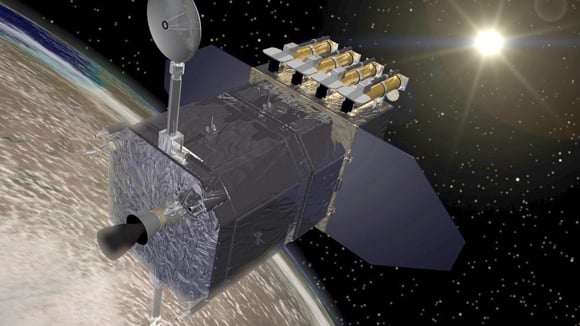
SDO is packing three instruments: the Atmospheric Imaging Assembly (AIA); the Extreme Ultraviolet Variability Experiment (EVE); and the Helioseismic and Magnetic Imager (HMI).
AIA is tasked with grabbing hi-res pics of "different layers in the sun’s atmosphere to further understand how changing solar magnetic fields release the energy that heats the solar corona and creates flares".
It will "snap a full disk image in 8 wavelengths every 10 seconds" at a resolution of 4096 x 4096 px, or "almost IMAX quality", using four telescopes each capable of discerning detail as small as 725 km.
EVE is designed to gauge the sun’s extreme ultraviolet (EUV) brightness as often as "every ten seconds", and will provide space weather forecasters with "warnings of communications and navigation outages" provoked by sudden EUV surges.
HMI will measure both "sound waves reverberating inside the Sun to build up a picture of the interior", and "the strength and direction of magnetic fields emerging on the Sun’s surface". It will offer the "first rapid cadence measurements of the strength and direction of the solar magnetic field over the visible disk of the Sun".
The collected data will be dispatched to a dedicated ground station at New Mexico's White Sands Complex at a rate of roughly 1.5 terabytes a day, the equivalent of "downloading half a million songs each day", NASA helpfully explains.
SDO will operate in an inclined geosynchronous orbit at the "outer edges of Earth's radiation belt", around 36,000 km out. The orbit allows "nearly continuous, high data-rate contact" with the ground station, but will involve two annual "Earth shadow" eclipses, of 2-3 weeks each, and "three lunar shadow events each year", the agency notes.
NASA has its main SDO site here, a fact sheet here (pdf), handy guide here (pdf) and press kit here (pdf). ®
 Biting the hand that feeds IT

