


This article is more than 1 year old
Just how political is your IT organisation?
The impact of the non-technical

For this week, the last in this workshop series, we were looking at the near-future, with particular focus on how we deliver server resources and a central question – are we any closer to the nirvana of dynamic IT delivery?
I’d love to say we’ve learned a lot from your feedback. What we can say is this is not an area that currently engenders a great deal of debate, not from the articles anyway! As we have said on other occasions however, an absence of dialogue is feedback in itself, suggesting that whatever dynamic IT might be, it is not something that is front of mind for many organisations today.
Which means it is a good job we focused this week’s poll on something a bit more tangible, namely how good you are at managing server resources as a pool. ‘Shared resources’ are seen by some as a cornerstone of dynamic IT management approaches. Or to put it another way, if you can’t manage all your servers together, you’re not likely to be able to do anything more clever in terms of resource allocation and so on.
We compared our findings by company size. Looking first at how server resources are allocated for example, we can see that there isn’t really one pervading approach adopted today – organisations are more-or-less as likely to be buying dedicated kit as they go as using spare capacity from a pool.
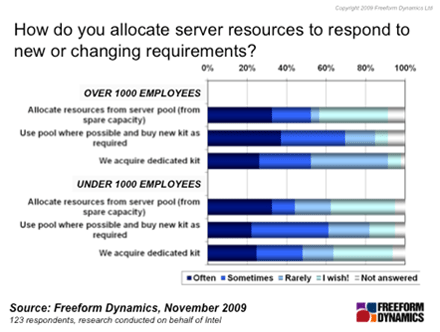
What stands out are the numbers that are saying ‘I wish!’ to the different responses, by company size. There’s little desire for buying dedicated kit as-and-when in larger organisations, for example. But the desire to operate a pool structure comes across loud and clear. Meanwhile, in smaller companies, it appears to be harder to get funding to support new kit purchases, should the pool itself prove insufficient.
When we look at the challenges, we start to get a pretty clear picture of why this might be. At a high level, there’s little between the areas seen as possible sources of improvement. But when we consider things by company size, some specific differences emerge.
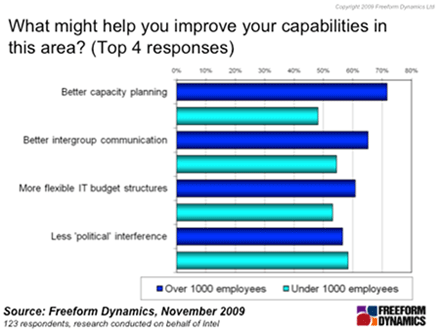
For larger organisations, ‘Better capacity planning’ emerges as an area of possible focus, followed by ‘better communications’, and ‘more flexible budgets’. ‘Politics’ is the fourth criterion, suggesting it plays a part, but it won’t be the blocker.
How different a view we have for smaller organisations, however! ‘Political’ is the number one issue, followed by ‘communications’ and ‘budgetary flexibility’ – all of which (from this perspective) can be seen as management challenges, rather than anything technical.
The conclusion we can draw is stark. If ‘capacity planning’ is the main issue, big companies are already doing the things they need to do, but probably lack a level of process maturity. Perhaps a review of best practice frameworks such as ITIL and COBIT could help here, to push things in the right direction. As for smaller companies, the challenges are institutional.
This is only one sample, to be sure – but if it is anything to go by, it suggests that no amount of technology or best practice will be able to overcome the lack of political will, or inherent communications weaknesses. Consider the following piece of feedback on the poll for example: “We have had instances where someone was told 'we can't accommodate your workload due to lack of capacity.' Instead of discussing it with us, they go out and buy a server on their budget and tell us 'now you have capacity, put it in your server room.' ”
More effective use of server resources may, in principle, be broadly able to save organisations money and make IT operate more efficiently. But for some organisations at least, the issues to be overcome have little to do with IT. Indeed, anybody looking to develop server management strategies may be surprised at the non-technical nature of some of the areas that are worthy of their attention. ®
 Biting the hand that feeds IT

