Parking spot flies to International Space Station
Spacecraft docking day or night
Cloud storage: Lower cost and increase uptime
A new Russian module has arrived at the International Space Station today, providing the orbiting outpost with an much-needed extra parking spot for its expanded crew of six.
The unmanned Russian Mini-Research Module 2, also known as Poisk, docked to the space-faring port of the Zvezda service module on Thursday 15:41 GMT (10:41 EST). It used an automated radar-guided system to rendezvous, two days after launching from Kazakhstan.
Because the space station's crew was increased to six this year, two Russian Soyuz spacecraft are required to be docked at the ISS at all times to serve as emergency lifeboats. Before the new Poisk docking module, that left only one open spot for docking Russia's Progress resupply craft and for Soyuz crew rotation missions.
Poisk means "search" or "explore" in Russian.
It is the first major addition to the outpost from Russia since the launching of the near-identical Pirs docking module in 2001. In addition to Poisk providing the ISS with additional parking, the module will be used as an airlock for spacewalkers wearing Russian Orlan spacesuits.
Poisk arrived at the ISS carrying about 1,750 pounds of equipment that includes water supply gear, crew hygiene supplies, medical equipment, personal items, and spare parts. The module weighs about 8,000 pounds and is about 13 feet long and eight feet in diameter at its widest point, according to NASA.
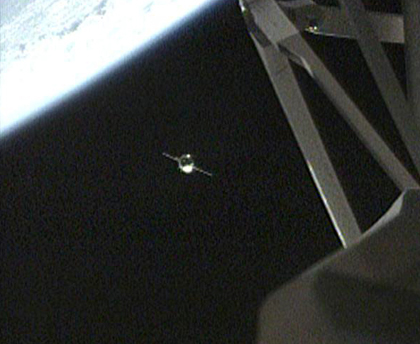
Poisk approaching the ISS, courtesy: NASA TV
The station now has five docking ports total: one located on the American segment for US shuttles, and four on the Russian segment. European Space Agency craft also dock on the Russian segment, while Japanese craft are attached to the American segment.
Russian cosmonauts Max Suraev and Roman Romanenko will open the hatch to Poisk on Friday and enter the module for the first time. But before the Poisk is ready to host visiting spacecraft, the module's Progress space tug will be jettisoned around December 8. Cosmonauts will also perform a spacewalk in January to ready the port for rendezvousing.
Meanwhile, the ISS Expedition 21 crew is preparing for next week's scheduled arrival of space shuttle Atlantis on the STS-129 mission to deliver critical spare parts to station. Atlantis is penciled in for a launch from Kennedy Space Center in Florida on November 16. ®
COMMENTS
Re de-orbitting the ISS
Remember that the Eiffel Tower was only supposed to stay up for a year too.
It's a shame they dumped Mir really. But by the end Mir was a godawful botch-job, full of short-circuits and riddled with a nasty type of fungus that was affecting astronauts' health and eating away at the circuitry, so it was too hard to keep it going.
Once there's enough ISS up there to do useful stuff, I expect it *will* get some real use. Crystal growth in particular is something which can be done properly in zero-G, and that's got real implications for silicon wafers and other real-world stuff. The problem until very recently is that there hasn't been enough ISS to allow more crew than required to keep the thing ticking over, so zero-G experiments just haven't been happening. Now they are, which is good.
The ISS problem at the moment is that it's in LEO which isn't a good place for most things. An ISS out at a Lagrange point would be significantly more useful. All current space-based observatories need to work 100%, and any failure tends to wipe them out. Having the ISS in reasonable proximity to WMAP or future Hubbles would solve the maintenance problem - you'd still need to send parts up the gravity well, but it'd be a lot easier if there's a maintenance crew on hand. Out at a Lagrange point, you're also outside the Earth's magnetic field, so it's a good opportunity to check how exposure to solar radiation affects people and equipment (and to test out your shielding), whilst still being close enough to get back home. As a stepping-stone to Mars, that'd be a good call.
The problem of course is how to lift it. The likely answer would be a VASIMR engine. That wouldn't generate enough impulsive thrust to affect ISS integrity, but it'd still provide enough push to move the ISS around at a reasonable rate. The ISS doesn't look much like a rocket or a space shuttle, but of course there's no need for it too - space doesn't need aerodynamics.
Ahem, personal items?
Come on El Reg what we want to know is, has anyone smuggled a grot mag up there yet, and if so, who has had the first one-handed space walk?
Re: Only one American dock?
True, but terribly naive.
The Americans will put up four docking ports, to maintain docking port parity and also preserve the existing one for willy-waving value (regardless of whether or not they actually have any spacecraft to dock with them). Barack Obama will make a keynote speech stating the new US objective to have over a hundred docking ports in orbit before the end of the decade. The Russians will counter by announcing a humungous new booster capable of lifting a single 100 port module in one go, which they'll never actually build. The Americans will spend billions of dollars actually building a similar booster (which will differ in that it will have plush upholstry, be able to also carry a crew and have a potato peeling attachment*), before they notice that the Russians haven't ponied up with the firestick.
The ISS will run out of power and come crashing back to earth as all its solar panels will be shaded by docking port modules.
*Courtesy of a NASA budget bill line item.

Agentless Backup is Not a Myth
Steps to Take Before Choosing a Business Continuity Partner
Requirements Checklist for Choosing a Cloud Backup and Recovery Service Provider
Cloud storage: Lower cost and increase uptime
SaaS data loss: The problem you didn’t know you had