The Register® — Biting the hand that feeds IT

Feeds

Google’s cloud rains on Amazon’s future

Mountain View voodoo wins devs

Agentless Backup is Not a Myth

Amazon may rule the public cloud today, but more developers have faith in Google's prospects going into the future, according to new research.

Evans Data released a report on Tuesday measuring how software developers perceive web-based computing providers like Amazon, Microsoft, AT&T, Google, Rackspace and Hewlett-Packard. More than 400 developers were asked to rate the companies based on criteria such as current capabilities, ability to execute on their vision, scalability and security.

Evans measured companies using a decidedly Gartner-esque Magic Quadrant, plotting "completeness of solution" and "ability to execute" on different axis of its chart below. As with Gartner, it pays to be in the top right-hand corner of the Evans' quadrant.

When it comes to current position in the market, devs rated Amazon and Google way on top, with Amazon receiving the edge. Google, however, was believed to have a better ability to execute on its cloud service strategy.
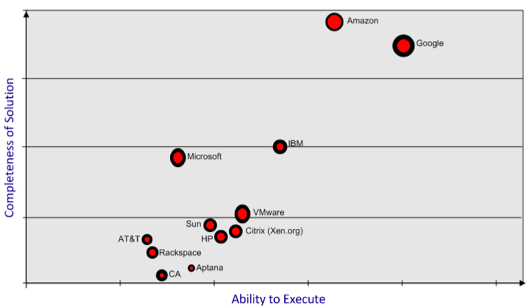
As they see it: how developers rate leaders and followers in cloud computing

Amazon and Google topping the list is unsurprising given the their early entrance and heavy push into the market. The next three companies in terms of perceived completeness of their services were IBM, Microsoft, and VMware respectively.

Moving to the horizontal axis of yonder chart: we see while Microsoft is considered to have a capable cloud solution, it lags behind Sun, HP, Citrix, VMware, IBM, Amazon and Google when it comes to developer confidence in their offerings.

IBM meanwhile, appears to have been quite successful in pitching its ability to provide cloud services despite its relative late entry into the public cloud market.

IBM was also the top choice when it comes to perceived security. About 21.7 per cent said IBM is the best in guarding from data loss and leaks. Amazon was second with 20.2 per cent, VMware third with 9.9 per cent, followed by Microsoft with 9.1 per cent, Google with 8.7 per cent, and Sun with 7.5 per cent.

In terms of scalability, Google wins the race. About 31.0 per cent of those polled said the company has the most resources available to accommodate a highly dynamic application. Amazon was a distant second with 17.8 per cent, then Microsoft with 10.9 per cent, IBM with 8.9 per cent, and VMWare with 7 per cent.

Google also trounced the competition when the devs were polled about reliability, latency, lack of vendor lock-in and cost-to-value ratio.

The Evans poll was conducted in September, so the results should include any PR fallout from Google's well-publicized outages that month. Clearly Google is doing something right in publicity.

According to Evans: "Amazon, who was first to market in the public cloud space, now shares the leadership opposition for publicly accessible clouds with Google. However, Google shows more strength in both perceived capabilities and perceived ability to execute, and the adoption patterns for Google are stronger going into the future. Google is likely to be the top performer in the public cloud space."

So is there something inherently better in Google's cloud-based voodoo? What do you think?

A copy of the report is available free here, although registration is required. ®

Regcast training : Hyper-V 3.0, VM high availability and disaster recovery

Latest Comments
Anonymous Coward

Perception is king

That's what my old boss used to tell me.

The cloud offerings from Google, Amazon, and Microsoft (and probably the rest) all have fairly important distinctions that obviously impact their suitability. For example Google AppEngine supports Python and Java. If you wanted to run a web application Google would be an obvious choice. Assuming you can work around the lack of support for relational databases. Azure supports relational and tabular data, and the dotnet platform, which obviously means C# etc now. It's not hard to see support for F# and possibly IronPython / IronRuby in the not too forseeable future too. EC2 doesn't seem to cover the full story. AFAIK there is no app server .. simply a set of service endpoints for powering other apps .. maybe they should have gone with Amazon AppEngine

In terms of what you can do on your VM, Amazon EC2 grants you full admin rights, which means you can install whatever the hell you want to make your app sing. AppEngine and Azure both limit your privileges and thus the freedom to install that annoyingly essential 3rd party component. If that is a problem for you then EC2 looks increasingly attractive.

The scalability and reliability limits will likely rarely cause a problem on any platform since surely for the vast majority they will exceed anything they can provide 'on premise'.

I don't think perception has much relevence here, but then again I thought that before said boss fired me

0
0

a study like that must specify what kind of developers we are talking about

There are several types of developers around, with diferent skills an backgrounds. Microsft in the past was very good at hiring and coopting developers to build solutins and market them as independent software vendors.

In our case our company made more money around MS Windows plataform them I can dream working with these other plataforms... Google and Amazon dont have a tenth of MS support and tools for developers. It is not comparable companies in these aspects.

So what kind of developers gave their opinions?

Developers of Google applets using Google tools or high skilled linux and windows c programmers?

0
0

Lets get this straight

This report is based on developers' perception. People perceive Google to have a good service, and they perceive Rackspace to have a poor service (based on the quadrants they ended up in.)

But when people actually go to evaluate and purchase these services, perception goes out the window and people actually evaluate "What does this company actually offer and for how much."

Those types of things are useful. And knowing what people perceive is marginally useful. But this has no relation to the actual state of the offerings available today.

0
0

More from The Register

SCO vs. IBM battle resumes over ownership of Unix
Zombie lawsuit back and wants to suck the brains out of Linux
Bjarne Again: Hallelujah for C++
Plus: Now officially OK to admit you never used STL algorithms
Interwebs taunt Sir Jony over Apple eye candy makeover
Hey Ive, Ive... add more unicorns, willya?
Apple: iOS7 dayglo Barbie makeover is UNFINISHED - report
Plus: You don't like the icons? Blame marketing
Red Hat to ditch MySQL for MariaDB in RHEL 7
So long, Oracle! Don't let the door hit you on the way out
Shy? Socially inadequate? Fiddling with your phone could help
App 'tells the brutal truth' about social inadequates' chatup lines
Java EE 7 melds HTML5 with enterprise apps
New release arrives with GlassFish, NetBeans support
 breaking news
'Office Facebook' firm Tibbr wants you to PAY for mobe-meetings app
Great idea. Punters won't cough for it though
 breaking news
The only Waze is Google: Ad giant tipped to gobble map app 'for $1.3bn'
Pac-Man-satnav-ish upstart in bidding war with Apple, Facebook
 breaking news
PM Cameron calls for modern, programmable computers! (We think)
IT education musings to G8 chiefs to mystify IT industry