


This article is more than 1 year old
The tools of the trade: Cutting edge or a bit embarrassing?
Get your skills on

Workshop Do the phrases ‘cutting edge’ and ‘your IT shop’ constitute a contradiction in terms, or do you work in a sleek and streamlined vision of sci-fi IT?
When we asked you about this last year we got the impression that for most organisations it was more the former than the latter. That’s not to say you told us things were falling around your ears, just that it takes quite a lot of effort to keep your IT systems on the straight and narrow.
What came across loud and clear from the research was that it wasn’t so much the tools you used that were causing things to be less than optimal, but the gaps between them. Where the tools and skills exist everything tends to run smoothly.
However, it doesn’t matter how good the individual widgets are when it’s the view across the infrastructure that really matters – particularly if we’re trying to manage the capabilities we provide to the business as ‘services’. I say ‘if’, because the levels of fragmentation we currently work with don’t make it easy to get that ‘end to end view’ of a service. So maybe it’s a moot point, today at least.
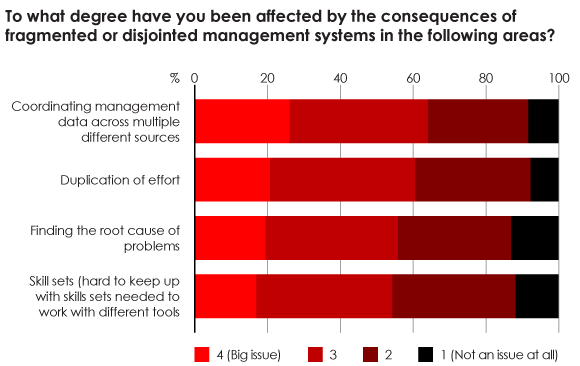
Some unexpected findings emerged when we explored this idea of fragmentation further. The difference in the level of burden experienced by IT departments that consider their IT management environments to be highly co-ordinated, versus those that do not, isn’t nearly as clear cut as we might have thought. We also found that some organisations were still suffering despite having made efforts to the contrary.
The bottom line, we found, was that regardless of the approach taken to IT management, many organisations are not well placed to address new demands placed on IT. This is linked as much to the overall shortcomings of the IT management tools and solutions in place, as much as it is to individual strategies and buying criteria followed over time.
We’re not sure there are any easy answers when it comes to filling in the gaps. Theorists talk about maturity, and to be sure there is always further an organisation can go, but such models don’t really capture the complexities of managing the IT jungle, which is as much about staving off the encroaching chaos as moving things forward. One of the things we’d like to hear from you about is how you manage to strike a balance, and the efforts you find yourselves having to go to in order to achieve this.
The bottom line: is investment to improve ‘service management’ seen as a strategic priority in your organisation or are you reliant on coming up with your own tactical work-arounds, in a more reactive manner? Are you big on process, or getting the tools you need – particularly in the Current Economic Climate (TM)? For example, one of the Register readers told us he was using free tools from Spiceworks for his asset management requirements.
We know that free stuff and personal favourites have always been part and parcel of the IT practitioner’s toolbox. Are they now a prerequisite in the absence of real investment or are they actually pretty good? As usual, we’d love to hear from you. ®
 Biting the hand that feeds IT

