The Register® — Biting the hand that feeds IT

Feeds

Caviar Black gets 2TB model

WD expands range upwards

WD has uprated its four-platter, 2TB disk technology to 7200rpm with Caviar Black and WD-RE4 models.

This move was foreshadowed by leaks from European resellers earlier this month. The first 3.5in 2TB products from WD spun at 5,400rpm.
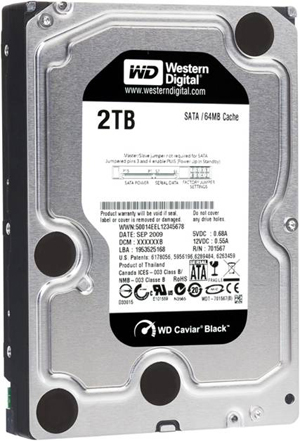
WD Caviar Black 2TB

Capacities range from 500GB, through 640GB, 750GB and 1TB, up to 2TB. In the 2TB product, the read/write head has a two-stage actuator, with the second stage driven by piezo-electronic technology for more precise head-to-track positioning. Interestingly this is technology used by UK start-up DataSlide in its hard rectangular drive technology.

In all models, except the 500GB and 640GB ones, the drive motor shaft is secured at both ends to reduce system-induced vibration. This so-called StableTrac technology helps stabilise the platters for more accurate tracking. Clearly, WD has been pushing the technology envelope out to get the reliable data access it needed.

There is a 64MB cache and WD says the drive has a couple of integrated processors for greater controller performance. The interface is 3Gb/s Sata, with no SAS interface mentioned.

The Caviar Black model is meant for gamers, high-end desktops and workstations. The WD-RE4 version, with its 1.2 million hours before failure rating, is for servers, network-attached storage (NAS) and storage area network (SAN) usage.

The Caviar Black 2TB GB (model WD2001FASS) drives are available now through WD distributors and resellers, with a manufacturer’s suggested retail price of $329 plus local VAT (£232.00). The RE4 2TB (model WD2003FYYS) drive is currently being qualified by OEMs. Both drives have a five-year limited warranty. ®

Latest Comments

TB vs TiB

1 TB formats as 1 TB, if your OS shows less, blame the OS for reporting incorrect values

and learn the difference between binary and decimal prefixes.

its 1000 GB with decimal prefixes but 931 GiB using binary prefixes (you cannot use decimal prefixes for binary numbers - learn the difference between GB and GiB)

1 TB = 1 000 000 000 000 bytes

my hdd is actually showing 1 000 201 977 856 bytes so in fact i've got 200 megs for free

0
0

@Steve Evans - common-mode failure

WD drives no good? More probably, you got unlucky, and your RAID array was populated with drives all from the same bad batch (built with a batch of faulty components). Google, and you'll find a few people swearing never to touch Hitachi / Seagate / Samsung drives again, having likewise experienced batched failures. A batch of defective components could happen to any of them.

Herein is a warning for anyone using RAID. If all the disks in an array are purchased at once from a single supplier, it is far more likely than is commonly thought that when one fails, the rest will be going the same way *soon* - so be prepared and buy an extra spare! You can spot the danger by checking the manufacturing dates and serial numbers of the drives.

I don't know of any supplier of RAID arrays that does the obvious right thing. Buy batches of disks from all the major manufacturers at (say) monthly intervals. Build arrays for customers such that no two disks in an array come from the same batch. For example, a safer 4-drive RAID array might contain Hitachi-July, WD-August, Seagate-August and WD-October, rather than 4x WD-October.

Trouble is that the typical suit wouldn't get it. If they ever noticed, they'd probably deduce that the RAID vendor was in financial distress because the drives weren't a "matched set"! Sometimes, a matched set is the absolutely last thing one wants.

Another warning about hard drives. Accelerated ageing tests can only go so far. Every drive we buy is in some ways a prototype - by the time it has run for long enough to prove its design, it is also obsolete! And the corollary is, that even if the drives that manufacturer X shipped 3 or more years ago prove to be unreliable, it might not be a reason to avoid that manufacturer today, just as long as they've learned their lesson. How do you know if they have? There's the problem.

Airlines understand common-mode failure. They never, ever, have both jet engines serviced at the same time, to make certain that the same mistake is never made on both of them at the same time, and discovered mid-takeoff or at 35000 ft. mid-Atlantic.

0
0

So...

..what does that format to? My 1Tb samsung format's to 931Gb, 'losing' 69Gb. Does a 2Tb format to 1,862Gb, 'losing' 138Gb?

0
0

@Annihilator

Unfortunately in my recent experience, 400 and 500gig RE2 drives, a lot *does* go wrong. I've had at least 50% of the 500gig drives fail, and all the 400gig drives failed. When they fail they just start going into the "spin up, click click click, spin down repeat until false" loop.

Luckily as they were all in raid configurations I was able to replace each drive before the next failure on all but one occasion when two failed within a day of each other, and I was out of spares. Due to the high death rate I had already experienced I had been very strict with my backup schedules, so I didn't loose anything important.

However it has made me very very wary of WD RE drives. Especially as there seems to have been little to no coverage of the problems in the eMedia, despite plenty of forum chatter. Maybe if they renamed themselves to Apple/Microsoft they might have picked up a grilling.

In comparison a test trial with cheap 1TB Samsung spinpoint drives has worked faultlessly for months. Maybe I should focus more on the "I" in RAID... Inexpensive

0
0

RAID rebuild on these...

... is the main problem. A 250GB drive can be written at normal speeds (50MB/s) for let's say 5000 secods (a hour and something), 2TB drive at 150MB/s (which is pretty generous) would take ~13333 seconds(3 hours and a bit), which makes the exposure time (in which another drive failure will fuck you up) 2-3 times larger. Drives are getting bigger, but the speed to them doesn't grow as fast as we'd like it to...

0
0

More from The Register

Microsoft reveals Xbox One, the console that can read your heartbeat
Upgrades Live service – and no always-on requirement
 breaking news
Review: Sony Xperia SP
The new mid-range marvel? Oh yes.
US boffin builds 32-way Raspberry Pi cluster
Beowulf cluster built for the price of a single PC
Dell's PC-on-a-stick landing in July: report
Wyse up, suckers, could this be a new set-side-stick?
Review: HP Pavilion 14 Chromebook
All roads lead to Chrome?
Borked your iDevice? Pay EVEN MORE to have it fixed by Applecare
Or scream at their hapless techies on their forums
HTC woes prompts 'leave now' tweet from former staffer
Chief product officer latest to bail from sinking mobe-maker
Euro PC shipments plummet into bottomless pit of DOOOOM
11th quarter of decline, 20pc drop on last year - Gartner