Sony sparks digi book fireworks with ePub move
Giving Mills and Boon readers something to hide
Customer Success Testimonial: Recovery is Everything
Analysis Sony has said its ebooks will henceforth be supplied solely in ePub format, creating a duopoly with Amazon's Kindle platform.
Sony's endorsement of ePub gives the format a welcome breath of life, but its decision to mandate Adobe's Content Server is more interesting; the combination challenges Amazon's Kindle and could lead to a duopoly of providers protecting content in an industry more interested in middle-aged housewives than early-adopting IT professionals.
There is a myriad of ebook formats - 26 listed in Wikipedia - with varying capabilities but generally focused on creating works that can be somewhat reformatted to suit the device being used to read them. This contrasts with PDF documents, which mandate the whole layout (WYSIWOG - What You See Is What Others Get - as Adobe used to term it).
Sony's strategy is to use a combination of ePub and PDF: the latter in situations where changing the layout is too important to change, such as comics or some technical manuals, and the former for everything else including the eBooks on sale from the Sony Store.
But it's a strategy inspired by Adobe: ePub is managed by the International Digital Publishing Forum, an organisation whose only employee was snapped up by Adobe back in September 2007 when Adobe announced its full support for the standard. Since then a new employee has been found, and various publishers and content producers have signed up to endorse the standard which looks set to dominate pretty quickly - alongside PDF - with Adobe pushing for either format to be combined with its Content Server 4 to provide the combination of text format and digital rights management that's considered essential to the success of electronic publishing.
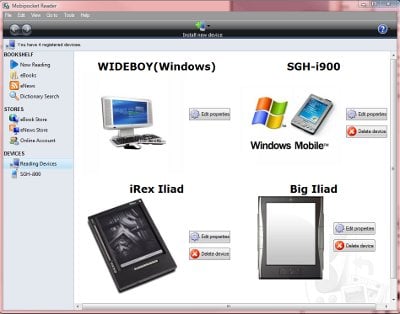
All this sidelines the already-popular Mobipocket format, which combines formatting and DRM in its own ".mobi" files, and allows users to copy content between devices as well as buying it from a variety of sources. But Mobipocket is owned by Amazon these days and has been withering slowly as the new owner focuses on shifting Kindle from a piece of hardware into a software platform, and it surely won't be long before Mobipocket is merged into something firmly locked to the Amazon store.
The Kindle platform also embodies both content and rights management, including the more controversial ability to retrospectively rescind those rights as spectacularly demonstrated by its recent withdrawal of electronic copies of George Orwell's Nineteen Eighty-Four. Kindle also operates as an extension to Amazon's book store, ensuring revenue for generations to come - but DRM isn't just about protecting revenue streams, it also protects the industry itself, though it may not always be clear why the publishing business feel it necessary to impose restrictions that proved so unpalatable to music fans.
Part of the problem with literary piracy is the inability of authors to make money elsewhere: personal appearances don't often pay, and many authors don't perform well in public. Selling posters, t-shirts or branded towels isn't going to work for many, so authors are denied alternative sources of revenue that arguably exist for musicians.
Next page: Banging the DRM
COMMENTS
Book swapping
I'm married to someone who reads lots of "bodice rippers", and she is constantly swapping them with the women that she works with, and with her sisters.
The e-book versions of these books are only available from the publisher, and they offer what they describe as a "generous" 10% discount. But the paper books are usually sold at 20% or 25% below the publishers list price, so there's it's not likely that any of these ladies are going to switch to e-books anytime soon.
Region locking
One point that has not yet been mentioned is the issue of region locking. In the early years of ebooks, you could buy from, say, Fictionwise (one of the largest and best sources of ebooks around) no matter where you lived in the world, and pay a fairly reasonable price (generally about the same or slightly lower than the paper copy available at the time - so hardback cost for the first few months after release). This price was even more reasonable if your dollar exchange rate was good... In the last year or so, various publishers have wised up to the ebook market, and suddenly realised that their contracts for ebook publishing are limited to the same geographical region as their paper copies.
Now this makes sense for paper books: a given company will usually only have the distribution logistics to handle a particular area, so publishing contracts are sold (by the authors or their agents) on a country by country basis to whoever can distribute to that country. Unfortunately, the electronic rights have usually been bundled up in those deals, so they are also limited by country, and that makes no sense at all. Now that publishers have realised this, and started making threats to the ebook distributors, suddenly it is now impossible to buy about 80% of fictionwise's content outside of the north america. Instead, you have to find a source in your own country, assuming that the publisher in that country even has its act together enough to be providing it at all.
Fictionwise, and presumably other ebook market places, are attempting to inject some sanity and negotiate the worldwide rights that any sane person would expect with purely electronic product being sold over the internet, but this is going to take years for their current catalogue, and is still usually not being achieved on newly released books. Meanwhile, if I want to, say, pick up an Iain M Banks, or Terry Prattchet novel in ebook format, I first have to locate a distributor (good luck with that), and then get charged generally about 20% MORE than the paper price...I WANT to compensate authors for their work, but if they don't offer to sell their product to me, or if I am charged an extortionate amount of money when others are not, then my options become limited to stealing or doing without (for the record, I've been doing without, but my god have I been tempted - Prattchet is more addictive than crack).
This is more and more turning into exactly the same situation as with the music industry, with lack of availability and the perception of price gouging leading to massive piracy by people who are determined to get electronic versions of their media from people who just don't seem to get it. The reality is that authors make far less money than their musical counterparts, and the publishing industry is nothing like the bloated music industry, but their current actions are going to get them tarred with the same brush, and with the same disasterous results.
One place where DRM is understandable
Is books. Literature and knowledge is still a prized commodity, unlike music where every pub in the land has bands making a decent stab of it.
But for ebooks to take off, they must be £1 or £2 per book, not £6 upwards. Books more than CDs have huge costs in printing, storage and transportation and the saving must be passed on. Part of the problem with music is record companies not realising a download album is worth a lot less
than a physical one. A low price would also pretty much kill the grumble of being unable to pass the book on.
Much as I am against closed formats, Kindle is by far the better system at the moment. The wireless features are superb and I would love to subscribe to a newspaper and have it waiting for me on the device every morning and not have to do a thing.
The Kindle-style 'ecosystem' could well save newspapers as well as taking ebooks mass market. But Amazon need to open it so everyone from your library to your quirky local bookstore can publish, sell and manage books on the device.

IT infrastructure monitoring strategies
Agentless Backup is Not a Myth
Top 10 SIEM implementer’s checklist
Steps to Take Before Choosing a Business Continuity Partner
Enabling efficient data center monitoring