


This article is more than 1 year old
US Marines' Afghan robocopter-supply contest down to two
Unmanned air haulage could be cheaper than trucks

Ambitious plans by the US Marines which might reshape tomorrow's battlefields - and even upset civilian logistics in some circumstances - have moved ahead. A competition to select an unmanned aircraft for delivery of supplies to isolated outposts in Afghanistan by 2010 has now eliminated all but two contenders.
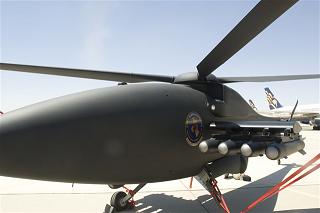
In the black corner ...
The original Marine Corps "IMMEDIATE CARGO UNMANNED AERIAL SYSTEM" plan called for manufacturers to step up with flying robots able to hover at high altitudes (for instance up in the Hindu Kush) and deliver ten tons of supplies across distances of 150 miles in 24 hours. The Marines specified that the gear had to be almost ready to go right away, as they wanted to be using it in the field by next year.
As regular Reg readers will know, there are in fact a few robot air vehicles out there potentially able to tackle such tasks. Our old friends the Fire Scout droid kill-chopper, the A160T Hummingbird unmanned whisper-copter and the MMIST SnowGoose robo motor'chute all came forward, as did an unmanned version of the Kaman K-MAX intermeshing-rotor whirlybird.
It has now been revealed that the Fire Scout is out, as is the SnowGoose. The latter, while it has already been used for Afghan resupply by US special forces, was perhaps always on a hiding to nothing. It is Canadian not US made, and it fails to meet the strict letter of the requirement as it can't hover. Makers MMIST had spoken of modifying the existing parawing, perhaps to gyrocopter configuration - and will no doubt have pointed out that the SnowGoose can lift off without trouble from a moving Humvee or ship - but evidently this didn't convince the Marines.
With the Fire Scout also out of the running for undisclosed reasons, that leaves the A160T and K-MAX - perhaps coincidentally the offerings from the two biggest US defence firms, Boeing and Lockheed.
The A160T is said to offer exceptional high-altitude performance, deriving from its cunning variable-speed rotor tech. It is also touted for its quietness, though this isn't a requirement in this context.
The K-MAX, already in widespread service as a manned chopper and lately touted in a robotised version by Lockheed, is also noted for its lifting ability. Its two intermeshing rotors avoid the need for a tail prop, channelling all its power into lift and letting it carry more than its own weight. The intermesh approach with two adjacent rotor hubs is said by its designers to be simpler than coaxial twin rotors as seen on some Russian machines and the Sikorsky X3 high-speed prototype.
The Marines have now given Boeing $500k and Lockheed $860k to further demo their robo-lifters, with a February deadline. The winning aircraft - assuming one or both actually shows it is ready for combat - will immediately be purchased in some numbers and sent to Afghanistan, where the Marines are now heavily engaged in the war-torn south alongside British and some other allied troops.
 Biting the hand that feeds IT

